Home › Journal › Italian Design, Craft & Collecting › The Italian gardens Bottega Veneta made into perfume
JOURNAL · MADE IN VICENZA
The Italian gardens behind Bottega Veneta’s Parco Palladiano
The Italian gardens Bottega Veneta made into perfume
Six perfumes, an architect’s obsession with Palladio and two Italian villa gardens that inspired one of Bottega Veneta’s most unusual collections. Both villas can still be visited in Vicenza.
You have saved two places. Leave your email and you will find them on any device, plus the next drop.
Philip Schäfer, CC BY-SA 3.0 via Wikimedia Commons
Know before you go
Magnolia at dawn, cypress in the afternoon and rose after sunset. Discover where you can find the Italian villa gardens behind Bottega Veneta’s Parco Palladiano perfume collection.
THE STORY ↓ · PARCO PALLADIANO ↓ · THE GARDEN ↓ · THE SIX FRAGRANCES ↓ · PLAN YOUR VISIT ↓
01 · BOTTEGA VENETA
From Lauren Hutton wearing Bottega Veneta in American Gigolo to Andy Warhol making a film for the house, from Rihanna and A$AP Rocky to Kendall Jenner, Jacob Elordi, Hailey Bieber, Rosie Huntington Whiteley, Margot Robbie and Charlize Theron, the Italian luxury brand has spent decades moving through cinema, art, fashion and celebrity culture.
The story began in Vicenza, Italy, in 1966. Bottega Veneta's main atelier still occupies an eighteenth century villa in Montebello Vicentino, where the house's leather craftsmanship has an address quite different from the luxury shopping streets of Milan, Paris or New York.
In 2016, for its fiftieth anniversary, Bottega Veneta introduced one of the most intriguing projects of the Tomas Maier years. Called Parco Palladiano, meaning Palladian Park, the collection translated the gardens of historic Italian villas into perfume. Its inspiration came from Andrea Palladio, the Renaissance architect whose work in Vicenza influenced country houses, private estates and some of the most admired residential architecture in Britain and America.
02 · PARCO PALLADIANO: THE STORY
Lord Burlington brought Palladio's architectural ideas into Georgian Britain. Thomas Jefferson studied The Four Books of Architecture. The grand country house, with its classical façades, lawns and cultivated landscape, became an enduring expression of wealth and taste.
At Chiswick House in London, Burlington created a villa partly inspired by Palladio's La Rotonda in Vicenza. The Victoria and Albert Museum identifies the connection in its history of Palladianism.
Almost three centuries later, the same architectural inheritance found an admirer in Tomas Maier, Bottega Veneta's creative director from 2001 to 2018.
His father was an architect with what Maier himself described to Vogue as a “Palladio obsession”. The fascination survived into his fashion career and became especially personal when he joined a luxury house founded in the architect's home city.
For Parco Palladiano, Maier explored the botanical landscape around the villas. The inspiration came from cypress trees, clipped box hedges, magnolias, roses, fruit trees and aromatic herbs, experienced at different moments of the day.
The relationship between Bottega Veneta and Palladian architecture continued beyond perfume. In 2017, the house staged The Hand of the Artisan at Chiswick House, temporarily recreating the atmosphere of its Montebello atelier inside the London villa inspired by La Rotonda.
03 · A GARDEN BY THE HOUR
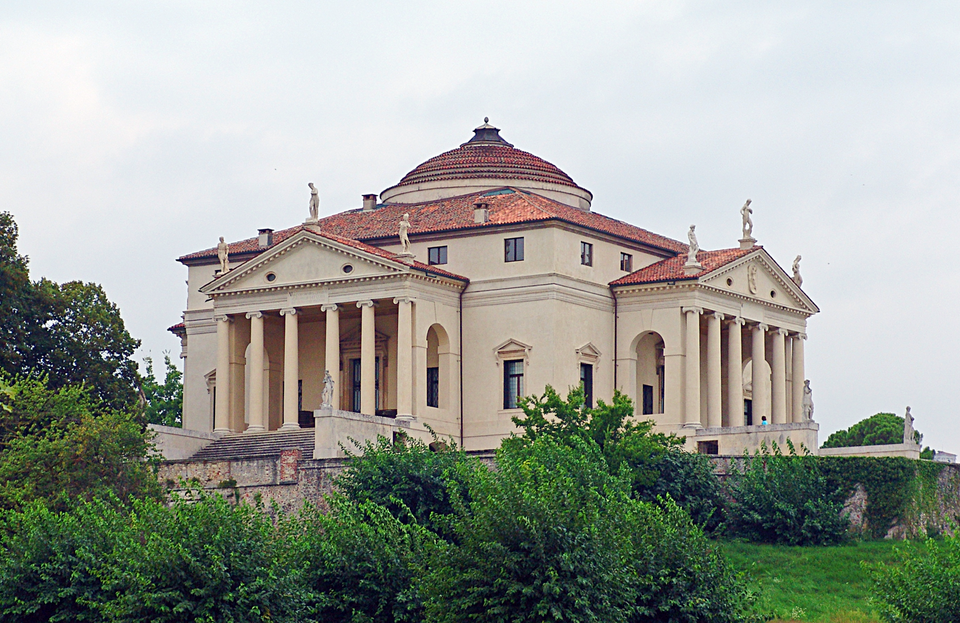
Two villas played a particularly important role in Maier's research: Villa Almerico Capra, known as La Rotonda, designed by Andrea Palladio, and Villa Fracanzan Piovene in Orgiano, an eighteenth century estate designed by Francesco Muttoni in the Palladian tradition.
Both are in the province of Vicenza, where Renaissance architecture and the historic culture of the Veneto villa remain part of the landscape.
Maier visited the gardens, observed their plants and assembled a botanical brief for a group of perfumers. The assignment was unusually open: each could interpret the character of a particular plant and the moment in which its scent seemed most expressive.
The result, developed over more than two years, was a collection of six fragrances, each identified by a Roman numeral and conceived as a different experience of the Palladian garden.
There was magnolia in the cool of the morning, cypress beneath the spring sun, pear among grasses and mint, the warmth of summer azaleas, aromatic herbs and, finally, a rose imagined indoors after spending the day in the sun.
Parco Palladiano offered something particularly seductive about the Italian villa: architecture could be admired from the outside, interiors could be visited, and now even the garden had acquired a fragrance.
04 · MAGNOLIA IN THE MORNING, ROSE AFTER SUNSET
The original six fragrances followed a botanical itinerary.
Parco Palladiano I, Magnolia, suggested flowers at their aromatic peak before the heat of the day. II, Cipresso, combined cypress with the spicy presence of pink pepper. III, Pera, introduced pear and mint; IV, Azalea, evoked the flowers of a summer garden.
V, Lauro, drew on the aromatic character of laurel, rosemary and sage. VI, Rosa, imagined a rose brought from the garden into the villa in the evening, its scent mingling with the atmosphere of the rooms and their wooden furnishings.
The bottles, with Roman numerals and glass decorated with Bottega Veneta's unmistakable Intrecciato pattern, connected the fragrances to the house's leather heritage and the Veneto tradition of glassmaking.
The collection travelled internationally, including a Japanese launch documented by Vogue Japan in June 2016.
And the original six were only the beginning.
By 2018, Parco Palladiano had expanded to fifteen fragrances, exploring more of the botanical landscape, including olive, chestnut, oak, clover, pomegranate and blue sage.
The original collection remains a fascinating chapter in Bottega Veneta's history, when one of Italy's best known luxury houses drew on the gardens and architectural heritage of the place where it was founded.
05 · Plan your visit
The gardens that inspired Parco Palladiano are places you can experience on a visit to Vicenza.
Villa La Rotonda, one of Andrea Palladio's most celebrated buildings, stands just outside Vicenza's historic centre. Its four classical porticoes overlook the surrounding landscape, while visits can include the historic interiors, gardens and nineteenth century Romantic Grove. Private tours are also available by arrangement.
Villa Fracanzan Piovene, in Orgiano, offers a different experience of the Italian country house. Its historic garden, extensive park and rural estate preserve the atmosphere of eighteenth century villa life. Visitors can explore the garden and park and join guided visits through the furnished interiors and historic collections.
Both villas welcome visitors according to their official programmes. For anyone interested in Italian gardens, luxury heritage and the relationship between landscape and design, they provide an unusually personal introduction to the world that inspired Bottega Veneta's Parco Palladiano.
The perfume collection belongs to the house's design history. The gardens are still there to visit.
Sources
- Vogue · How Bottega Veneta's New 6-Piece Perfume Collection Bottles the Scent of an Italian Summer
- Condé Nast Traveler · Bottega Veneta’s New Perfumes Actually Smell Like an Italian Garden
- Vogue Japan · ボッテガ・ヴェネタから新フレグランスコレクションが店舗限定で発売。
- Vogue Italia · Bottega Veneta, sei nuovi profumi Parco Palladiano
- Victoria and Albert Museum · Palladianism – an introduction
- The Metropolitan Museum of Art · The Idea and Invention of the Villa
- Vogue Italia · Bottega Veneta The Hand of Artisan
- Villa La Rotonda · Plan your visit
- Villa Fracanzan Piovene · Visits
- Grandi Giardini Italiani · Villa Fracanzan Piovene