Home › Night › Urban after dark › Teatro Olimpico
CLASSICAL MUSIC IN ITALY · TEATRO OLIMPICO
Bach’s Hercules Meets Palladio’s Hercules in Vicenza
Some of Europe’s most memorable musical experiences begin with the venue. Vicenza offers a compelling reason to add another Italian city to your classical music itinerary.
Hercules was born in Thebes. Palladio’s theatre still has the original 1585 streets of Thebes and eleven sculptures of the hero. Now Bach brings him back for two extraordinary evenings inside the world’s oldest surviving indoor theatre, 31 October and 1 November 2026.
You have saved two places. Leave your email and you will find them on any device, plus the next drop.
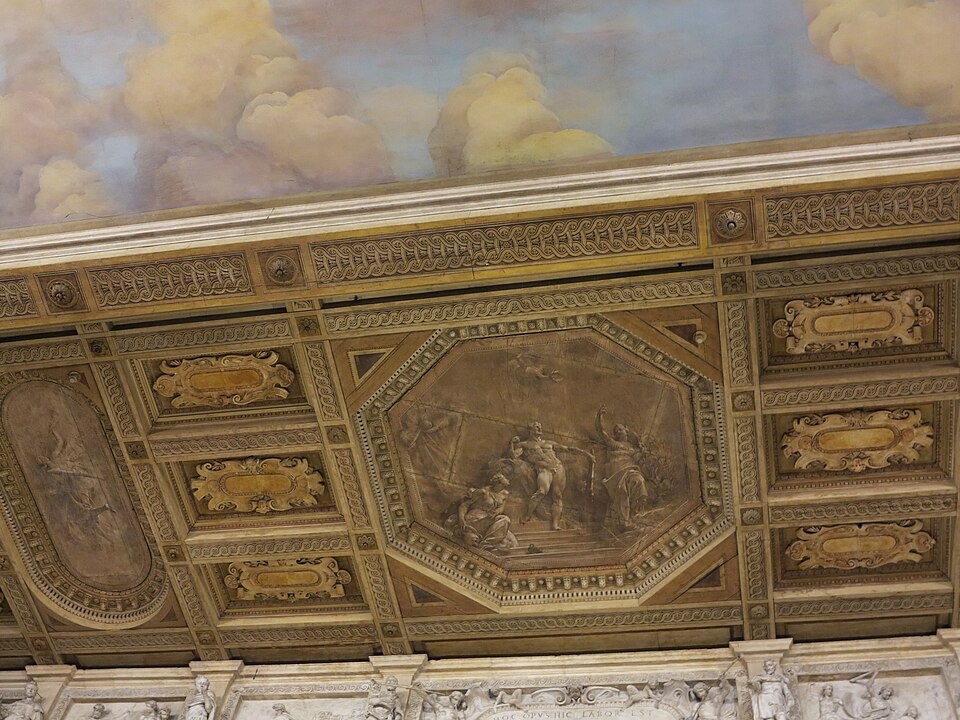
Annika_of_Nine, CC BY-SA 4.0 via Wikimedia Commons
Know before you go
WHY GO ↓ · HERCULES AND THE THEATRE ↓ · THE CHRISTMAS CONNECTION ↓ · THE SECOND CANTATA ↓ · THE INTERNATIONAL COMPANY ↓ · THE PROGRAM & INFO↓
WHY GO
A Greek hero caught between Pleasure and Virtue, a cantata that would later become part of Bach's Christmas Oratorio, and a theatre that already has Hercules written into its architecture.
On 31 October and 1 November 2026, Hercules returns in music as Progetto Bach presents L’Olimpo di Bach, a semi staged performance featuring the hero’s famous choice between Pleasure and Virtue, a German vocal ensemble, Italian Baroque musicians and two cantatas whose music travelled into some of Bach’s greatest sacred works.
The coincidence between the setting and the programme is particularly appealing. The Teatro Olimpico contains eleven sculpted scenes from the Labours of Hercules, while the original Renaissance stage represents the streets of Thebes.
Hercules is coming home, at least in mythology.
HERCULES HAD A CHOICE TO MAKE
Long before Disney made Hercules a household name, the Greek hero had already survived monsters, impossible challenges and a particularly complicated family history. His legendary Twelve Labours included killing the many headed Hydra, cleaning the Augean stables by diverting two rivers and bringing Cerberus, the fearsome guard dog of the Underworld, back to the land of the living.
But the episode Bach chose for his 1733 cantata concerns a different kind of challenge. In Laßt uns sorgen, laßt uns wachen, BWV 213, Hercules must decide which path his life will follow. Pleasure offers comfort, enjoyment and an easier existence. Virtue demands effort, courage and the pursuit of honour. Hercules listens, hesitates and eventually makes his choice.
Written for the eleventh birthday of Friedrich Christian, the future Elector of Saxony, in September 1733, the cantata uses characters from Greek mythology to celebrate the education of a young prince.
Writing in The New York Review of Books, music historian George B. Stauffer examines the work's surprisingly theatrical nature. Hercules is sung by an alto, following the conventions of eighteenth century opera, while Pleasure attempts to seduce him with a lullaby.
As a young man, Hercules encounters two women offering radically different futures. Pleasure promises an easy life of enjoyment and indulgence. Virtue offers honour, achievement and a lifetime of effort. The dilemma feels remarkably familiar today. What would you choose if immediate pleasure and the life you wanted to build led in opposite directions?
Bach gave the story an operatic treatment, complete with seduction, an answering Echo and a love duet. The cantata was originally performed in a Leipzig coffee garden to celebrate the eleventh birthday of a Saxon prince. Its musical afterlife would be even more surprising: part of the score became Bach's Christmas Oratorio.
THE CHRISTMAS CONNECTION
The music has a second life that is even more surprising.
A year later, Bach reused several movements from Hercules at the Crossroads for his Christmas Oratorio, transforming the music originally written for an allegorical drama into compositions celebrating the birth of Christ. The Netherlands Bach Society documents how Bach adapted these earlier secular cantatas for the Christmas celebrations of 1734 and 1735.
One of the most memorable connections concerns the aria sung by Pleasure to tempt Hercules into sleep. Bach later adapted its music into a lullaby for the infant Jesus.
THE CANTATA THAT WENT FROM CITY HALL TO THE MASS IN B MINOR
The second work in the programme has its own unexpected biography.
Wir danken dir, Gott, wir danken dir, BWV 29, was first performed in Leipzig on 27 August 1731 for the inauguration of a new city council. Its brilliant opening uses an organ solo adapted from music Bach had previously composed for violin. According to the Netherlands Bach Society, the music of its opening chorus later reappeared in two movements of the Mass in B minor, the Gratias agimus tibi and Dona nobis pacem. Bach was remarkably inventive in returning to compositions he considered worth revisiting, adapting them for different audiences, texts and occasions. In Vicenza, these two works bring together a mythological hero choosing his future and a city giving thanks for its government, all inside a Renaissance theatre created by an academy devoted to the ideals of classical antiquity.
THE GREEK CITY THAT SURVIVED IN AN ITALIAN THEATRE
Thebes is one of the great cities of Greek mythology, the home of Oedipus, the Sphinx and Hercules himself. It also exists today in central Greece. For the opening of Vicenza's Teatro Olimpico in 1585, architect Vincenzo Scamozzi recreated seven streets of ancient Thebes behind Palladio's monumental stage. Their apparent depth is an illusion: the elaborate wooden perspectives extend for just twelve metres. Above them, eleven sculpted panels celebrate the Labours of Hercules, the patron hero of the Accademia Olimpica. On 31 October and 1 November 2026, Bach's Hercules will appear in music beneath those same Renaissance sculptures. And on Halloween, the hero who once brought the three headed dog Cerberus out of the Underworld seems particularly well cast.
FROM KIEL TO VICENZA: A VERY UNIQUE COMPANY
The 2026 performance also brings together different generations of musicians.
The Vokalensemble an der Kieler Gelehrtenschule, directed by Anne-Beke Sontag, travels from Germany to perform with the Italian Baroque orchestra Il Teatro Armonico, directed by Margherita Dalla Vecchia. The German ensemble is especially interesting. According to the Kieler Gelehrtenschule, it includes four current students, five former pupils, two parents and five university trained singers. Its members will perform alongside professional musicians in a semi staged production. Giovanni Sinopoli contributes the scenic interpretation.
The orchestra performs on copies of historical instruments, bringing the sound of Baroque music into Palladio's original architectural setting. The result is also a fitting continuation of Progetto Bach's international history in Vicenza, developed since 2000 around the work of Michael Radulescu and Margherita Dalla Vecchia.
THE TWO NIGHTS
SATURDAY, 31 OCTOBER 2026
20:30 to 22:30
SUNDAY, 1 NOVEMBER 2026
18:30 to 20:30
Teatro Olimpico, Vicenza
PROGRAMME
Johann Sebastian Bach
Laßt uns sorgen, laßt uns wachen, BWV 213
Hercules at the Crossroads
Wir danken dir, Gott, wir danken dir, BWV 29
For soloists, choir and Baroque orchestra.
Both dates present the same announced programme.
WHY THIS NIGHT BELONGS IN VICENZA
In a 2023 travel report, Le Monde described the Teatro Olimpico as the most moving of Palladio's works, singling out the extraordinary perspective streets preserved behind its stage. [8] The theatre can be visited during the day, but attending a live performance adds another dimension to the experience. For two nights in 2026, Bach's mythological hero appears in a theatre whose sculpted decoration celebrates his Labours, with the original streets of his legendary birthplace extending behind the musicians. Four centuries of architecture, a Greek myth and music with an unexpected Christmas history meet in the same room.
Discover the remarkable history of Bach inside Palladio's Teatro Olimpico.
INFO
EVENT L'Olimpo di Bach · XXVI Progetto Bach
VENUE Teatro Olimpico Piazza Matteotti 11 36100 Vicenza, Italy
DATES AND TIMES 31 October 2026 · 20:30–22:30, 1 November 2026 · 18:30–20:30
ORGANISER Associazione Mousikè · Il Teatro Armonico APS
PHONE / WHATSAPP +39 320 1424747/ EMAIL associazione.mousike@alice.it
Sources
- Teatro Olimpico di Vicenza · History of the Theatre
- Teatro Olimpico di Vicenza · Decoration
- Archaeological Museum of Thebes · Landscapes & Myths of Boeotia
- The New York Review of Books · Emotional, Operatic Bach
- Netherlands Bach Society · Christmas Oratorio in brief
- Netherlands Bach Society · Wir danken dir, Gott, wir danken dir
- Kieler Gelehrtenschule · Konzertreise des Vokalensembles an der KGS
- Le Monde · A la découverte de la Vénétie avec le plus grand architecte de la Renaissance
- Progetto Bach Vicenza · L'Olimpo di Bach
- The Metropolitan Museum of Art · The Labors of Herakles
- British Museum · Sarcophagus depicting the birth and twelve labours of Hercules
- Archaeological Museum of Thebes · Landscapes & Myths of Boeotia
- Teatro Olimpico di Vicenza · The Architecture of the Theatre
- Teatro Olimpico di Vicenza · Decoration
- Boston Baroque · J.S. Bach’s Laßt uns sorgen, laßt uns wachen, BWV 213
- The New York Review of Books · Emotional, Operatic Bach