Home › Places › Farms & vineyards › Tai Rosso · Colli Berici
GRENACHE, WITH A VICENZA ACCENT
Grenache over a fossil tropical sea: one of Europe’s great grapes grows in Vicenza
South of Vicenza, Tai Rosso grows on limestone hills formed beneath a warm tropical sea millions of years ago.
Drive south from Vicenza and the ground beneath the vineyards becomes wonderfully improbable. The limestone of the Berici Hills still holds fossil corals, shells and sea urchins from a warm tropical sea. Today these slopes grow Tai Rosso, a grape genetically identical to Grenache, Garnacha and Cannonau, but shaped by centuries in this small corner of Vicenza.
You have saved two places. Leave your email and you will find them on any device, plus the next drop.
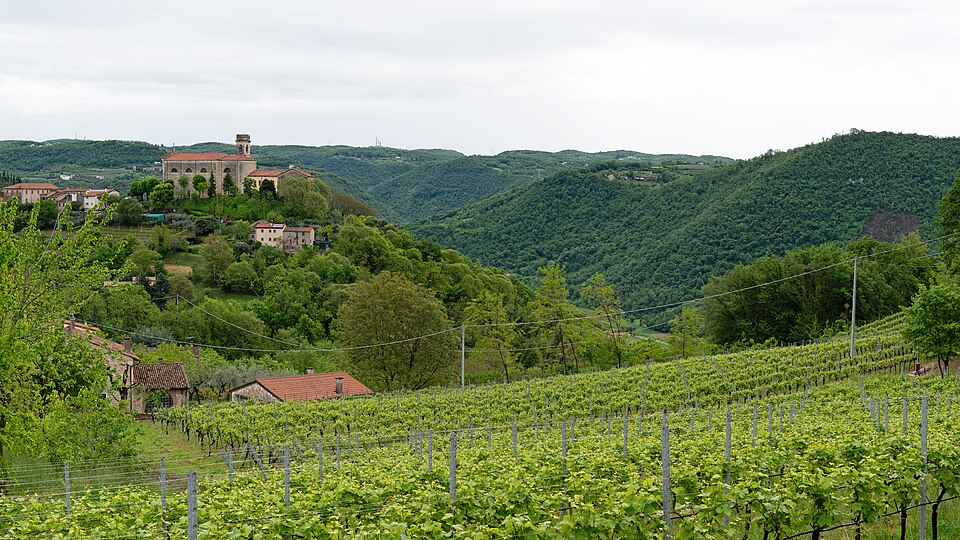
Thilo Parg, CC BY-SA 4.0 via Wikimedia Commons
About
Drive south from Vicenza and the vineyards begin to climb over a landscape formed beneath the sea. The limestone of the Colli Berici contains fossil molluscs, sea urchins, corals and algae, evidence of the warm marine environment that covered this part of the Vicenza province tens of millions of years ago. Some of the ancient waters were shallow enough for coral reefs to develop. Today, vines and olive trees grow over those marine rocks. Among them is Tai Rosso, the red grape most closely associated with the Berici Hills.
THE STORY ↓
WHAT TO LOOK FOR ↓
WHERE TO TASTE IT ↓
EXPLORE THE WINE HILLS ↓
Genetic research established that Tai Rosso belongs to the same grape family as French Grenache, Spanish Garnacha and Sardinian Cannonau. On the Colli Berici, however, years of local adaptation produced its own physical character, including larger berries and thicker skins than many French and Spanish Grenache vines. In the oldest production area around Barbarano, the wine is also traditionally known simply as Barbarano.
How Grenache reached these hills is less certain.
One local story leads to fourteenth century Avignon. During the period of the Avignon Papacy and the Western Schism, Vicentine churchmen are said to have travelled between this part of Italy and southern France. According to the story, vine cuttings returned with them from the Rhône.
It is an irresistible connection, especially because Châteauneuf du Pape became one of the great homes of Grenache. But there is no surviving document proving that this is how Tai Rosso reached Vicenza, and modern accounts treat it as one possible explanation among several. What is certain is the grape itself. Tai Rosso has been grown in the Berici Hills for generations and is now one of the defining wines of the Colli Berici DOC. The official consortium describes it as particularly suited to the drier, leaner soils and warm exposures of these hills.
WHAT TO LOOK FOR ↓
Tai Rosso is usually a lighter coloured red, with red berry and floral notes, moderate tannin and a freshness that makes it quite different from many richer expressions of Grenache.
The Colli Berici consortium describes typical notes of violet, plum, raspberry and woodland berries. Locally it is paired with risotto, cured meats, boiled meats and, perhaps most Vicentine of all, bacalà alla vicentina. The landscape is part of the experience. Around Barbarano Mossano and the southern Berici, vineyards share the slopes with olive groves, limestone outcrops and villages built from the same pale stone formed in that ancient sea.
WHERE TO TASTE IT ↓
The historic heart of Tai Rosso lies around Barbarano Mossano and the southern Colli Berici. For a direct introduction to the grape, these are three useful addresses in Vicenza province:
Cantina Pegoraro
Via Calbin 24, 36024 Barbarano Mossano, Vicenza
Tel. +39 0444 886461
Email: info@cantinapegoraro.it
Visits: accoglienza@cantinapegoraro.it
Piovene Porto Godi
Via Villa 14, 36021 Toara di Villaga, Vicenza
Tel. +39 0444 885142
Email: info@piovene.com
Villa di Montruglio
Via Montruglio 9, 36048 Barbarano Mossano, Vicenza
Tel. +39 371 1221941
Visits and tastings: visite@villadimontruglio.it
EXPLORE THE WINE HILLS ↓
The Heart of Tai Rosso
Barbarano Mossano, located about 20 kilometers south of Vicenza, is the historical center of Tai Rosso. The most scenic route into the area follows the Dorsale Berica ridge from Monte Berico, descending through vineyards, olive groves, and limestone hills before entering the village.
Medieval Rock and Prehistoric Hearths
The landscape around Mossano contains far more than vineyards. Embedded in the limestone cliffs are the Covoli delle Prigioni, a medieval rock structure built three stories high inside a natural cavity about 50 meters long. A short distance away, the Grotta di San Bernardino preserves traces of Neanderthal occupation dating back roughly 200,000 to 250,000 years. Both sites can be visited on selected guided dates, while group visits are arranged through Pro Loco Mossano.
The Ancient Sea Beneath the Vines
To taste the local wine where it is grown, begin at Cantina Pegoraro, Via Calbin 24, Barbarano Mossano, and continue toward Villaga and Toara. This route follows the geology of the Berici Hills, where vines and olive trees grow over limestone formed millions of years ago when a warm tropical sea covered this part of what is now Vicenza province.
The Village Architecture
Before leaving Barbarano, the village center preserves the site of the former medieval castle of the bishops of Vicenza, later incorporated into Villa Godi Marinoni. The surrounding area also includes other historic villas and the parish church of Santa Maria Assunta in Piazza Roma.
Good to know before you go
What is Tai Rosso? A red grape grown principally in the Colli Berici of Vicenza province and genetically identical to Grenache, Garnacha and Cannonau. Is Tai Rosso the same as Grenache? Genetically, yes. In the Colli Berici it has developed its own local characteristics after long cultivation in the area. Why is it sometimes called Barbarano? Tai Rosso produced in the historic area around Barbarano is traditionally known as Barbarano. Can you see fossils in the Colli Berici? The limestone hills contain abundant marine fossils, including molluscs, corals and sea urchins. The rocks record the tropical marine environment that once occupied this area. When should I go? The wine hills can be visited throughout the year. September is harvest season, while spring and early autumn are particularly good periods for exploring the vineyards and olive growing landscape. Do wineries require booking? Many small producers receive visitors by appointment, so contact the winery before travelling.
The Marano has small cobs and orange red kernels, glossy and glassy. It is not the corn you see in the fields around it, and once you have seen one you recognise it.
Stone ground Marano flour is used for the polenta served with bacalà alla vicentina, and by the bakeries and pastry shops that still work with local grain.
The American hybrids that arrived after the war produced more per hectare. Varieties selected for flavour rather than yield, like this one, left the fields.