Home › Places › Farms & vineyards › Villa di Montruglio · Pigafetta Camerini
FIRST VOYAGE AROUND THE WORLD · ASTRONOMY · ITALIAN WINE
The First Voyage Around the World, an Astronomy Ceiling and Italian Grenache
Taste Tai Rosso among historic vineyards, discover a frescoed hall of astronomy and follow a family connection to the first voyage around the world.
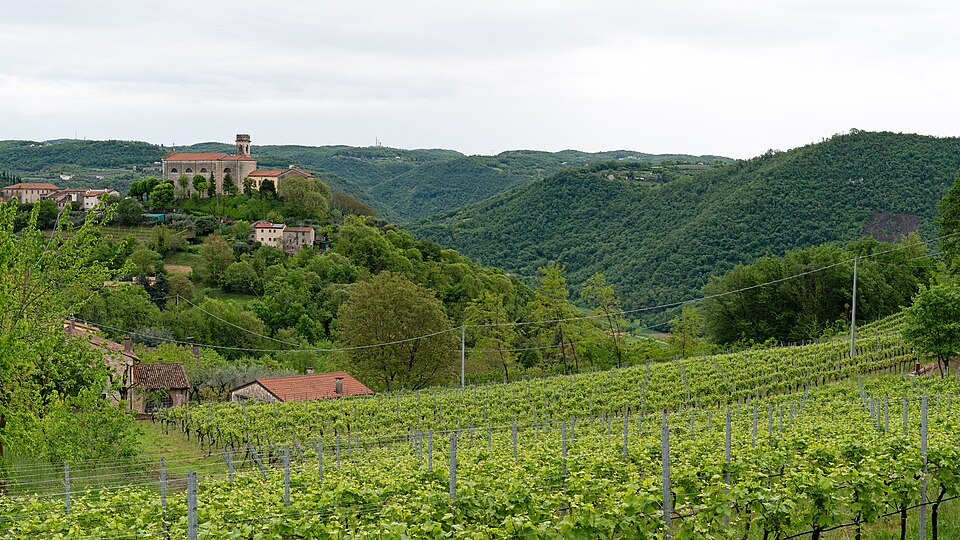
The first voyage around the world, a frescoed ceiling celebrating astronomy and geography, and a glass of Italian Grenache. Villa di Montruglio, in the hills of Vicenza, brings together three seemingly distant worlds. Its land once belonged to the Pigafetta family, whose most famous son chronicled the first circumnavigation and inspired the opening of García Márquez’s Nobel lecture. Two centuries later, the villa acquired an extraordinary room devoted to the arts and sciences. Today, the experience continues into its vineyards, with the estate’s own Tai Rosso, the local expression of Grenache.
You have saved two places. Leave your email and you will find them on any device, plus the next drop.
Thilo Parg · CC BY-SA 4.0 · Wikimedia Commons
Know before you go
Confirm seasonal opening, available rooms, wine tastings and private event arrangements directly with the estate. Guided visits include selected historic rooms and gardens. Wine tastings and private occasions can be arranged separately. Visits and tastings visite@villadimontruglio.it Private events and general information villadimontruglio@villadimontruglio.it Telephone +39 371 1221941
In this story: The First Voyage Around the World ↓ A Room of Astronomy and the Arts ↓ Taste Italy's Other Grenache ↓ The Garden Shaped by What Was Lost ↓ The Villa After Hours ↓ Ten Gods and an Old Armoury ↓ Contemporary Art Among the Columns ↓ Visit and Wine Tastings ↓
THE FIRST VOYAGE AROUND THE WORLD
The story begins five centuries ago, with a Vicentine family whose name would become inseparable from one of the greatest voyages in history.
The land on which Villa di Montruglio stands once belonged to the Pigafetta family. During the sixteenth century, the estate passed to the Arnaldi family through a marriage connection with the Pigafettas, a relationship documented by the Veneto Region and Arte Laguna Prize. The present villa was built much later, between the end of the seventeenth and the beginning of the eighteenth century. [1]
The name carries an extraordinary international history.
In 1519, Antonio Pigafetta left Europe with Magellan's expedition. Three years later, he was among the eighteen men who returned to Spain aboard the Victoria, having survived the first completed circumnavigation of the world. The Library of Congress preserves a magnificent illuminated version of his account, containing twenty three maps of the places encountered during the voyage. [2]
Pigafetta's writing also left a profound impression on literature.
When Gabriel García Márquez received the Nobel Prize in Literature in 1982, he began his lecture with Antonio Pigafetta and the extraordinary descriptions of the world recorded during the expedition. The Colombian novelist saw in those accounts something that anticipated the imaginative universe of Latin American literature. [3]
There is a small historical irony in the speech: García Márquez called Pigafetta a Florentine navigator. He was from Vicenza.
Villa di Montruglio belongs to the later history of the family lands. The documented relationship concerns the property and the Pigafetta lineage; the surviving eighteenth century house was built long after Antonio's lifetime.
For travellers following the history of the first voyage around the world, Montruglio adds a country estate to the places associated with Vicenza's most internationally travelled chronicler.
And inside the villa, an entirely different century left a particularly intriguing artistic echo of humanity's fascination with the wider world.
A ROOM OF ASTRONOMY AND THE ARTS
On the piano nobile, the principal floor of Villa di Montruglio, an extraordinary frescoed room celebrates Painting, Sculpture, Geography, Astronomy, Architecture, Music and Poetry.
The cycle was completed in 1714 by Francesco Aviani. Arte Laguna Prize identifies the signed and dated frescoes as the artist's only documented work, giving the room a particular importance in the history of Venetian painting. [4]
The ceiling gathers the arts and sciences within an elaborate eighteenth century decorative composition. Painted architecture extends the space beyond the actual walls, while the allegorical figures suggest a world devoted to knowledge, observation and artistic invention.
The room also preserves a rare green Venetian terrazzo floor, singled out in the Veneto Region's description of the estate. [1]
The relationship with Pigafetta is especially appealing to contemplate here. His account of the circumnavigation helped European readers imagine distant oceans and unfamiliar lands. Nearly two centuries later, Geography and Astronomy appeared among the pursuits celebrated in the villa's frescoes.
The paintings were created for their own eighteenth century cultural setting, with no documented intention to commemorate Antonio Pigafetta. Yet the presence of these subjects on former Pigafetta family land gives Montruglio a particularly rich association between the history of exploration and the visual culture of knowledge.
The room can be visited as part of the villa's historic interiors itinerary, alongside the entrance hall and other spaces of the residence.
And after a room devoted to the wider world, the experience can continue with something entirely local, grown on the same hillside.
TASTE ITALY'S OTHER GRENACHE
The vineyards of Montruglio introduce a different pleasure: Tai Rosso, the Italian expression of Grenache.
Known elsewhere as French Grenache, Spanish Garnacha and Sardinian Cannonau, the grape has developed a distinctive identity in the Colli Berici, the limestone hills south of Vicenza.
Writing in Decanter, James Button describes Tai Rosso as one of the region's defining wines. He traces the character of the Colli Berici to fossil rich limestone, an ancient tropical seabed and a landscape also marked by historic volcanic activity. [5]
At Villa di Montruglio, Tai Rosso grows on sedimentary limestone, with vineyards exposed to the south and southwest. The estate produces a wine made entirely from the variety, including grapes from vines whose oldest plantings are approximately sixty five years old. [6]
The wine has a relatively pale ruby colour, with aromas of fresh fruit and flowers. Its delicate character makes it particularly appealing when served slightly cool, as recommended by the estate.
There is another version worth discovering: Montruglio also produces a pink sparkling Brut made from Tai Rosso, with fine bubbles and notes of red berries. [6]
Visitors can arrange a tour of the historic villa followed by a tasting of the estate's own wines. The combination gives wine tourism here a particularly unusual dimension: a frescoed room of astronomy, the history of a great voyage, eighteenth century architecture and vineyards producing one of northern Italy's lesser known expressions of Grenache. [7]
THE GARDEN SHAPED BY WHAT WAS LOST
The gardens of Montruglio have their own unusual history.
An elaborate Italian garden once occupied the broad terrace in front of the villa. It disappeared during the German occupation of the property in the Second World War.
When Duke Luigi Silvestro Camerini restored the estate, he chose to retain the great open lawn in front of the façade. Grandi Giardini Italiani documents how this decision restored an uninterrupted relationship between the architecture and the surrounding countryside. [8]
Beyond the terrace, the nineteenth century park contains mature Lebanon cedars, oaks, holm oaks and cypresses. Woodland continues into the hills, with vineyards forming another part of the estate's landscape.
The park was developed under the Camerini family, who introduced tree planting and a winding approach that allows the villa to appear progressively through the greenery.
Behind the Barchessa, landscape architect Ermanno Casasco later redesigned the courtyard garden. The historic brolo, a productive orchard and kitchen garden associated with Venetian country estates, survives as another part of the property's domestic history. [8]
A walk through the grounds moves between formal architecture, old trees, open views and cultivated vines, with the landscape changing considerably from one side of the villa to the other.
THE VILLA AFTER HOURS
Villa di Montruglio can also be experienced privately.
Its frescoed rooms, monumental portico and gardens are available for personal occasions, cultural gatherings and events arranged directly with the estate. [9]
Each part of the house offers a different atmosphere.
The Sala Affrescata brings the arts and sciences overhead. The Salone dell'Olimpo is populated by classical figures, while the Sala delle Armi preserves objects from the equestrian and military past of the property.
Outside, the nine arched portico in warm Pietra di Nanto creates a sheltered setting beside the courtyard, with the park and vineyards extending beyond the monumental buildings.
A private dinner, a birthday, a family celebration or an intimate cultural evening can therefore take place within an estate whose architecture, painted interiors and surrounding landscape have distinct identities.
Private use of selected rooms is available by arrangement. Complete exclusivity of the entire property must be confirmed directly, including the spaces, dates and hospitality services involved.
TEN GODS AND AN OLD ARMOURY
The Barchessa contains two of the villa's most unusual interiors.
Its nine arched portico was constructed between 1710 and 1714, drawing on the architectural language of Palladio and Vincenzo Scamozzi. The arches are built from Pietra di Nanto, the warm limestone quarried in the Berici Hills. [4]
Above the portico, the Salone dell'Olimpo takes its name from ten statues representing divinities of classical antiquity.
The great timber roof, stone walls and sculptural figures give the room the character of a private gallery devoted to classical mythology.
Below, the Sala delle Armi preserves an entirely different collection. Once part of the stables, it became an armoury under Duke Luigi Silvestro Camerini, with historic weapons, horse bits, spurs and other objects associated with aristocratic equestrian life. [4]
Astronomy and the arts in the villa, classical divinities above the portico, and the material culture of centuries past below it: Montruglio offers considerably more to explore than its monumental façade first suggests.
CONTEMPORARY ART AMONG THE COLUMNS
Montruglio also has a place within contemporary art.
The estate has participated in the international network of Arte Laguna Prize, bringing contemporary artistic practices into dialogue with its historic interiors, gardens and monumental stone architecture. [4]
The large spaces of the Barchessa and the sculptural character of the villa offer a compelling setting for exhibitions and cultural programmes.
Past artistic initiatives should be distinguished from exhibitions currently open to visitors. Check the villa's calendar for future installations, music and cultural events.
WHY VISIT VILLA DI MONTRUGLIO IN VICENZA?
Few historic estates in northern Italy bring together such different chapters of cultural history within one visit.
The land once belonged to the family of Antonio Pigafetta, chronicler of the first circumnavigation. The villa preserves an eighteenth century ceiling celebrating astronomy, geography and the arts. Its vineyards produce Tai Rosso, the local expression of Grenache described by Decanter as a defining wine of the Colli Berici.
Add the historic park, the hall of classical gods, the armoury and the possibility of wine tastings or private visits, and Montruglio becomes an unusually rich destination for travellers interested in exploration, art, gardens and Italian wine.
Sources
- Regione del Veneto · Pigafetta and Arnaldi family lands, architecture, green Venetian terrazzo and historical estate · Villa Pigafetta Arnaldi Camerini
- Library of Congress · Antonio Pigafetta, the first circumnavigation, eighteen survivors and twenty three illuminated maps · Journal of Magellan's Voyage
- NobelPrize.org, Gabriel García Márquez · Nobel Lecture, 8 December 1982 · The Solitude of Latin America
- Arte Laguna Prize · Francesco Aviani, signed frescoes of 1714, classical sculpture and monumental Barchessa · Villa Montruglio, Mossano, Italy
- Decanter, James Button · 16 August 2020, Tai Rosso, Grenache and the fossil limestone of the Berici Hills · Colli Berici: Six to Discover
- Villa di Montruglio · Tai Rosso vineyards, grape variety, terroir and estate wines · Tai Rosso and Spumante Brut
- Villa di Montruglio · Guided visits and wine tasting experiences · Visite
- Grandi Giardini Italiani · Lost formal garden, nineteenth century park, Camerini family and Ermanno Casasco · Villa di Montruglio Pigafetta Camerini
- Villa di Montruglio · Private dinners, historic rooms, receptions and event conditions · Eventi