Home › Places › Hidden gems › Asiago Astrophysical Observatory, Stazione del Pennar
THE COLOURS OF THE STARS
Learn to read a star by its rainbow, in the same observatory where Margherita Hack studied starlight
An evening astronomy workshop with spectrum glasses and the Galileo telescope.
Stars have colours we rarely learn to read. A rainbow can reveal what a star is made of. In Vicenza a Asiago Astrophysical Observatory, the Colours of the Stars laboratory lets visitors split light into visible spectra with special glasses and learn how astronomers identify the chemical signatures hidden inside starlight. Margherita Hack used the same branch of astronomy here between 1951 and 1954, collecting more than 180 stellar spectra with the Galileo telescope.
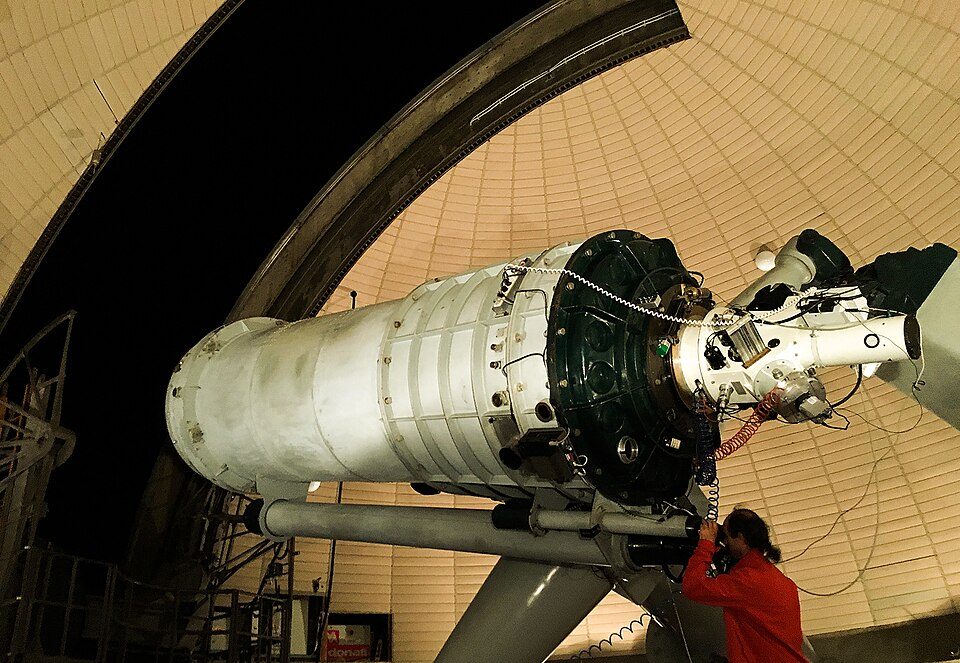
Photo: 罗放 · CC BY-SA 4.0 · Wikimedia Commons
Know before you go
On the Asiago Plateau, in the province of Vicenza in northern Italy, you can visit an observatory included in Atlas Obscura’s selection of 20 stargazing destinations, alongside Palomar and Mount Wilson. During Colours of the Stars, a pair of spectrum glasses introduces you to stellar spectroscopy: how astronomers discover what distant stars are made of by reading their light. [1][2]
Read the rainbow: an astronomy workshop in Asiago ↓ / Margherita Hack, stellar spectra and novae ↓ / See the 650 kg spectrograph ↓ / Visit the Galileo telescope ↓ / How to book
READ THE RAINBOW: AN ASTRONOMY WORKSHOP IN ASIAGO
Look through the spectrum glasses and compare the lamps. Their light separates into colours, with different patterns of lines revealing different chemical elements. During Colours of the Stars at Asiago Astrophysical Observatory, this simple experiment introduces a question that reaches far beyond the room: how do astronomers know what stars are made of? [2] The European Space Agency describes stellar spectra as the fingerprints of stars. Their patterns reveal chemical composition, temperature and motion. Learning to recognise those patterns gives the night sky another dimension: the light reaching Earth contains evidence about the stars that sent it. [3]
MARGHERITA HACK, STELLAR SPECTRA AND NOVAE
Margherita Hack, the Italian astrophysicist elected an Honorary Fellow of the Royal Astronomical Society, worked with starlight at this observatory between 1951 and 1954. Using the Galileo telescope and its Prism Spectrograph A, she collected more than 180 spectra, including observations of the blue supergiant 55 Cygni and the star Zeta Tauri. [4][5] Her research also connects Asiago’s story to novae and erupting stars. With astronomer Pierluigi Selvelli, she later wrote Recurrent Novae for a NASA scientific publication. Its subjects include T Coronae Borealis, the recurrent nova known as the Blaze Star. The chemistry you begin exploring with spectrum glasses belongs to the same science used to investigate these stellar eruptions. [6][7]
SEE THE 650 KG SPECTROGRAPH
To see the instrument behind Hack’s observations, arrange a visit to Asiago’s Museum of Astronomical Instruments. Built in Florence by Officine Galileo in 1946, Prism Spectrograph A weighs 650 kilograms. Its flint glass prisms separated starlight into spectra for astronomers to photograph and study. [8] The museum collections are accessible free of charge by advance reservation. Book this separately from the workshop if you want to include the historic instrument in your visit. [9]
VISIT THE GALILEO TELESCOPE
Inside the dome is the 1.22 metre Galileo telescope, inaugurated in 1942 as Europe’s largest telescope. It remains a research instrument: the ASIACO comet atlas documents spectra of 41 comets collected with the Galileo. [10] The published Colours of the Stars programme includes a visit to the Galileo dome, subject to maintenance, and remote observations when skies are clear. This is an astronomy experience at a working observatory in the mountains north of Vicenza, where the instruments you encounter have helped astronomers investigate stars and comets. [2][10]
HOW TO BOOK
Selected dates. Check the next edition with IAT Asiago and book in advance. The summer 2026 workshops lasted approximately 90 minutes. Confirm the programme and ask about English language availability when booking. [2]
Workshop bookings · IAT Asiago
+39 0424 462221
info@asiago.to
Observatory enquiries
visite.asiago.dfa@unipd.it
Separate museum reservations
museo.astronomia@unipd.it [9]