Home › Places › Museums & antique books › Gallerie d’Italia · Vicenza
THE WORLD INSIDE PALAZZO LEONI MONTANARI
Gallerie d’Italia and the Beginnings of a National Cultural Institution
Built on a textile fortune, Palazzo Leoni Montanari became the first home of Gallerie d’Italia, and a cultural address for Vicenza.
Before Milan, Naples and Turin came a Baroque palace in Vicenza, a local banking dynasty and an ambitious idea about who should have access to art. Today, this address welcomes everything from international illustration and contemporary photography to major exhibitions. This autumn, works from the Prado, the Louvre and other leading museums have arrived for Giandomenico Tiepolo. Vicenza, it appears, has been ahead of this particular cultural story all along.
You have saved two places. Leave your email and you will find them on any device, plus the next drop.
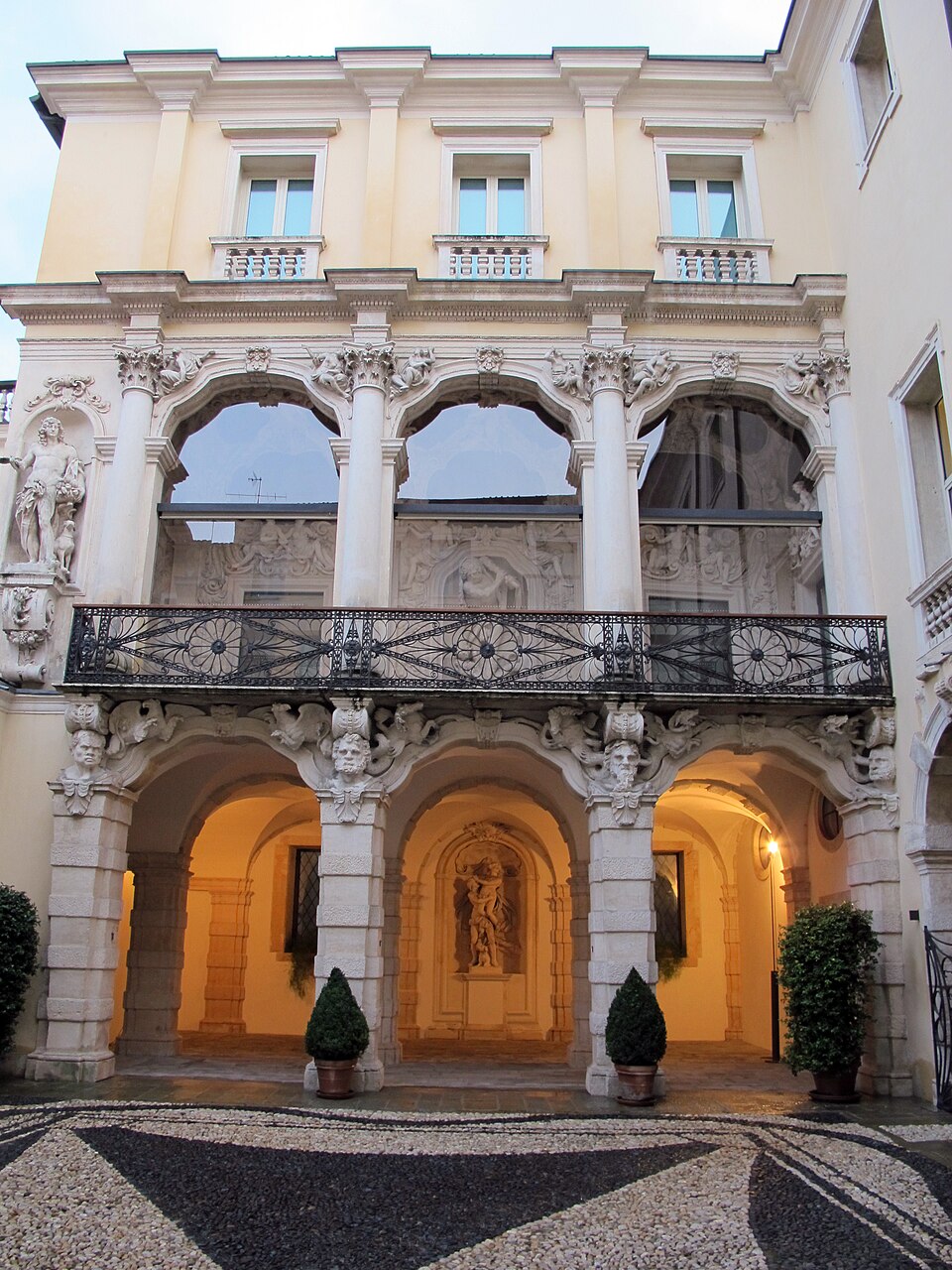
I, Sailko, CC BY-SA 3.0, via Wikimedia Commons
Know before you go
FIND YOUR STORY
A · The first Gallerie d'Italia museum opened in Vicenza ↓
B · A Textile Fortune and a Very Ambitious House ↓
C · Five Centuries On, Vicenza’s Chronicler of the First Circumnavigation of the Globe ↓
D · The New Yorker, the Oceans and the Art of Data ↓
E · What the Palace Means to Vicenza ↓
F · NOW SHOWING: Tiepolo and the Crowd Looking the Other Way ↓
G · The Vicenza Tiepolo Card: Four Places, One Ticket ↓
A · The first Gallerie d'Italia museum opened in Vicenza ↓
The Gallerie d’Italia are the museums of Intesa Sanpaolo, one of Italy’s largest banking groups. Through four historic buildings in Vicenza, Milan, Naples and Turin, the bank makes its art collections available to the public and hosts temporary exhibitions, concerts and cultural programmes.
For visitors who associate the name with Milan’s grand address on Piazza della Scala, the chronology is worth correcting.
Vicenza opened the first museum in 1999. Naples followed in 2007, Milan in 2011 and Turin in 2022. [1]
There is an important distinction in this history. The national museum network, subsequently brought together under the name Gallerie d’Italia, grew from an earlier initiative at Palazzo Leoni Montanari in Vicenza.
The story was already local long before it became national.
B · A Textile Fortune and a Very Ambitious House ↓
To understand why the Gallerie d’Italia began in Vicenza, it helps to meet a family with a taste for social advancement.
Around 1676, Giovanni I Leoni Montanari began building a grand residence in Vicenza’s historic centre. The family fortune had come through his maternal grandfather, Bernardino Montanari, a successful textile manufacturer and merchant who saw considerable promise in his grandson. Giovanni put the money to work on the family’s standing. In 1693, the Leoni Montanari secured a hereditary noble title. [2]
The palace was a persuasive architectural announcement. In a city whose reputation rests on Palladio’s classical restraint, the Leoni Montanari commissioned a Baroque spectacle of frescoes, sculpted figures and exuberant stucco. Heracles has a loggia, Apollo a hall, and modesty appears to have been excused from the decorative programme.
Then came the bankers. In 1908, Banca Cattolica Vicentina acquired the building for its headquarters. Following later mergers, the palace passed into the banking group that would become Intesa Sanpaolo. When it ceased serving its former banking functions in 1990, cultural activities began to occupy the rooms.
The decisive moment arrived in 1999, when Banca Intesa opened Palazzo Leoni Montanari as a permanent public museum. In a 2014 statement marking the museum’s fifteenth anniversary, Intesa Sanpaolo explicitly described the decision as an act of openness towards the citizens of Vicenza, rooted in a sense of civic responsibility. [3]
That is the documented answer to why the first museum opened here in Vicenza: the bank already owned an important Vicenza palace with a long local history, and chose to make its artistic heritage available to the city. For all its magnificent ceilings, the building’s most consequential change was probably the moment ordinary visitors were invited through the front door.
C · Five Centuries On, Vicenza’s Chronicler of the First Circumnavigation of the Globe ↓
On 6 September 2022, exactly five hundred years after the ship Victoria returned to Spain from the first circumnavigation of the world, the Gallerie d’Italia Vicenza opened an exhibition devoted to Antonio Pigafetta.
Everyone knows Magellan. Antonio Pigafetta from Vicenza wrote the famous travelogue and journal titled The First Voyage Round the World (originally in Italian as Relazione del primo viaggio intorno al mondo). In this work, he documented detailed daily accounts of the voyage, sea life, weather, and newly discovered lands. When the Victoria returned to Spain in 1522, Pigafetta was among just 18 men who had survived the first circumnavigation of the world.
Centuries later, on 8 December 1982, Gabriel García Márquez opened his Nobel Prize lecture with Pigafetta'diary.
For the anniversary, Milan’s Biblioteca Ambrosiana lent its historic manuscript of Pigafetta’s Report on the First Voyage Around the World, one of the surviving witnesses to his account. The exhibition brought together early maps, books and objects that explored how Europeans pictured the world before and after the expedition. [4]
It was an inspired choice of venue.
The man whose words helped generations imagine the Pacific, Patagonia and the Philippines was being celebrated in his home city, inside a palace whose own story had travelled from private wealth to public culture.
It also gave Vicenza a chance to recognise one of its most internationally significant writers, a figure whose fame overseas has often exceeded his visibility at home.
D · The New Yorker, the Oceans and the Art of Data ↓
Anyone expecting a strictly eighteenth century programme may be surprised by the names that have appeared on the exhibition calendar.
The relationship with Illustri, Vicenza’s international illustration festival, has brought artists such as Malika Favre, Noma Bar and Christoph Niemann into Palazzo Leoni Montanari.
In 2024, the museum presented a solo exhibition by Barcelona illustrator Javier Jaén, whose editorial work has appeared in The New Yorker, The New York Times, TIME and National Geographic. His visual wit found an entertaining counterpart in a building that has never suffered from a shortage of imagery. [5]
From October 2025 to April 2026, Cristina Mittermeier. La grande saggezza, presented in collaboration with National Geographic, brought the Mexican photographer’s images of oceans, wildlife and human communities to Vicenza. Her career has combined marine conservation with the kind of photography that makes people look twice at the natural world. [6] Spring 2026 introduced another international name: Giorgia Lupi, the Italian information designer based in New York and a partner at Pentagram. Her exhibition, L’umanesimo dei dati, explored the human experiences concealed within information and numbers. Lupi’s work is represented in the permanent collection of New York’s Museum of Modern Art. [7]
There is something appealing about the range of these encounters. A palace that preserves medieval Russian icons and Venetian paintings has also welcomed contemporary illustrators, environmental photography and the visual language of data.
E · What the Palace Means to Vicenza ↓
The history of a cultural institution can be measured through its exhibitions. Its place in a city becomes more interesting when you look at the people who come through the doors between them.
At Palazzo Leoni Montanari, children can explore the decorative characters of the building or try activities connected with spinning and weaving. The latter seems especially apt in a house paid for by a textile fortune. [8]
The museum also offers activities for older people, including Arte e memoria, which uses works of art to encourage recollection and conversation. Its accessibility programmes involve visitors with different physical, sensory and cognitive needs. [9]
Then there is the music. In 2026, Ensemble Musagète marks twenty five years of its relationship with Intesa Sanpaolo. The chamber ensemble performs in the palace, works with young musicians and takes concerts into residential and community care settings in the Vicenza area.
Its 2026 and 2027 season extends from the museum’s frescoed rooms to places such as Residenza Villa Caldogno, connecting a programme of classical music with people who may have limited opportunities to attend concerts elsewhere. [10]
That gives the palace a civic role beyond its visitor numbers. Children learn here, artists meet audiences here, and some of the music created for its programme reaches people elsewhere in the province.
F · NOW SHOWING: Tiepolo and the Crowd Looking the Other Way ↓
Giandomenico Tiepolo (1727–1804). Un mondo nuovo
9 October 2026 to 17 January 2027
For generations, the frescoes Giandomenico Tiepolo painted at Villa Valmarana ai Nani in Vicenza were credited to his famous father, Giambattista. The mistake hinged on a date: 1757 had been read as 1737, when Giandomenico was just ten years old. [16]
That thorny artistic inheritance is at the heart of Un mondo nuovo, curated by Valter Curzi, Carolina Brook and Fabrizio Magani. Bringing together 68 works from the Prado, Louvre, Kunsthistorisches Museum, Morgan Library & Museum and other international collections, the exhibition follows Giandomenico from his travels alongside his father through Germany and Spain to his own paintings, drawings and engravings. His subjects gradually shift towards the people of Venice, their humour, habits and private sorrows, culminating in the comic and melancholy figure of Pulcinella. [11]
The title holds a beguiling historical curiosity. Mondo Novo means “New World”, but in eighteenth century Venice it was also the name of a travelling optical attraction called a pantoscopio. Through lenses fitted into a wooden box, spectators could marvel at images of distant places, a popular precursor to cinema.
Giandomenico painted one at Villa Valmarana in 1757, then revisited the subject around 1765. That later painting has travelled from Madrid’s Prado to Vicenza, alongside a reconstruction of the optical device from Padua’s Museo del PRECINEMA. In the painting, the entire crowd faces the spectacle, leaving us to wonder what everyone is looking at. [12]
In 1791, Giandomenico returned to the subject once more. Some scholars believe he included himself beside his father, who had died twenty one years earlier. The identification remains uncertain, but the possibility of this painted reunion is touching. [18]
The exhibition's New World also belongs to Giandomenico himself: a painter who found his own voice in the human comedy of everyday life, beyond his father's magnificent gods and heroes.
G · The Vicenza Tiepolo Card: Four Places, One Ticket ↓
For the exhibition, Vicenza has introduced a particularly useful ticket: the Vicenza Tiepolo Card, developed with Vicenza Turismo e Cultura.
It connects four places in the city, each preserving part of Giandomenico Tiepolo’s story. [13]
Gallerie d’Italia · Vicenza
For the international exhibition and its exceptional loans, including Il mondo nuovo from Madrid.
Villa Valmarana ai Nani · Vicenza
For Giandomenico’s 1757 chinoiserie frescoes, including a room where visitors can actually spend the night.
Sleep inside Tiepolo’s painted China, the Via Vicenza story
Palladio Museum · Vicenza
For seven frescoes painted by Giandomenico in 1773 for Palazzo Valmarana Franco and now preserved in the museum.
Museo Civico di Palazzo Chiericati · Vicenza
For Enea, Anchise e Ascanio, in one of Palladio’s celebrated city palaces.
The ticket covers admission to the four sites. An overnight stay beneath the frescoes at Villa Valmarana is booked separately.
H · UPCOMING: The Cultural Diary ↓
The Tiepolo exhibition has brought its own calendar of conversations, music and encounters with the less familiar pleasures of eighteenth century life.
Here are a few dates worth keeping in mind. [10, 14]
30 October 2026, 17:00 · Vicenza tra parole e suoni
An afternoon devoted to Goffredo Parise, the Vicenza born writer who died forty years ago, combining literature and music.
8 November 2026, 11:00 · Dall’argilla al palcoscenico
An Art & Drink visit exploring ancient Greek theatre masks and Tiepolo’s Pulcinella, with a tasting in collaboration with Ca’ del Sette Vini of Gambellara, in the province of Vicenza.
13 November 2026, 18:00 · The Art of Giandomenico Tiepolo
Exhibition curators Valter Curzi and Carolina Brook discuss the painter’s career, his relationship with his celebrated father and the character of his mature work.
11 December 2026, 18:00 · A Journey into Eighteenth Century Optical Views
Carlo Alberto Zotti Minici, director of Padua’s Museo del Precinema, explores the devices that once allowed audiences to peer into unfamiliar places. An especially good companion to the exhibition’s Il mondo nuovo.
13 December 2026, 11:00 · Light, Gold and Colour Between East and West
An Art & Drink encounter between Giandomenico’s paintings and the museum’s Russian icon collection.
18 December 2026, 18:00 · Giandomenico Tiepolo at Villa Valmarana ai Nani
Art historian Antonio Mazzotta explores the frescoes in the villa’s Foresteria, extending the story beyond the exhibition.
17 January 2027, 11:00 · Venezia il mondo novo
On the exhibition’s closing day, an Art & Drink visit revisits Venetian society, Pietro Longhi and the optical entertainments of the eighteenth century.
21 March 2027 · Ensemble Musagète
The chamber music season concludes with a concert marking the ensemble’s twenty fifth anniversary.
Some talks are free with advance reservations recommended. Art & Drink visits and concerts have separate admission arrangements.
I · Before You Go ↓
Gallerie d’Italia · Vicenza
Palazzo Leoni Montanari
Contrà Santa Corona 25
36100 Vicenza, Italy
Opening hours: Tuesday to Sunday, 10:00 to 18:00. Closed Mondays. Last admission at 17:30.
Admission: €5 standard, €3 reduced. Free for visitors under 26, Intesa Sanpaolo customers and other eligible categories. Free admission for everyone on the first Sunday of each month.
Reservations: Recommended online, and required for selected events.
Phone: +39 800 167 619
Email: vicenza@gallerieditalia.com
Official website:
https://www.gallerieditalia.com/en/vicenza/
Sources
- Gallerie d’Italia · Il progetto
- Gallerie d’Italia Vicenza · Palazzo Leoni Montanari
- Intesa Sanpaolo · Le Gallerie d’Italia di Intesa Sanpaolo compiono 15 anni e si rinnovano
- Gallerie d’Italia Vicenza · Pigafetta e la prima navigazione attorno al mondo. Non si farà mai più tal viaggio
- Gallerie d’Italia Vicenza · ILLUSTRISSIMO Javier Jaén
- Gallerie d’Italia Vicenza · Cristina Mittermeier. La grande saggezza
- Gallerie d’Italia Vicenza · Giorgia Lupi. L’umanesimo dei dati
- Gallerie d’Italia Vicenza · Attività didattiche dedicate a Palazzo Leoni Montanari
- Gallerie d’Italia Vicenza · Accessibilità alle Gallerie d’Italia di Vicenza
- Gallerie d’Italia Vicenza · SOUND | Pomeriggio tra le Muse. Ci vuole tempo per diventare giovani
- Gallerie d’Italia Vicenza · Giandomenico Tiepolo (1727–1804). Un mondo nuovo
- Intesa Sanpaolo · Mostra Giandomenico Tiepolo. Un Mondo Nuovo a Vicenza
- Vicenzareport · Vicenza, da domenica 25 ottobre le visite guidate su Giandomenico Tiepolo con la Tiepolo Card
- Gallerie d’Italia Vicenza · #INSIDE. Giandomenico Tiepolo (1727–1804). Un mondo nuovo
- Gallerie d’Italia Vicenza · Plan your visit to Vicenza
- Foresteria Villa Valmarana ai Nani · La storia delle date
- Museo del PRECINEMA · Guida in italiano
- Ca’ Rezzonico, Museo del Settecento Veneziano · A Journey into 18th Century Venice