Home › Places › Museums & antique books › Palazzo Chiericati
PALLADIO · OLD MASTERS · ART MUSEUMS IN ITALY
Why did Palladio build a palace above a cattle market?
Floodwater, Roman architecture and an extraordinary art collection: the Renaissance palace where Memling, Van Dyck, Tiepolo and Palladio share an unlikely history.
Andrea Palladio raised an aristocratic palace above a busy river market to protect it from floods and livestock. Its monumental porticoes were conceived partly for public use. Today, the building houses one of the Veneto's important civic art collections, with works by Hans Memling, Van Dyck, Tintoretto and Tiepolo, thirty three original Palladio drawings, and a remarkable 2026 arrival from a Parisian art museum.
You have saved two places. Leave your email and you will find them on any device, plus the next drop.
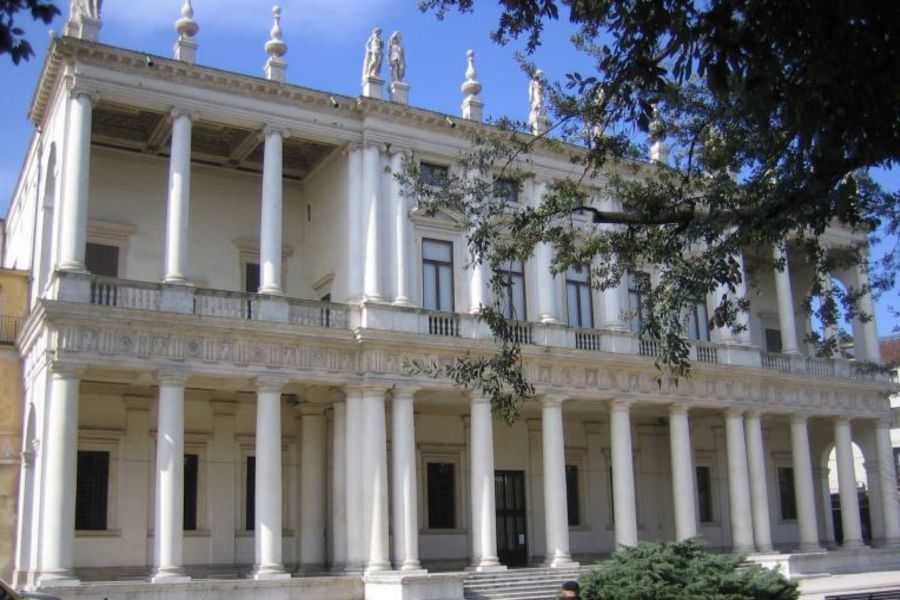
Palazzo_Chiericati Andrea Palladio, CC BY-SA 3.0 via Wikimedia Commons
Know before you go
Email museocivico@comune.vicenza.it Telefono +39 0444 222811 Prenotazioni gruppi e scuole booking@comune.vicenza.it Oggetto email Palazzo Chiericati: museum visit and booking enquiry
In this story: The Palace Above the Cattle Market ↓ A Private Palace with a Public Portico ↓ Memling, Van Dyck and the Masters Inside ↓ The Paris Connection ↓ Palladio's Original Drawings ↓ A Museum Already in the Victorian Guidebooks ↓ One Family, Two Palladian Addresses ↓
THE PALACE ABOVE THE CATTLE MARKET
The history of Palazzo Chiericati begins with an unexpected problem for a Renaissance aristocrat: cattle, floodwater and a busy river port.
In 1546, Girolamo Chiericati inherited several houses overlooking Piazza dell'Isola, an open area at the eastern edge of Vicenza, enclosed by the Retrone and Bacchiglione rivers. It was the city's river port and a market for timber and livestock. The neighbourhood offered commercial activity and an unusually generous urban prospect, together with frequent flooding and the less agreeable business of cattle trading. [1]
Palladio's solution was architectural theatre with a practical purpose. He raised the residence on a substantial stone podium, giving its central staircase the ceremonial character of an ancient Roman temple. The elevation also protected the building from floodwater and the animals gathered in the square below.
The extraordinary two level colonnade was therefore born from the conditions of a working city. Palladio imagined the open piazza almost as a Roman forum, with the Chiericati residence providing its monumental classical frontage. [1]
The building now stands on Piazza Matteotti, just across from the Teatro Olimpico, making the original river market almost impossible to imagine without knowing its history.
A PRIVATE PALACE WITH A PUBLIC PORTICO
Girolamo Chiericati needed more space than his inherited buildings could provide.
In order to realise Palladio's scheme, he requested permission from Vicenza's city council to occupy approximately four and a half metres of municipal land in front of the property. In exchange, the new portico would remain available for public use. [1]
That arrangement helps explain one of the most distinctive features of Palazzo Chiericati. The ground floor opens generously towards the square, while the upper loggia gives the family residence the grandeur of a public building.
Palladio borrowed elements from Roman architecture, including the Portico of Octavia, to establish a new language of civic magnificence.
When he published I Quattro Libri dell'Architettura in 1570, he made his own buildings part of an architectural treatise that would circulate far beyond Italy. The Metropolitan Museum of Art identifies the book as central to the international spread of Palladio's ideas. [2]
Palazzo Chiericati demonstrates that ambition in a particularly unexpected setting: an aristocratic palace designed for a square filled with merchants, timber and livestock.
MEMLING, VAN DYCK AND THE MASTERS INSIDE
Palazzo Chiericati has another life, and it is a compelling reason to go inside.
Since 1855, the building has housed Vicenza's Museo Civico, whose collections grew through donations from aristocratic families, religious institutions and private collectors. [3]
Its holdings include works by Hans Memling, Jacopo Tintoretto, Paolo Veronese, Antoon van Dyck, Luca Giordano, Giambattista Tiepolo and Giambattista Piazzetta.
Among the works associated with the collection are Memling's Crucifixion, Van Dyck's The Ages of Man, Tintoretto's Saint Augustine Healing the Lame and Tiepolo's Truth Unveiled by Time. [3]
The collection has an especially strong Vicentine identity. Important Renaissance altarpieces arrived from the demolished church of San Bartolomeo, while other works preserve the artistic history of buildings and collections that disappeared or changed during the nineteenth century.
A palace that once displayed the social standing of a single family now contains works assembled across centuries of the city's artistic life.
THE PARIS CONNECTION
The autumn of 2026 brings an unusually interesting international encounter to Palazzo Chiericati.
From 8 September 2026 until 31 January 2027, the museum is hosting Hans Memling's Allegory of Virginity, on loan from the Musée Jacquemart André in Paris, the celebrated private collection established by Nélie Jacquemart and Édouard André on Boulevard Haussmann. [4]
The painting belongs to the museum's Ospiti al Chiericati programme, which brings important works from other collections into conversation with Vicenza's permanent artistic heritage.
The same programme also features Giovanni Battista Zelotti's Deposition of Christ into the Tomb, a painting originally created for the nuns of Corpus Domini in Vicenza and now conserved at Pitten Castle in Austria. [4]
For art travellers, these loans offer an additional reason to see the collection in 2026: an exchange between a historic Italian civic museum, a Parisian house museum and a work that travelled from Vicenza to Austria.
PALLADIO'S ORIGINAL DRAWINGS
Behind the museum's public galleries lies another remarkable collection.
The Gabinetto Disegni e Stampe preserves approximately nine thousand works, including drawings, prints, manuscripts and rare books. Among them are thirty three autograph drawings by Andrea Palladio, donated in 1838 by the Veronese collector Gaetano Pinali. [5]
The collection also contains architectural drawings by Vincenzo Scamozzi and later Vicentine architects, alongside prints by Albrecht Dürer, Giambattista and Giandomenico Tiepolo, Piranesi, Canaletto and the Remondini publishers of Bassano del Grappa.
One particularly intriguing holding is Vincenzo Scamozzi's travel notebook documenting his journey from Paris to Venice. [5]
These materials are preserved in specialist collections and are available to researchers by appointment. They should not be confused with works permanently displayed in the public galleries.
For anyone interested in architectural drawing, collecting, engraving or the history of Italian books and prints, Palazzo Chiericati contains a second, less visible museum within the museum.
A MUSEUM ALREADY IN THE VICTORIAN GUIDEBOOKS
The significance of Palazzo Chiericati as an art destination reaches back well beyond contemporary tourism.
An 1881 edition of Cook's Tourist's Handbook for Northern Italy directed English speaking visitors to the Museo Civico at Palazzo Chiericati, recording an admission charge of half a franc. The guide singled out works attributed to Cima da Conegliano, Bartolomeo Montagna and Titian. [6]
It also described two rooms devoted to drawings by Palladio and Scamozzi, alongside collections of coins and natural history.
The details offer a fascinating view of nineteenth century cultural travel. Vicenza was already being presented to international visitors through Palladio, painting, drawing and historical collections.
Today, the museum's numismatic holdings comprise approximately twenty five thousand coins and medals, while the architectural drawings are preserved under specialist conservation conditions. [3, 5]
The visitor experience has changed considerably since 1881, but the combination of architecture, collecting and art remains the institution's defining attraction.
ONE FAMILY, TWO PALLADIAN ADDRESSES
The Chiericati family's relationship with Palladio extended beyond the city palace.
While Girolamo commissioned the urban residence, his brother Giovanni commissioned Villa Chiericati at Vancimuglio, in the agricultural countryside east of Vicenza.
The palace and villa reveal two sides of Palladio's experiments during the early 1550s. In the city, he developed a monumental residence with open colonnades facing a public square. In the country, he experimented with the complete Ionic temple front that would become central to later Palladian villas. [1, 7]
The family had already played an important role in Palladio's career. Girolamo was among the influential supporters who helped secure the architect's commission for the loggias of Vicenza's Basilica.
The two Chiericati buildings can be experienced as a connected architectural itinerary: an art museum in the historic centre and an early Palladian villa in the surrounding plain.
VISITING PALAZZO CHIERICATI
Palazzo Chiericati is home to the Museo Civico and is open to the public with admission tickets.
Its permanent collections, temporary exhibitions and historic rooms offer several ways to experience the building. Particular works may be in storage, on loan or temporarily inaccessible during conservation and installation work.
For the 2026 season, check the museum's current gallery access and the Ospiti al Chiericati exhibition programme before visiting.
Sources
- Centro Internazionale di Studi di Architettura Andrea Palladio · The river market, flooding, public portico and architectural commission · Palazzo Chiericati, Vicenza
- The Metropolitan Museum of Art · Palladio's architectural treatise and its international influence · I quattro libri dell'architettura di Andrea Palladio, 1570
- Italian Ministry of Culture · Civic art collections, Memling, Van Dyck, Tintoretto, Tiepolo and numismatic holdings · Museo civico di Palazzo Chiericati
- Città di Vicenza, Musei Civici · International loans from Paris and Austria, September 2026 to January 2027 · Ospiti al Chiericati: L'allegoria della Verginità di Memling e La deposizione di Zelotti
- Musei Civici di Vicenza · Thirty three autograph drawings by Palladio, Scamozzi's travel notebook and historic print collections · Gabinetto disegni e stampe
- Thomas Cook · Cook's Tourist's Handbook for Northern Italy, 1881, p. 112, historical source supplied in VIA VICENZA BOOKS · Vicenza, Museo Civico
- Centro Internazionale di Studi di Architettura Andrea Palladio · Giovanni and Girolamo Chiericati and the early Palladian temple front · Villa Chiericati, Grumolo delle Abbadesse