Home › Places › Nature & trails › Ghiacciaia di Peralto
Hidden rural history in Vicenza
The restored brick dome icehouse
Before refrigerators, this brick chamber stored a mountain village’s food, medicine and winter ice.
Before electric refrigeration reached the Vicenza mountains, Peralto had a communal cold store. Ice was packed into an underground brick chamber for meat and food, but local memory records another use: doctors prescribed it to relieve fever, and sick children were given priority. Restored after decades of abandonment, the Ghiacciaia di Peralto survives above Arsiero as a rare piece of everyday mountain infrastructure from 1900.
You have saved two places. Leave your email and you will find them on any device, plus the next drop.
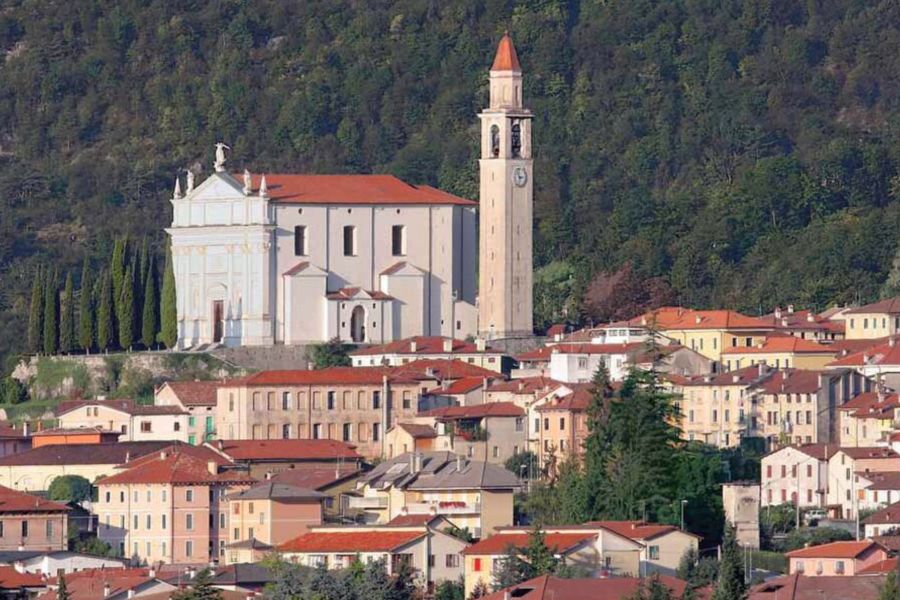
Panorama_di_Arsiero_con_la_Chiesa_di_San_Michele Arxvice, CC BY-SA 4.0 via Wikimedia Commons
About
Hidden in Peralto, above Arsiero, the Ghiacciaia di Peralto was designed in 1897 and documented in regular use by 1900. The protected entrance faces north to limit warming from the sun, while a semicircular stair descends into the storage chamber.
→ The doctor could prescribe ice
Before refrigerators, ice could be medicine.
Ice was used for food, but also to relieve severe fevers. According to local memory, doctors even wrote prescriptions for collecting it, with sick children given priority.By the eve of the First World War, requests for ice had become formal enough that paperwork needed to be validated at the town hall. The scale of the need was real.
→ An epidemic once required almost 95 tonnes of ice
The scale becomes clearer from an earlier episode.
During an epidemic in 1876, Arsiero needed so much ice to relieve patients suffering from severe fever that the municipality purchased 947.98 quintals, almost 95 tonnes, from two suppliers in nearby Valli del Pasubio. The later construction of Peralto’s own municipal icehouse belongs to that world, when cold itself had economic and medical value.
→ Abandoned, filled with rubble, then recovered
The Peralto icehouse eventually lost its purpose as mechanical refrigeration spread. It was sold in 1943 and subsequently abandoned, eventually filling with demolition material.
In 2014 it returned to municipal use through a thirty year loan agreement, and the municipality and local volunteers began clearing and restoring it. What survives today is therefore not a reconstruction built for tourism, but the recovered structure itself.
→ Walk there through the old mountain landscape
The icehouse also sits directly on a walking route.
CAI trail 534 passes the Giassara, the local dialect name for the icehouse, while climbing from Case Pierini through Crosara, Cise and Peralto towards the higher slopes. The CAI describes the route as an easy mountain trail with approximately 320 metres of ascent and around 1 hour 15 minutes of walking for the published section.
If you are making a half day of Arsiero, the same territory has another completely different landscape nearby.
At La Pria, the Astico cuts through rock into narrow channels and deep green pools framed by woodland and the Prealps. The place was described by Vicentine novelist Antonio Fogazzaro in Daniele Cortis, and the Acqua Ferro Fuoco project also traces its industrial history through former mills and a paper works.
The two stops work unusually well together: one explains how mountain communities stored cold, the other how they used moving water.
.
Good to know before you go
The restored icehouse can be seen at Peralto, above Arsiero. Interior access and guided visits are not advertised on a permanent daily timetable, so check locally before travelling specifically to enter the chamber. Local information Comune di Arsiero Municipal telephone +39 0445 741305 Municipal email segreteria@comune.arsiero.vi.it