Home › Places › Nature & trails › Le Priare
ROMEO&JULIET · UNDERGROUND EUROPE · DARK FOLKLORE
A Death Chamber, 25 Natural Caves and the Secret Beneath Juliet’s Castle
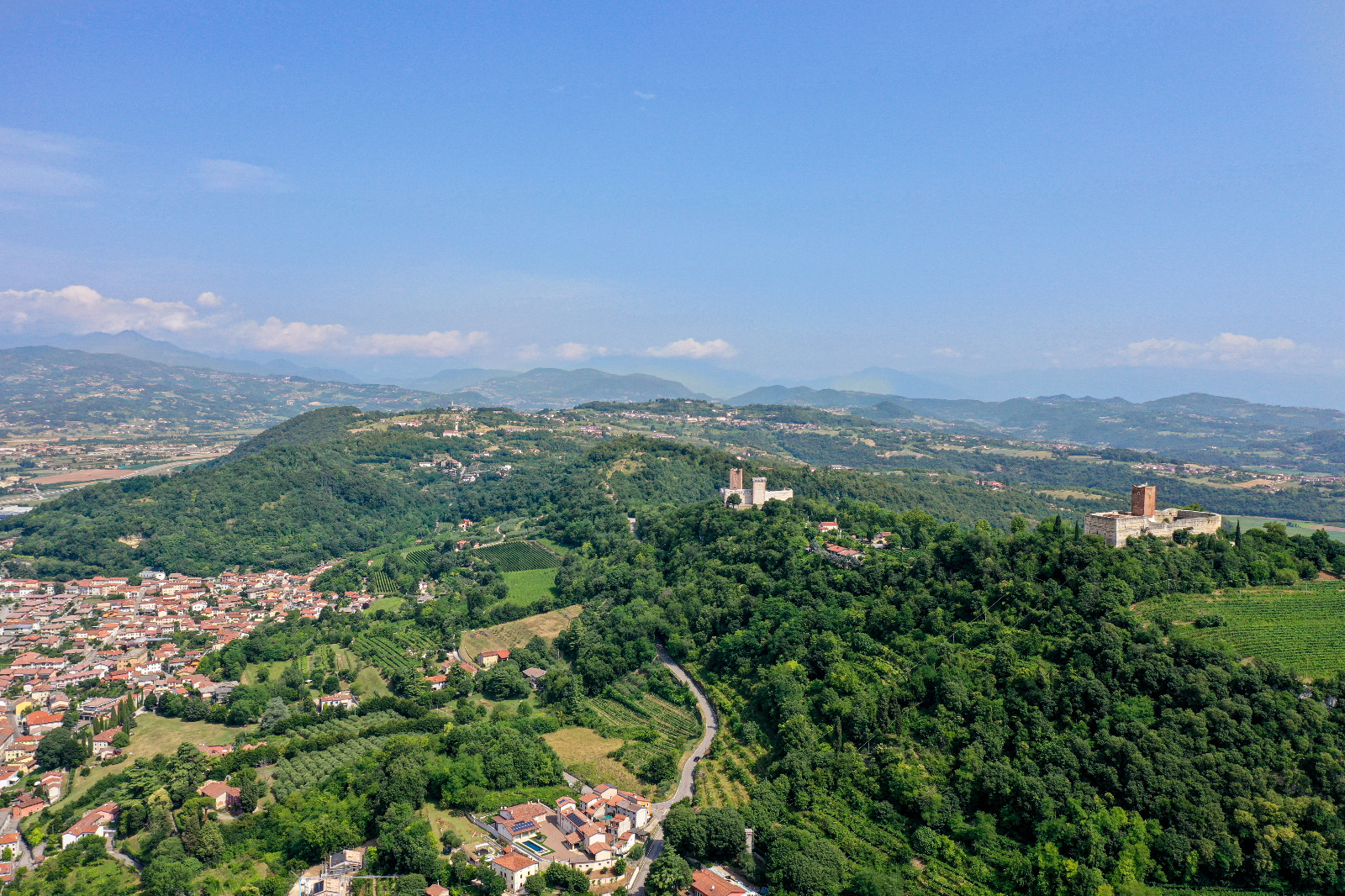
Visit Romeo and Juliet’s castles in Vicenza, then follow a guide into the stone quarries beneath Juliet’s fortress.
The walk between Romeo and Juliet’s castles has a third stop, inside the hill itself. Beneath the hill of Juliet’s medieval castle lies a 1.5 kilometre underground labyrinth of ancient stone quarries and natural caves. At Le Priare in Montecchio Maggiore, Vicenza, visitors follow illuminated passages towards a chamber known as the Vano della Morte, the Death Chamber, where a centuries old tale of condemned prisoners meets a surprising geological discovery. The guided route reveals a hidden world of quarried stone, natural rock formations and passages once used as wartime shelters.
You have saved two places. Leave your email and you will find them on any device, plus the next drop.
Know before you go
Information and reservations Pro Loco Alte Montecchio Telephone: +39 0444 696546 Mobile: +39 340 0796224 Email: info@prolocoaltemontecchio.it Confirm seasonal openings and visiting conditions before travelling.
In this story: Into the Illuminated Quarries ↓ The Death Chamber and Its Disputed Legend ↓ Twenty Five Natural Cavities ↓ A Medieval Punishment Written in Stone ↓ The Refuge That Became a Mushroom Farm ↓ Romance, Dance and Unusual Performances Underground ↓ Plan Your Descent ↓
INTO THE ILLUMINATED QUARRIES
A few minutes below the medieval castle associated with Juliet, the hillside opens into a labyrinth excavated over centuries.
Le Priare takes its name from pria, the Venetian word for stone. Quarrymen extracted the soft limestone known as pietra di Vicenza, cutting chambers and passages deep inside the hill. Over time, their work intersected an older network of naturally formed cavities. [1]
Today, visitors receive a protective helmet and descend with a guide into illuminated galleries. The artificial chambers retain the marks of stone extraction, while carefully positioned lighting exposes openings, shafts and the different textures of the rock.
The temperature remains between 10 and 15°C throughout the year. Above ground are the vineyards and medieval fortresses of Montecchio Maggiore; below, the experience belongs to stone, shadow and the unusual proportions of a place excavated by generations of workers. [1, 2]
The full underground complex extends for 1,475 metres, although the public visit follows only the authorised section.
THE DEATH CHAMBER AND ITS DISPUTED LEGEND
The most intriguing room bears a rather unsettling name: Vano della Morte, the Death Chamber.
According to local tradition, prisoners condemned at Juliet's Castle were thrown through a shaft in the medieval fortress into the darkness below. The chamber contains tall natural limestone chimneys, giving the story an unexpectedly convincing physical setting. [2]
The legend became even more interesting when speleologists investigated it.
Beginning in 2000, the Club Speleologico Proteo of Vicenza explored the natural cavities and produced a detailed topographical survey of the underground complex. Their measurements established that the shafts associated with the supposed executions lie outside the castle walls. The romantic and rather gruesome story could no longer be reconciled with the surveyed architecture. [2]
It is a fascinating piece of underground folklore: an alleged medieval execution chamber whose actual location dismantles the story told about it.
The name survives, along with the great natural openings that helped give the place its sinister reputation.
TWENTY FIVE NATURAL CAVITIES
Le Priare contains an unusual encounter between human engineering and natural geology.
Of the 1,475 metres recorded by the speleologists, approximately 1,186 metres belong to excavated chambers and passages. Another 289 metres comprise twenty five natural cavities intercepted during the extraction of stone. [2]
These formations are associated with epikarst, the zone where rainwater infiltrates and gradually dissolves limestone, creating fissures, shafts and cavities.
The quarrymen encountered these natural voids as they advanced through the hill. The result is a subterranean landscape where worked surfaces meet naturally eroded rock, and regular extraction chambers open towards irregular geological formations.
One branch extends towards a second opening, creating a connection that recalls the hidden passages of medieval fortifications. Only part of the principal branch is accessible on the visitor route, according to the speleological survey. [2]
The guided visit gives an unusually tangible introduction to the meeting between stone extraction and the processes that shape limestone underground.
A MEDIEVAL PUNISHMENT WRITTEN IN STONE
The caves have another curious connection with the history of Vicenza.
Their earliest documented references lead back to 1231, when the community of Montecchio Maggiore was reportedly obliged to provide stone for the construction of Vicenza's Ponte Pusterla. [2]
According to chronicles later cited by local historians, the obligation was imposed as punishment for an offence committed by the community. The inhabitants were required to supply and transport the stone needed for the bridge.
The account offers a memorable glimpse of medieval civic life: a public works project financed, according to historical tradition, through a collective penalty.
Stone extracted from the hills around Montecchio helped provide building material for the surrounding territory over many centuries. The quarries continued to operate, with decreasing intensity, until after the Second World War.
THE REFUGE THAT BECAME A MUSHROOM FARM
The twentieth century gave Le Priare two very different uses.
During the Second World War, residents sought shelter in the underground galleries during air raids. Some of the walls closing off lateral chambers are thought to date from alterations made during that period. [2, 3]
Once quarrying ended, the underground passages acquired a surprisingly domestic purpose.
Between 1972 and 1985, Le Priare operated as a mushroom farm. The protected subterranean environment offered conditions suitable for cultivation, although the commercial activity eventually ceased and the complex deteriorated. [2]
The speleological surveys begun in 2000 helped make a new public use possible. The galleries were subsequently prepared for guided cultural visits, opening to visitors in 2008. [3]
Stone quarry, wartime shelter, mushroom farm, geological curiosity: very few tourist caves in Italy have such a varied history of human occupation.
ROMANCE, DANCE AND UNUSUAL PERFORMANCES UNDERGROUND
Le Priare has also become an occasional stage for performances that use the subterranean setting itself.
In February 2026, Dimore d'Amore combined guided visits with musical theatre in a programme involving Villa Cordellina and Le Priare. The experience continued underground, bringing a contemporary interpretation of romance into the old quarry chambers. [4]
An even stranger programme followed in May.
During Montecchio Maggiore's 2026 Giornata del Turismo Diffuso, Le Priare hosted Il rifugio segreto delle Api, a dance performance devoted to bees and their search for a healthy place to live. Visitors could also discover the world of beekeeping through an educational hive, audiovisual interpretation and honey tastings organised with the Associazione Provinciale Apicoltori Vicenza. [5]
These events give the galleries a cultural identity beyond the ordinary cave tour. Their historic atmosphere has hosted romance, dance, environmental storytelling and sensory experiences.
Both 2026 editions have concluded. Future performances and unusual openings depend on the published cultural calendar.
WHY VISIT LE PRIARE IN VICENZA?
For travellers looking for unusual underground places in Italy, historic caves in Europe or unexpected experiences beyond the country's familiar monuments, Le Priare offers an unusually rich combination.
The visitor can descend into excavated limestone galleries beneath the hill of a medieval castle, encounter natural cavities within an ancient quarry, hear the story of a supposed death chamber disproved by scientific surveying, and follow a site that later served as a wartime shelter and mushroom farm.
The experience also belongs to the wider history of Vicenza's building stone, connecting centuries of craft and quarrying with the physical landscape from which the material came.
CAN YOU EXPLORE ALL 1,475 METRES?
The figure refers to the full surveyed development of the underground complex. Guided visitors follow a shorter authorised route; some branches and natural cavities remain inaccessible for safety reasons. [1, 2]
IS THE DEATH CHAMBER REAL?
The underground chamber known as Vano della Morte exists, but the tale of condemned prisoners being thrown into it from Juliet's Castle is unsupported by the topographical findings. The natural chimneys associated with the story lie outside the castle walls. [2]
CAN YOU VISIT LE PRIARE WITH CHILDREN?
The guided caves welcome families. Helmets are supplied, visitors should wear practical clothing and suitable footwear, and children must remain with the group throughout the tour. Admission is free for children up to ten years of age under the published 2026 tariff. [1]
Sources
- Pro Loco Alte Montecchio Maggiore · 2026 visitor season, helmets, tickets, underground routes and reservations · Le Priare
- Club Speleologico Proteo, Vicenza · Geological survey, 25 natural cavities, quarry history and the Death Chamber legend · Le Priare di Montecchio Maggiore
- Città di Montecchio Maggiore · History of the stone quarries, wartime shelters, geological interpretation and public opening · Priare
- Città di Montecchio Maggiore · 14 and 15 February 2026, immersive musical theatre and guided underground visits · Dimore d'Amore
- Città di Montecchio Maggiore · 24 May 2026, dance performance, beekeeping interpretation and honey tastings · Giornata del Turismo Diffuso 2026