Home › Places › Nature & trails › Osservatorio Astrofisico del Pennar
STARGAZING IN ITALY
Stand beneath one of Europe’s great historic telescopes in Italy
Public observatory visits, telescope sessions and mountain sky on the Asiago Plateau.
If you are planning a stargazing trip in Italy, this is one of the most serious observatory visits you can book. At the Pennar Observatory on the Asiago Plateau, visitors can enter the dome of the 122 cm Galileo telescope, join official public astronomy programmes and explore one of Europe’s landmark mountain observatories. The wider Asiago astronomy system also includes Cima Ekar, home to Italy’s largest optical telescope.
You have saved two places. Leave your email and you will find them on any device, plus the next drop.
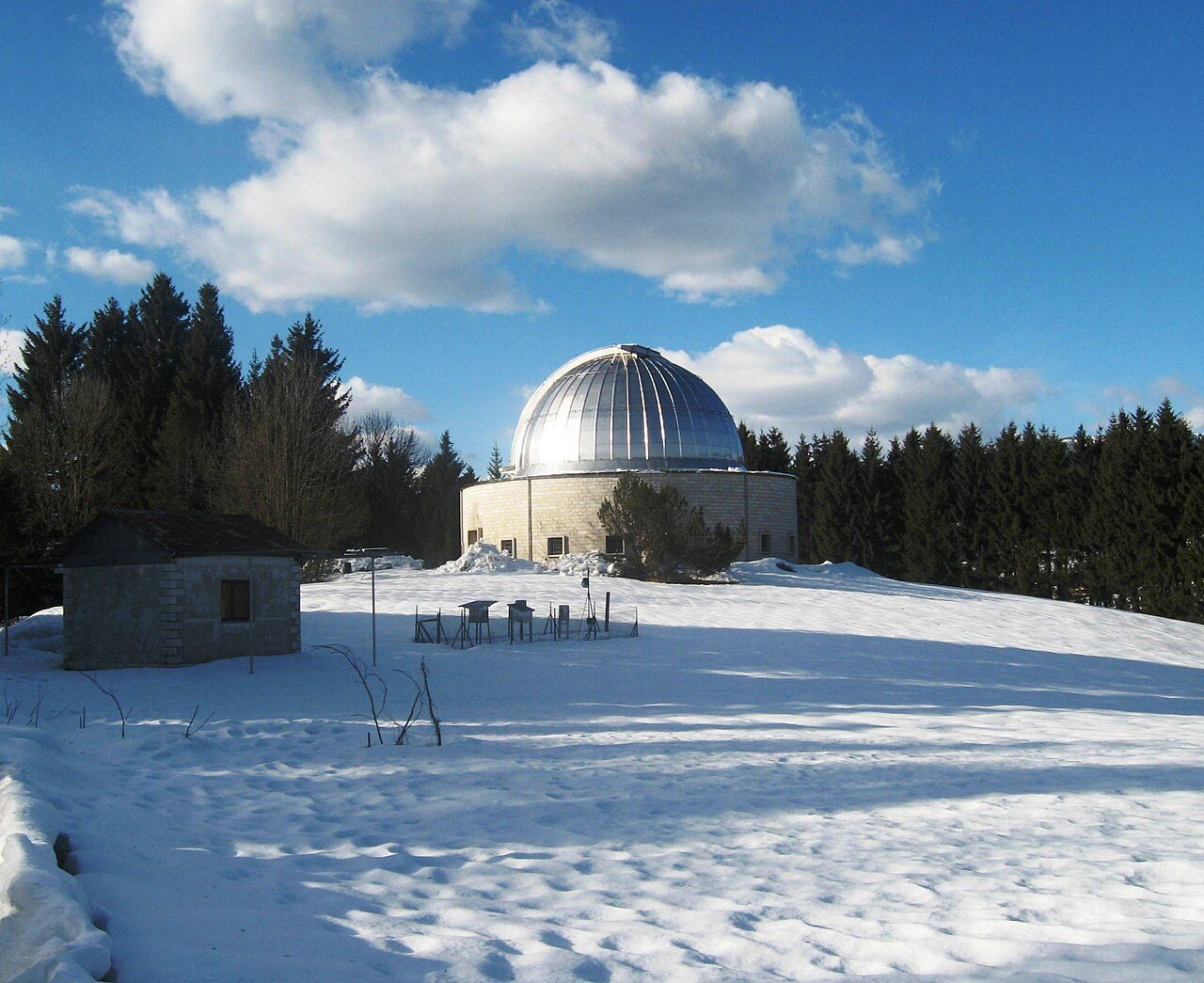
G.F.S. · CC BY-SA 3.0 · Wikimedia Commons
Know before you go
Who runs it: INAF, the University of Padua and local tourism partners. Booking: Reservation is required for all public activities. Tickets: Public programme listings currently indicate €12 full price, €7 reduced for ages 6–17, free for children up to 5 and some university/observatory categories, plus a €24 family ticket. Information and reservations: IAT Asiago Telephone: +39 0424 462221 Email: info@asiago.to Museum booking: museo.astronomia@unipd.it Why go: If you want more than casual stargazing and are looking for one of the best observatory visits in Italy, this is a strong candidate.
About
To get physically close to an instrument with an extraordinary double life: Europe’s largest telescope in 1942, still working more than eighty years later. You can enter the historic dome, stand beneath its 50 tonne rotating structure and see the 122 cm Galileo at close range. Depending on the public programme, visits can also include astronomical observing sessions and live connections to the telescope. For anyone who knows the pleasure of waiting for a nova, following a comet ephemeris or checking whether a variable star has changed overnight, Pennar has something unusually real about it: this is still a working observatory, with an old telescope looking at events that have not happened yet.
The Observatory ↓ · Why Stargazers Go ↓ · What You Can Actually Do ↓ · The Telescope ↓ · The Bigger Astronomy Destination ↓ · Museum & Instruments ↓ · Plan Your Visit ↓ · FAQ ↓
THE OBSERVATORY ↓
If you are searching for where to go stargazing in Italy, the Pennar Observatory is one of the strongest answers in the country.
This is not just a scenic lookout or a small amateur dome. It is the historic campus of the Asiago Astrophysical Observatory, used by the University of Padua and INAF for research, education and public outreach. Visitors can book official programmes that include guided visits, astronomy activities and, depending on the programme, telescope observation sessions and access to the Galileo dome.
The setting matters too. The observatory stands on the Asiago Plateau, a mountain environment long associated with astronomy, clean air and skywatching.
WHY STARGAZERS GO ↓
The main appeal is simple: you can get physically close to a real research telescope in a serious mountain observatory that is still part of active astronomical life.
For astrotourism travellers, that makes the Pennar Observatory much more interesting than a generic science attraction. You are not just reading panels about the universe. You are entering a place where astronomers work, where students train and where the public can join organised astronomy experiences.
The University of Padua explicitly presents the observatory as a place the public can visit through initiatives that include telescope observations, seminars and science activities.
WHAT YOU CAN ACTUALLY DO ↓
The official public programme is run through the collaboration between INAF, the Department of Physics and Astronomy of the University of Padua and the Municipality of Asiago. All events require reservation.
Depending on the date and the programme, public activities can include:
-
guided visits to the observatory
-
access to the dome of the Galileo telescope
-
astronomy talks and themed lessons
-
observation sessions
-
family activities
-
workshops such as astrorockets and astrotombola
-
a visit to the Museum of Scientific Instruments
The official tourism listings also publish public ticket prices for observatory initiatives: €12 full price, €7 for ages 6–17, free for children up to 5 and specific university and observatory categories, plus a family ticket at €24.
For visitors planning a dedicated astronomy trip, the key point is that this is a bookable, structured public astronomy programme, not a vague possibility.
THE TELESCOPE ↓
The star of the visit is the Galileo telescope.
The University of Padua states that the Asiago Astrophysical Observatory was inaugurated in 1942 with what was then the largest telescope in Europe. The Galileo has a 122 cm mirror and remains part of the observatory’s scientific and educational life.
For the public, the emotional hook is obvious: you can stand inside the dome and see from close range one of Europe’s historic large telescopes, still linked to real astronomy rather than preserved as a dead relic.
If the telescope is under maintenance, access to the dome may be limited, so visitors should always check the official programme in advance.
THE BIGGER ASTRONOMY DESTINATION ↓
Pennar is not an isolated attraction. It is part of a much larger astronomy destination.
The Asiago system also includes the Cima Ekar observing station, a few kilometres away, where the 182 cm Copernico telescope is installed. The University of Padua’s museum and observatory materials identify it as the largest optical telescope on Italian soil.
That wider constellation is a major strength for astrotourism positioning. Few destinations can offer, in the same mountain territory, a historic major observatory, a public science programme, a scientific instruments museum and access to the area that also hosts Italy’s largest optical telescope.
For travellers researching observatories in Europe, telescope tourism or science themed weekend trips, this makes the Asiago Plateau exceptionally competitive.
MUSEUM & INSTRUMENTS ↓
The visit can extend beyond the dome.
The observatory campus is linked to the Museum of Scientific Instruments, which preserves astronomical instruments, archives and photographic material used by astronomers from the 1930s onward.
The museum’s own visitor page states that the collections are accessible free of charge, by reservation, and are particularly suitable to combine with an observatory visit.
For science minded travellers, this adds welcome depth. The experience is not limited to looking at one impressive machine. It opens onto the tools, archives and observing culture that made the site important in modern astronomy.
FREQUENTLY ASKED QUESTIONS ↓
Can you visit a real observatory in Italy?
Yes. The Pennar Observatory on the Asiago Plateau offers official public programmes with reservation, including visits to the observatory and access to the Galileo telescope dome on selected dates.
Where can you go stargazing with a telescope in Italy?
The Asiago Astrophysical Observatory is one of Italy’s best known public astronomy destinations. Depending on the programme, visitors can join observatory activities, themed lessons and telescope related experiences.
Is the Pennar Observatory good for astrotourism?
Yes. It combines a historic major telescope, public science programming, mountain sky conditions, a scientific instruments museum and its place within the wider Asiago telescope system.
What is special about the Asiago Observatory?
The University of Padua states that it opened in 1942 with what was then the largest telescope in Europe. Today it remains active for research, education and public outreach.
Can families visit the observatory?
Yes. Official public activities include family oriented formats and reduced or family ticket options, but all events must be booked in advance.
Sources
- INAF - OAPd · Didattica e divulgazione ad Asiago
- Università degli Studi di Padova · Asiago Astrophysical Observatory
- Museo degli Strumenti dell'Astronomia - Università degli Studi di Padova · L’Osservatorio di Asiago
- Museo degli Strumenti dell'Astronomia - Università degli Studi di Padova · Visita il Museo
- Asiago Official Tourism Website · Iniziative per il pubblico presso l'Osservatorio
Vicenza had its own word for looking closer, and it is the proper beginning for anything worth discovering.
The Vicenza Lexicon →