Home › Places › Nature & trails › Riparo del Broion
Prehistoric Italy · Vicenza
A Neanderthal child and Ice Age jewellery in the Vicenza hills
A limestone shelter used by Neanderthals and early Homo sapiens, above a village in the Berici Hills.
A Neanderthal child lost a milk tooth here about 48,000 years ago. Thousands of years later, other occupants left shell ornaments and traces of red pigment beneath the same limestone overhang. Riparo del Broion, above Lumignano in the hills south of Vicenza, preserves both episodes. Woodland paths cross the surrounding slopes, with cliffs, natural shelters and views across the plain
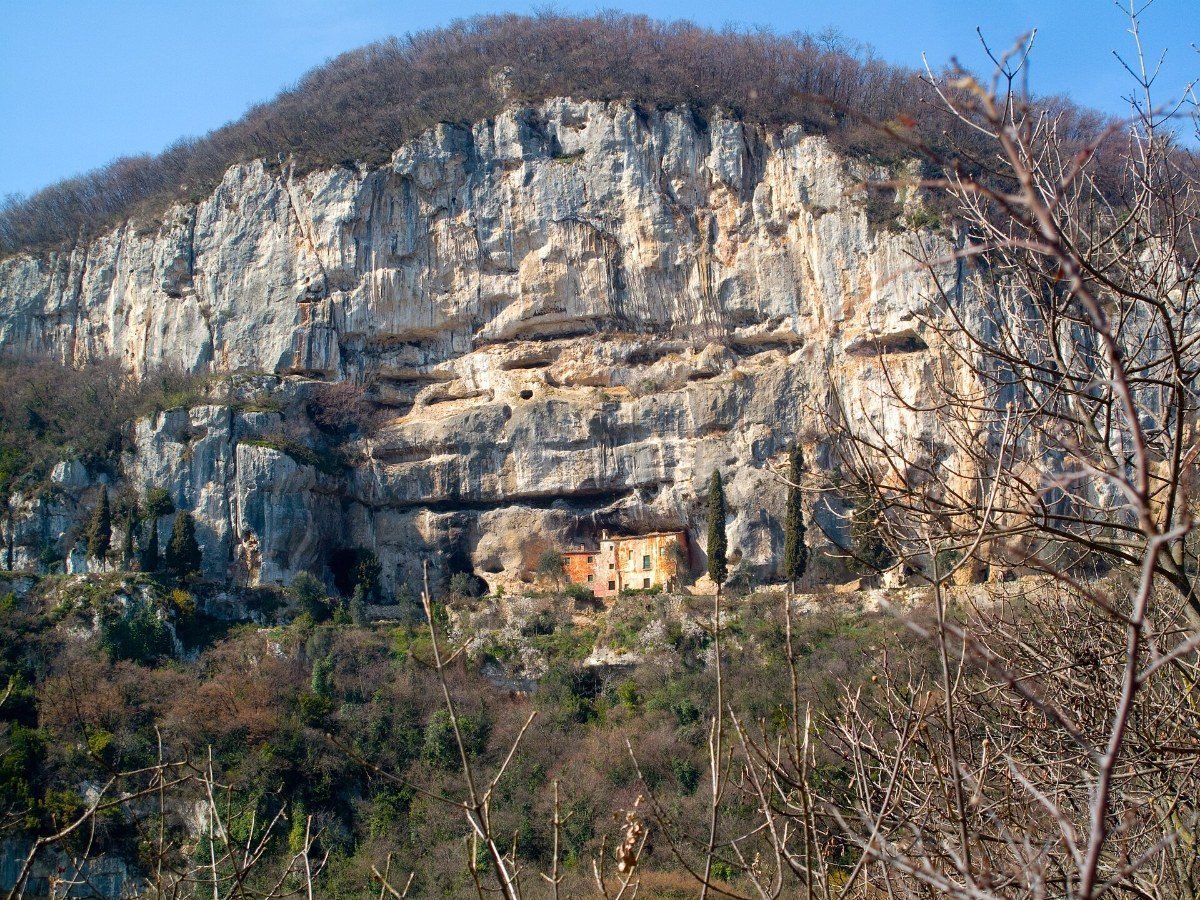
Claudio Gioseffi · CC BY-SA 4.0
Know before you go
Plan this as an archaeological landscape visit with walking on uneven ground. Contact Pro Loco Longare about the approach to Riparo del Broion, access restrictions and any organised visits before travelling. Village reference point Piazza Mazzaretto, Lumignano. Surrounding walking route Sentiero delle Scogliere di San Cassiano, route 3. Full circuit Approximately 6.8 km, 350 m of ascent and three hours. Difficulty Medium, according to the municipal tourism website. Telephone +39 388 2508390 Email info@prolocolongare.it
About
Riparo del Broion occupies a limestone overhang on the southern slope of Monte Brosimo, in the Berici Hills. Riparo means rock shelter: the archaeological deposits lie beneath a natural projection of the cliff. The nearby Grotta del Broion is a separate cave and archaeological site, so ask specifically for Riparo del Broion when arranging a visit. Lumignano is the village base for exploring this part of the Vicenza countryside. Stone stairways climb from beside the church, and marked paths continue through woodland and along the rocky slopes. Before setting out for the shelter, contact Pro Loco Longare about the approach, current restrictions and any organised archaeological visits. Remain outside fenced or otherwise protected excavation areas.
→ A child’s tooth, preserved for almost 48,000 years
Archaeologists found the small canine during excavations in 2018. It belonged to a Neanderthal child aged approximately eleven or twelve and had been shed during life. Researchers dated the occupation to between 48,000 and 45,000 years ago, placing the child among the later Neanderthals known from Italy.
The tooth also preserved a genetic connection with Neanderthals found in what is now Belgium. Its maternal lineage links this shelter in the Vicenza hills to the wider study of Europe’s last Neanderthal populations.
→ A longer walk among cliffs and a hillside hermitage
The Sentiero delle Scogliere di San Cassiano, marked as route 3, provides a longer circuit through the surrounding hills. The municipal tourism website lists approximately 6.8 kilometres, 350 metres of ascent and three hours, starting and finishing in Piazza Mazzaretto. On the same hillside, the Eremo di San Cassiano incorporates the remains of an early medieval church into a later building against the rock. The hermitage normally opens on the first Sunday of the month. Its visiting arrangements are separate from those of the prehistoric shelter.
→ Shell beads and red pigment, thousands of years later
Later archaeological layers, dated to approximately 44,000 to 42,400 years ago, contained shell beads, bone tools, engraved objects and red mineral pigments. The ornaments included marine shells and a pierced freshwater snail shell, evidence of considerable attention to small objects and their appearance. In 2019, the University of Ferrara described these discoveries as evidence of the earliest known Homo sapiens settlement in northern Italy. The finds concern the arrival of our own species, following the earlier Neanderthal occupation of the shelter
→ Continue with Vicenza’s archaeological collection
Back in the city, the Museo Naturalistico Archeologico, in the former Dominican convent beside Santa Corona, displays stone tools and other evidence of prehistoric life in the Vicenza area. Its collections provide a useful companion to a walk in the Berici Hills. Contact the museum about the galleries currently open and any particular Broion finds you hope to see.
Address: Contrà Santa Corona 4, Vicenza.
Telephone: +39 0444 222815.
Email: museonatarcheo@comune.vicenza.it.