The place: Creazzo
A few minutes west of central Vicenza, the flat city edge reaches the first hills of Creazzo. The old part of town occupies the higher ground; above it, cultivated plots follow a band of pale soil that local growers call terre bianche, white earth, a calcareous and sandy soil particularly suited to the town’s winter vegetable. The official cultivation plots are small and concentrated around agricultural districts such as Rampa, Rivella, Pizzamerlo and Ronchi.
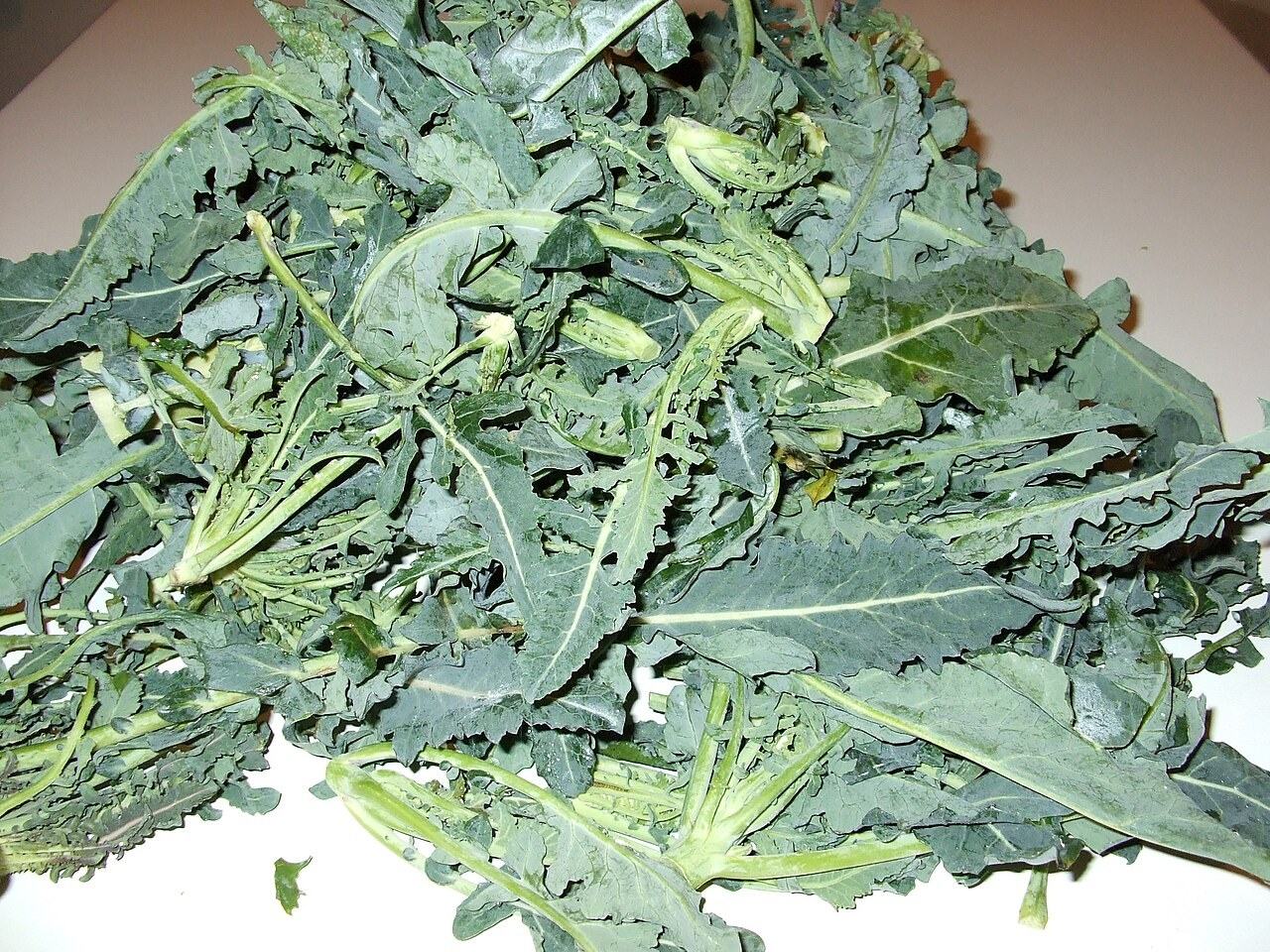
Creazzo has produced one of Italy’s best known chefs, Carlo Cracco. In winter, however, the local name to know is broccolo fiolaro di Creazzo. Its shape explains its name. Young shoots grow along the stem, and in the Venetian dialect spoken here they are fioi, children. Those shoots and the tender leaves are the prized parts in the kitchen. Growers harvest from November to February and wait for the cold: after frost, the plant concentrates sugars and its flavour becomes sweeter.
For decades this was practical winter food. In the 1960s it was still taken to market in sacare, crown shaped bundles tied with willow, at a time when fresh vegetables were far less abundant through the cold months. Its history in Creazzo is documented over several centuries, while the grand claims linking this specific local variety directly to ancient Rome are much harder to prove and are best left out of the story.
Ten kilometres to the Vicenza market
In the nineteenth century, Creazzo produced an estimated 150,000 heads of broccolo fiolaro a year, much of it bound for the markets of Vicenza. The journey was roughly ten kilometres. Growers made it on foot, with baskets suspended from a curved wooden pole, the bigòlo, balanced across the shoulders. Once in town, the vegetable had its own unmistakable appearance: sacare, large circular bundles of fiolaro tied with young willow branches, almost like green crowns. That way of selling it lasted well into the 1960s. For generations, winter fiolaro reached Vicenza through the same short route from hill fields to city market, one load at a time.
From Creazzo to Italian haute cuisine
Creazzo still cooks fiolaro in recognisably Vicentine ways. Rice soup, risotto, baked pasta, polenta, cotechino, sausage and roast pork all appeared in the January 2026 festival menus. The vegetable has enough bitterness for pork and enough sweetness after frost to work with cheese, rice and fresh pasta.
Carlo Cracco was born in Creazzo in 1965, trained with Gualtiero Marchesi, worked in France and built his career in Milan. His restaurant Cracco in Galleria currently holds one Michelin star. His relationship with fiolaro comes from home rather than from a fashionable rediscovery: local reporting records his father bringing the vegetable from Creazzo to Milan, while Cracco used it in contemporary restaurant cooking and presented it to the specialist press.
That short journey from Creazzo to Milan is only half the story.
The Japanese art of eating the season
Japan has an old expression, 初物七十五日, hatsumono shichijūgo nichi: eat the first foods of the season and you will live seventy five days longer. The promise belongs to folklore, but the importance given to season is deeply rooted. Japan’s Ministry of Agriculture uses the word shun for the period in which a food reaches its natural seasonal peak, and encourages eating according to that calendar.
Winter vegetables get particular attention. The Ministry explains that many accumulate sugars in their cells as protection against freezing, which is why spinach, cabbage and other winter greens become sweeter in cold weather. Komatsuna, the leafy brassica associated with Tokyo since the Edo period, is sweeter and more tender after frost. The biological detail could have been written in Creazzo: Veneto’s official description of fiolaro records the increase in sugars after frost and the resulting sweetness and tenderness.
Japan was interested in Creazzo long before the current wave of Italian vegetables in Japanese kitchens. A contemporary report published by Il Giornale di Vicenza in January 2003 records that Fuji Television had travelled to Creazzo the previous year specifically to film broccolo fiolaro production. The newspaper also reported interest from another Japanese broadcaster and, later that year, Japanese chefs using fiolaro with local dishes. The Fuji programme itself has not surfaced in the Japanese digital archives we searched, so the surviving evidence for that early television visit is the Italian contemporary report.
Twenty years later, Japanese sources provide far more detail.
From Creazzo to Saitama
Saitama borders Tokyo to the north. Japan travellers may know it through Kawagoe and its Edo period merchant streets, the bonsai nurseries of Omiya or the mountains and winter festival of Chichibu. The fiolaro trail goes instead to Sōka, an old post town on the Nikkō Kaidō associated with Matsuo Bashō’s Oku no Hosomichi, and a city whose famous senbei rice crackers still have dozens of specialist makers.
There, Chavi Pelto grows broccolo fiolaro for Japanese chef Kazuhiro Naoi. Chavi Pelto is an organic farm recognised by Sōka City, with its fields beside its shop and kitchen. Naoi, owner chef of the Tokyo restaurant 701, told Nisshin Seifun Welna’s professional De Cecco masterclass that the farm grows the traditional Veneto vegetable for him.
His recipe says more than any generic claim about Japanese interest in Italian food. Naoi boils the fiolaro until the leaves can be crushed into the pasta sauce, keeps the stems as pieces to bite into, and finishes casarecce with karasumi from Saga Prefecture. Veneto provides the vegetable; Japan supplies one of its great cured seafood ingredients.
A second growing season in Japan
Chef Hiroshi Koizumi takes it somewhere else again. He steams fiolaro until tender, browns it in oil and serves it with tachiuo, Japanese cutlassfish, alongside bulgur cooked with fish stock, squid ink and cumin, finished with kaffir lime cream and chrysanthemum petals. The dish has no interest in reproducing a Creazzo recipe. It treats fiolaro as a winter green with enough sweetness, bitterness and structure to work beside Japanese fish and Asian aromatics.
Saitama is no isolated experiment. A Japanese restaurant menu also identifies broccolo fiolaro grown in Marumori, Miyagi Prefecture, served with anchovy and garlic, while Japanese seed sellers now offer Broccolo Fiolaro di Creazzo seed to domestic growers, naming Creazzo and Vicenza as its place of origin.
That is the part of the story we like best. A vegetable whose season is dictated by frost on a small hill outside Vicenza has found cooks and growers in a country with its own sophisticated vocabulary for eating at the right moment of the year.
Sources
- Nisshin Seifun Welna, Pasta Master Class by De Cecco. Chef Kazuhiro Naoi explains that Chavi Pelto in Sōka, Saitama grows broccolo fiolaro for him and describes how he cooks it with karasumi from Saga Prefecture.
- Ministry of Agriculture, Forestry and Fisheries of Japan, winter vegetables and seasonality. Official material on the way winter vegetables accumulate sugars and become sweeter in cold weather.
- Ministry of Agriculture, Forestry and Fisheries of Japan, Washoku training text. Official teaching material on shun, seasonal ingredients and the expression hatsumono shichijūgo nichi.
- Discover Japan, Chavi Pelto in Sōka. Reportage on the organic urban farm where Naoi has broccolo fiolaro grown.
- Oising, interview with chef Hiroshi Koizumi. Direct documentation of fiolaro served with tachiuo, bulgur, squid ink, cumin and lime leaf.
- HUGE, official Rigoletto menu. Primary menu evidence for broccolo fiolaro grown in Marumori, Miyagi, served with anchovy and garlic.
- Gambero Rosso International, interview with Giancarlo Perbellini. On Carlo Cracco, Creazzo and the wider recognition of broccolo fiolaro in northern Italy.