Home › Places › Villas & Palaces › Palazzo Valmarana Braga
UNIQUE STAYS IN ITALY · PALLADIO · ART & PRIVATE ACCESS
Sleep in a Palladian palace, from frescoed rooms to a rooftop pigeon house
Eight historic apartments, Murano chandeliers, a monumental columned courtyard and an artist residency inside a UNESCO palace featured by The Guardian.
At Palazzo Valmarana Braga in Vicenza, sleeping inside Palladio comes with an extraordinary cast of characters. A Renaissance widow who commissioned the palace, an empress welcomed here in 1581, artists whose frescoes still decorate its rooms, and the man who restored its splendour all lend their names to eight private apartments. Choose a mezzanine overlooking the Ionic columns, rooms adorned with antique paintings and Murano chandeliers, or a former pigeon house with a rooftop terrace above Vicenza. Featured by The Guardian, this UNESCO palace offers one of Italy’s most personal encounters with Renaissance architecture.
You have saved two places. Leave your email and you will find them on any device, plus the next drop.
Andrea Palladio, CC BY-SA 3.0 via Wikimedia Commons
Know before you go
In this story: Eight Apartments Inside Palladio ↓ Choose Your Rooms and Your View ↓ The Courtyard and the Grand Staircase ↓ Frescoes, Murano Chandeliers and the Piano Nobile ↓ An Artist Residency Inside a Renaissance Palace ↓ The Secret Underground Rooms ↓ Have the Palace to Yourself for an Occasion ↓ The Woman Who Commissioned Palladio ↓ Plan Your Stay ↓
EIGHT APARTMENTS INSIDE PALLADIO
Palazzo Valmarana Braga offers one of the more unusual historic stays in Italy: the opportunity to make a Renaissance palace designed by Andrea Palladio your address in the centre of Vicenza.
When The Guardian visited in August 2024, the palace became part of its exploration of lesser known Italian destinations. The newspaper described an atmospheric stay with high ceilings, chandeliers, marble floors and frescoed interiors, placing Palazzo Valmarana among the memorable addresses of the journey. [1]
Today, eight individually named apartments occupy different levels of the historic complex. Some overlook the monumental Ionic colonnade, others the internal courtyard or Corso Fogazzaro. Two of the apartments are in the adjoining building, accessed through the palace, and offer a different relationship with its architecture. [2]
There is a genuine pleasure in this arrangement. Guests occupy a real private residence, with their own bedrooms, kitchens and living rooms, while Palladio's sixteenth century architecture remains present in the entrance, courtyard, staircases and surrounding historic spaces.
CHOOSE YOUR ROOMS AND YOUR VIEW
The eight apartments have individual characters, shaped by their position in the building.
Choosing where to sleep becomes a small way of discovering whose lives once filled its rooms. [2, 9]
Isabella remembers Isabella Nogarola Valmarana, the widow who commissioned Palladio in 1565 and whose portrait was placed on a foundation medal beneath the palace columns. Her apartment occupies the third floor, with a living room above the bedroom and windows opening towards Corso Fogazzaro. Alvise, named for her husband Giovanni Alvise Valmarana, one of Palladio's early and influential supporters, occupies the mezzanine, where the Ionic columns of the monumental entrance can be admired from the living room. [2, 9]
Their son Leonardo gives his name to an apartment overlooking the internal courtyard on the second floor. His bust still occupies a niche along the grand staircase, a particularly intimate encounter with the family before reaching the private rooms. Leonardo inherited the palace and commissioned the Valmarana Chapel at Santa Corona, another of Palladio's works in Vicenza. [2, 9]
The most illustrious guest of all arrived in 1581. Maria of Austria, daughter of Emperor Charles V, widow of Maximilian II and mother of Rudolf II, was received at Palazzo Valmarana by Leonardo, accompanied by her children Margaret and Maximilian. Her visit was important enough to be commemorated in a Latin inscription above the entrance, which survives today. Maria d'Austria, the apartment named in her honour, occupies two levels on the third floor, with a dining and living area below and bedrooms reached by an internal staircase. [2]
Art has its own place in this domestic genealogy. Zelotti e Rubini honours Battista Zelotti and Lorenzo Rubini, the artists responsible for the frescoes and gilded stuccoes of the Count's Studiolo on the ground floor. Their names now belong to a generous three bedroom apartment arranged across two levels. The original studiolo, with Aurora and the Hours painted overhead, survives elsewhere within the palace. [2, 4]
Luigi commemorates Vittor Luigi Braga Rosa, who acquired Palazzo Valmarana in 1960 and undertook its restoration. His former study has become an intimate mezzanine apartment, still adorned with his collection of prints depicting Palladian architecture. From here, the view falls towards the Ionic columns of the entrance hall, while the bedroom faces Corso Fogazzaro. A particularly appealing address for someone who would rather spend an evening with architectural drawings than another hotel television. [2, 4]
Two further residences occupy the adjoining building and are accessed through Palazzo Valmarana. The Andrea Palladio apartment brings frescoed decoration, antique paintings and Murano chandeliers into a spacious first floor residence. Above, Francesca occupies the former pigeon house, now an apartment with a large terrace overlooking the rooftops of Vicenza. The old domestic architecture has acquired a new purpose, with the city unfolding beyond its windows. [2]
Across these different floors, the palace offers an unusual intimacy with its own history: a patron's name above the street, a sculpted ancestor on the staircase, an emperor's family remembered over the entrance, a collector's engravings beside the living room, and the open sky above a former pigeon loft.
THE COURTYARD AND THE GRAND STAIRCASE
The entrance to Palazzo Valmarana is one of the pleasures of staying here.
Beyond the monumental façade on Corso Fogazzaro, the entrance opens towards an Ionic colonnade and the internal courtyard. Above the portico runs a gallery overlooking the open space below. [3]
Palladio devised an unusual arrangement for the palace. Constrained by existing buildings and the shape of the medieval street, he placed the principal reception hall parallel to the façade, where it could receive daylight from the courtyard.
The result gives the courtyard an important architectural role. Its open centre supplies light to rooms deeper within the building, while the colonnade and upper gallery create a sequence of views across different levels. [3]
The staircase adds its own company of historical figures.
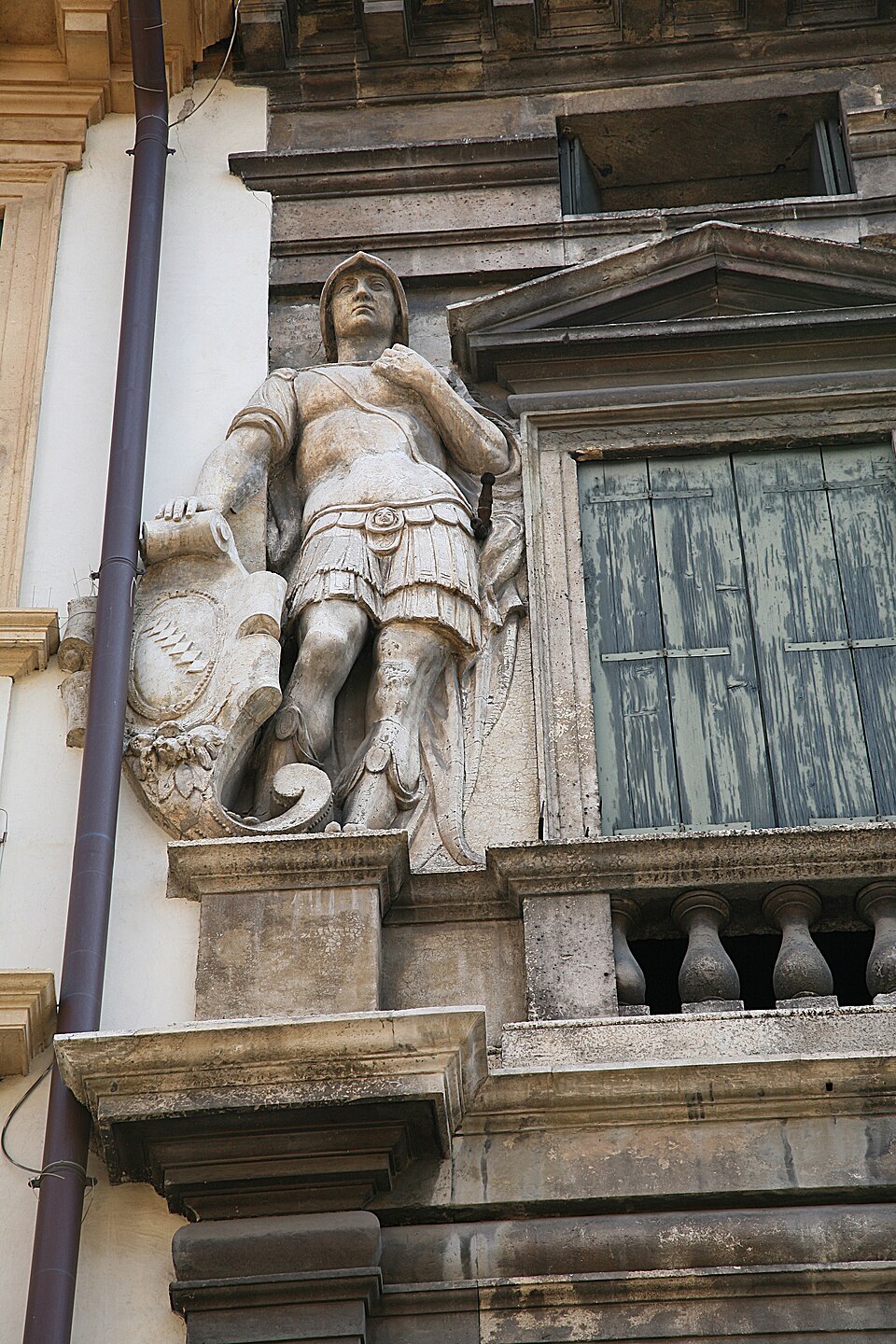
A stone statue of Fame, holding the Valmarana arms, stands in a niche near the entrance to the stairs. Traces of colour remain on its face, including the lips and eyes. Further up is the bust of Leonardo Valmarana, whose name survives in one of the apartments. [4]
These details give the common areas the character of a lived collection, assembled across generations and still part of the route into the private rooms.
FRESCOES, MURANO CHANDELIERS AND THE PIANO NOBILE
The principal reception rooms reveal a more ceremonial side of Palazzo Valmarana.
Arte Laguna Prize describes the piano nobile, the historic principal floor, with Murano chandeliers and paintings by the seventeenth century Vicentine artist Giulio Carpioni. The sequence includes the main salone and adjoining rooms, whose historic proportions and decorative finishes belong to the palace's aristocratic past. [5]
Another important room is the Studiolo del Conte, a small study on the ground floor.
Its vaulted ceiling preserves frescoes attributed to Battista Zelotti, painted in 1567 and 1568, set within white and gilded stuccoes by Lorenzo Rubini. Aurora and the Hours appear in the central oval, accompanied by Venus and Adonis, Hercules, Mercury and other mythological figures. [3, 4]
It is worth distinguishing the historic reception rooms from the individually bookable apartments. Access to the piano nobile and studiolo follows the palace's own visiting and event arrangements; accommodation does not automatically include private use of every monumental interior.
For travellers interested in Renaissance interiors, Italian decorative arts and historic residences, the building offers several layers of experience within a single address.
AN ARTIST RESIDENCY INSIDE A RENAISSANCE PALACE
The artistic life of Palazzo Valmarana extends into contemporary photography.
The palace is a partner of Arte Laguna Prize, the international contemporary art competition, which has included an artist residency at Palazzo Valmarana among its special prizes. The residency programme provides accommodation, cultural visits and a final exhibition of the artist's work. [5]
In March 2025, Berlin based photographer MXPRIVÉ presented Frammenti, a solo exhibition developed during his residency in Vicenza.
His project examined the city's architecture through details of light, geometry, texture and material. Instead of monumental views, the photographs concentrated on fragments of buildings, surfaces and architectural relationships that might otherwise escape attention. [6]
This gives Palazzo Valmarana an interesting contemporary identity. Palladio's architecture becomes both accommodation and a subject for artistic investigation.
The palace has also hosted photography exhibitions, meetings, temporary displays and cultural presentations in its ground floor spaces.
For an art focused stay in Vicenza, this is a particularly compelling connection: a Renaissance palace that continues to participate in the city's contemporary artistic life.
THE SECRET UNDERGROUND ROOMS
Beneath the palace lies another architectural experience, opened to the public following recent restoration.
In October 2024, the UNESCO Vicenza programme announced the first public opening of Palazzo Valmarana's restored underground rooms.
The spaces extend beneath the historic complex, with vaulted chambers and brickwork laid in a herringbone pattern. Their recovery introduced a permanent exhibition dedicated to the conservation of the palace, including historic photographs, drawings, films and documents. [7]
The rooms also have a contemporary use. UNESCO identifies them as suitable for small cultural events, exhibitions and concerts.
The descent from the upper apartments to the vaulted subterranean chambers gives Palazzo Valmarana another dimension: an architectural itinerary running from the rooftop to the historic foundations.
Visits to the underground rooms require separate arrangements and may be offered by appointment or as part of scheduled guided visits.
HAVE THE PALACE TO YOURSELF FOR AN OCCASION
Palazzo Valmarana has a second form of hospitality beyond overnight accommodation.
Its historic spaces can be considered for private gatherings, cultural evenings, presentations, small receptions and special occasions. Arte Laguna Prize identifies the columned atrium and courtyard as spaces for receptions and concerts, while the ground floor includes an exhibition area arranged over two levels, measuring approximately 110 square metres. [5]
The Palladian Routes programme also confirms that selected spaces within Palazzo Valmarana Braga are available for small private events, meetings and presentations, generally during the day or until 9pm, with each proposal considered according to its format and practical requirements. [8]
A milestone birthday, a private cultural gathering, a small reception among historic architecture or an art presentation could all provide a reason to experience the palace beyond the ordinary museum visit.
The distinction between reserving an apartment and arranging private use of a historic room is important. The accommodation is offered as residential lodging, while private events require separate approval and arrangements.
A full palace buyout, use of the piano nobile for a large celebration, or exclusive access to every apartment and historic space must be confirmed directly with the management.
THE WOMAN WHO COMMISSIONED PALLADIO
One of the palace's most appealing details concerns the person who brought it into existence.
In December 1565, Isabella Nogarola Valmarana, widow of Giovanni Alvise Valmarana, signed the building contracts for the family's new residence.
Her portrait was placed on a commemorative foundation medal dated 1566, later discovered beneath one of the entrance columns. The Palladio Museum confirms both the medal and Isabella's role as the formal commissioner of the palace. [9]
The building's monumental façade, with six giant Composite pilasters extending across its principal levels, remains one of Palladio's most ambitious experiments in urban architecture.
The Valmarana family also commissioned other works from Palladio, including the country villa at Lisiera and the private family chapel in Santa Corona.
A stay at Palazzo Valmarana therefore begins an architectural itinerary that can continue through three distinct expressions of the family's life in Vicenza: an urban residence, a country estate and a private chapel.
WHY CONSIDER PALAZZO VALMARANA AMONG ITALY'S UNIQUE HISTORIC STAYS?
Palazzo Valmarana Braga combines several experiences that are usually encountered at separate addresses.
Guests can sleep in apartments within a UNESCO Palladian palace, look out towards a Renaissance colonnade or an internal courtyard, choose rooms decorated with historic prints and furnishings, or stay in a former pigeon house with a terrace above Vicenza.
The building also offers access, according to visiting arrangements, to frescoed historic rooms, an art programme linked to international artist residencies and restored underground spaces used for exhibitions and small cultural events.
The Guardian's account of staying here gives the accommodation independent international recognition. Its architectural pedigree is established by the Palladio Museum and UNESCO, while Arte Laguna Prize documents a continuing role in contemporary artistic production. [1, 3, 5, 9]
CAN YOU STAY INSIDE A PALLADIAN PALACE IN VICENZA?
Yes. Palazzo Valmarana Braga offers eight individually named apartments within its historic complex. Most occupy different levels of the palace itself, while the Andrea Palladio and Francesca apartments are in the adjoining building and accessed through the palace. [2]
CAN YOU RESERVE PALAZZO VALMARANA FOR A PRIVATE OCCASION?
Selected historic spaces can be used for small private events, receptions, presentations and cultural gatherings by arrangement. The palace's residential apartments and historic event spaces have separate conditions. Exclusive use of the complete complex has to be discussed directly with the management. [5, 8] The historic atrium and courtyard have public visiting arrangements, while access to the piano nobile, frescoed rooms and restored underground spaces follows specific opening dates or advance reservations. [10]
Apartments can be booked individually for private stays. For cultural events, exhibitions or private use, contact the palace directly to confirm available spaces and conditions.