Home › Places › Villas & Palaces › Villa La Rotonda
HIDDEN ITALY · SECRET ROOMS & UNDERGROUND TOURS
A secret passage, four hidden spiral staircases and a monumental kitchen beneath a Palladian masterpiece
The secret underground tour of a Palladian masterpiece that helped shape England's country houses.
Before Chiswick House, Mereworth Castle and Stourhead, there was an Italian Renaissance villa whose architecture would influence generations of English country houses [1, 2, 3, 7]. Its hidden world is equally fascinating: four spiral staircases, a vaulted passage, a monumental kitchen and an ingenious cooling device concealed beneath a frescoed dome [9]. In Vicenza, Italy, a special 90 minute guided tour opens the basement of Andrea Palladio's Villa La Rotonda, one of Europe's most influential Renaissance houses and part of a UNESCO World Heritage site [4, 10, 11].
You have saved two places. Leave your email and you will find them on any device, plus the next drop.
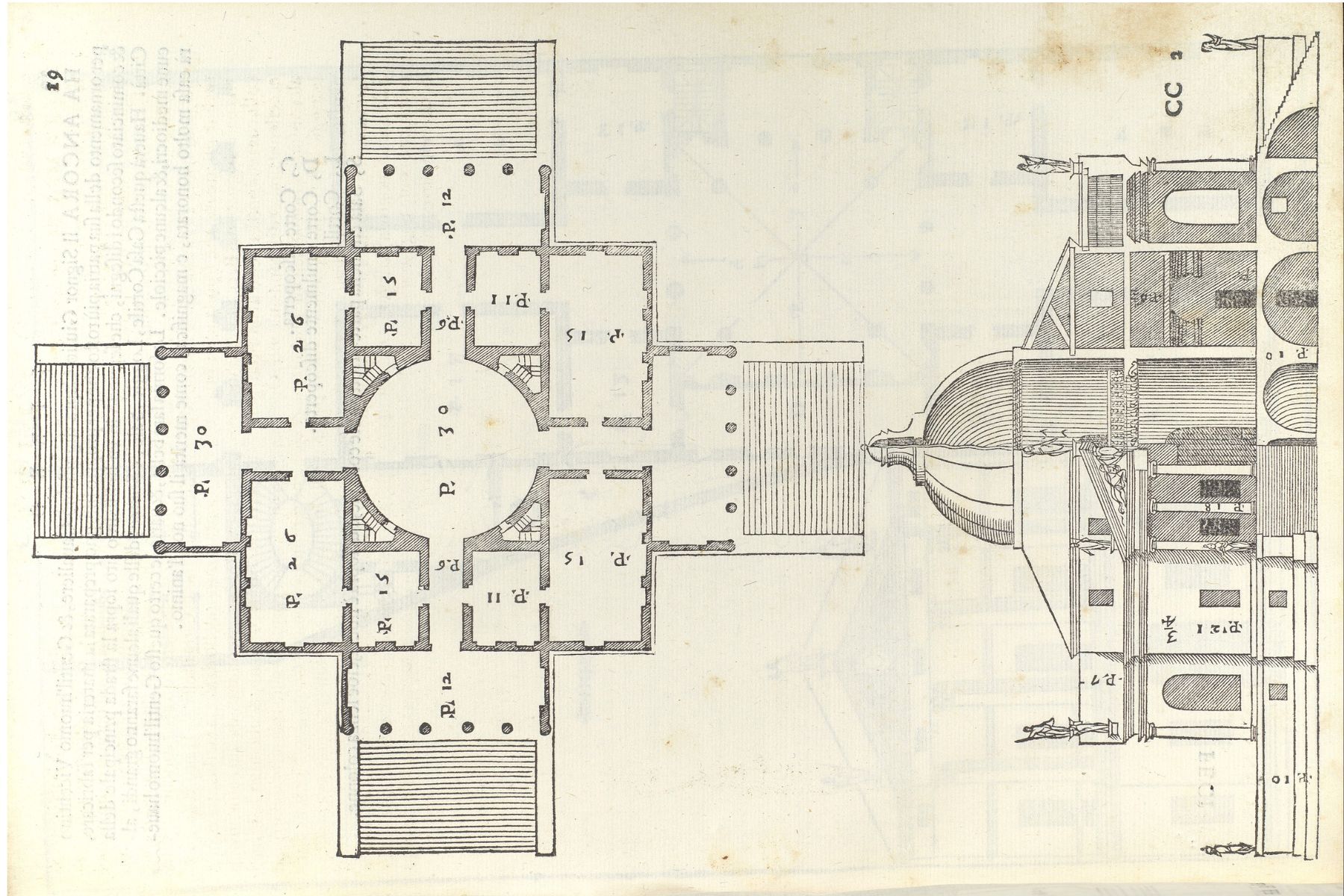
Author: Andrea Palladio (Italian, Padua 1508–1580 Vicenza) Illustrator: Christoph Krieger (German, born Nuremberg, died Venice, ca. 1590) Illustrator: Johann Chrieger (German, active 16th century) Publisher: Dominico de' Franceschi (Italian, active 1557–86)
Know before you go
In this story: The Underground Tour ↓ Four Staircases and a Secret Passage ↓ A Renaissance Air Conditioner ↓ The Monumental Kitchen ↓ The Italian Origins of the English Country House ↓ Book the Underground Tour ↓
THE UNDERGROUND TOUR ↓
The famous dome is only half the story.
Designed in 1566 for Paolo Almerico, a former member of the papal court who had returned to Vicenza, Villa La Rotonda became one of the most influential private residences in European architectural history [1, 4, 8]. Its four temple fronts, circular hall and mathematical proportions helped establish a model that would travel from Renaissance Italy to the great country houses of Britain [1, 2].
The Metropolitan Museum of Art identifies La Rotonda as an inspiration for Chiswick House, while its account of neoclassical architecture documents the direct architectural relationship with Mereworth Castle. Historic England also identifies Stourhead as an important Palladian country house [1, 2, 7]. Architectural Digest features Villa La Rotonda in its examination of neoclassical architecture and Palladio's enduring influence on Western design [6].
But behind the building's celebrated symmetry is another story, involving cooking, domestic service, concealed circulation and a surprisingly sophisticated way of cooling a house during an Italian summer [9].
The official guided visit, The Secrets of La Rotonda, includes the gardens, the grand Piano Nobile and the basement with its monumental kitchen [10, 11]. Over 90 minutes, the familiar Renaissance masterpiece acquires a different dimension, one rooted in the daily life and practical ingenuity of a 16th century residence.
FOUR STAIRCASES AND A SECRET PASSAGE ↓
La Rotonda was designed around a central circular hall, enclosed within a square. At each of the square's four corners, Palladio incorporated a narrow spiral staircase connecting the different floors, including the mezzanine and attic [9].
These staircases served an architectural purpose beyond circulation. According to the villa's official historical description, their masonry also contributes to the structural support of the building [9].
At ground level, a vaulted passage beneath the great external staircases provides direct access from the garden to the service rooms. This lower floor has cross vaulted ceilings and contains the historic kitchen [9].
The arrangement reveals how Palladio combined formal grandeur with the practical requirements of a private house. Above were the rooms for receiving guests, with frescoes, stucco decoration and views in four directions. Below were the rooms associated with food preparation and the daily running of the residence [5, 9].
The spiral staircases, vaulted access and service rooms are documented architectural features. Access to individual staircases during a guided visit should be confirmed with the villa.
A RENAISSANCE AIR CONDITIONER ↓
One of La Rotonda's most curious architectural details is a carved stone face set into the floor of its famous central hall [9].
The stone mask is pierced with openings connecting the Piano Nobile to the lower level. Its purpose was surprisingly practical: cooler air from below could rise into the hall during the summer months [9].
High above, the dome culminates in a lantern through which daylight enters the great circular room. Below, the perforated stone connects that ceremonial space with the service floor. The arrangement forms a vertical relationship between the different levels of the house, combining architectural geometry with an early approach to passive cooling [9].
The villa's official architectural history identifies the perforated mask as part of its original cooling concept. It is one of the most intriguing details in a building better known for its columns, symmetrical façades and Renaissance frescoes [9].
THE MONUMENTAL KITCHEN ↓
Beneath the celebrated rooms of La Rotonda is a historic kitchen that forms the centrepiece of the special underground visit [10, 11].
The lower floor retains its brick cross vaults and domestic service spaces, offering a rare opportunity to examine the functional architecture of a famous Italian Renaissance villa [9].
The kitchen is particularly interesting because La Rotonda was conceived as a private suburban retreat rather than a conventional agricultural estate. Paolo Almerico had returned from Rome, and Palladio created a residence in which classical architecture, cultivated leisure and domestic comfort occupied the same building [5, 8].
Smarthistory, the international art history publication, describes La Rotonda as a country residence conceived with the character of a palazzo. The Palladio Museum also records that the building was originally without the agricultural annexes typical of many Veneto villas [5, 8].
That distinction makes the kitchen especially revealing. Its presence completes the portrait of an elegant private residence whose monumental architecture depended on a carefully planned domestic interior.
THE ITALIAN ORIGINS OF THE ENGLISH COUNTRY HOUSE ↓
Why does a secret underground tour in Vicenza have a connection with some of Britain's most famous historic houses?
The answer dates to the international success of Palladio's architecture.
His Four Books of Architecture, published in 1570, became one of the most influential architectural publications in Europe. In the early 18th century, a lavish English edition helped introduce his designs to a new generation of architects and patrons [1, 12].
The Metropolitan Museum of Art identifies Chiswick House, designed for the third Earl of Burlington, as an important early English adaptation inspired by La Rotonda. Its research also documents the architectural relationship between Mereworth Castle in Kent and Palladio's villa. Both houses became important expressions of English Palladianism [1, 2, 3].
The movement reached other great country estates, including Stourhead in Wiltshire, documented by Historic England as an important Palladian villa [7].
This influence reached far beyond Britain. UNESCO identifies Palladian architecture as a major force in the development of European and North American building traditions [4].
For travellers fascinated by Europe's historic country houses, Regency architecture and the elaborate domestic arrangements associated with period dramas, La Rotonda offers the chance to examine an important Renaissance precedent, including the parts of the house that rarely appear in architectural photographs.
BOOK THE UNDERGROUND TOUR ↓
THE SECRETS OF LA ROTONDA
The official special tour includes the exterior, the Piano Nobile and the basement with its monumental kitchen [10, 11].
When: Saturday at 12:00, subject to the official calendar and confirmation.
Duration: 90 minutes.
Full price: €25.
Reduced price: €15 for eligible visitors.
Language: Italian. English guided visits can be arranged by contacting the villa at least 15 days ahead, for groups of at least 10 people.
Booking: Advance reservation required. The official 2026 programme specifies a minimum of 10 participants for the scheduled Secrets tour [10, 11].
Private visits including the lower floor and monumental kitchen may also be arranged directly with the property [10].
GOOD TO KNOW BEFORE YOU GO
The standard admission ticket covers the gardens, the Piano Nobile and the 19th century Romantic Grove. For access to the monumental kitchen and basement, choose the Secrets guided tour or an appropriate private visit [10].
Villa La Rotonda is at Via della Rotonda 45, Vicenza, Italy [8]. The interiors are not accessible to wheelchair users because of the historic staircases [10]. Always confirm the date, language and access arrangements with the property before travelling.
FREQUENTLY ASKED QUESTIONS
Can you visit the underground rooms of Villa La Rotonda?
Yes. The official Secrets of La Rotonda guided tour includes the basement and monumental kitchen, with advance booking [10, 11].
Does Villa La Rotonda have secret passages?
The building contains a vaulted passage beneath the external staircases and four internal spiral staircases connecting its levels [9]. These are documented architectural features.
How did Palladio cool Villa La Rotonda?
A perforated stone mask in the central hall allowed cooler air from the lower floor to rise into the Piano Nobile. The villa's official history identifies it as a Renaissance cooling device [9].
Which English country houses were inspired by Villa La Rotonda?
Chiswick House and Mereworth Castle have documented architectural links to La Rotonda through the Metropolitan Museum of Art. Stourhead belongs to the broader English Palladian country house tradition [1, 2, 3, 7].
Can you book the underground tour in English?
English language guided visits require advance arrangements with Villa La Rotonda. The official website requests at least 15 days' notice and a minimum group of 10 people [10].
Sources
- The Metropolitan Museum of Art · The Idea and Invention of the Villa
- The Metropolitan Museum of Art · The Neoclassical Temple
- Chiswick House & Gardens · Design and Gardens
- UNESCO World Heritage Centre · City of Vicenza and the Palladian Villas of the Veneto
- Smarthistory · Andrea Palladio, La Rotonda
- Architectural Digest · Neoclassical Architecture: Everything You Need to Know
- Historic England · Stourhead House, Stourton with Gasper
- Palladio Museum · Villa Almerico Capra detta La Rotonda
- Villa La Rotonda · The Villa
- Villa La Rotonda · Visits and Tickets
- Villa La Rotonda · Modalità di visita 2026
- The Metropolitan Museum of Art · Villa Rotunda, The Architecture of A. Palladio in Four Books