Home › Places › Villas & Palaces › Villa Valmarana Bressan
PALLADIO'S EARLY WORK · LIGHT & INTERIORS · PRIVATE EXPERIENCES
Dine in Palladio’s Early Renaissance Villa, Among Twelve Roman Emperors
A private dinner among painted Roman emperors
A private dinner beneath twelve painted Roman emperors, with daylight entering through Palladio’s great arched opening and candlelight taking its place after dusk. At Villa Valmarana Bressan in Vicenza, the architect’s experiments of 1542 are still part of the experience: a Doric serliana, rooms inspired by Roman baths, and frescoed interiors that can be reserved for a personal occasion. One of the earliest surviving expressions of Palladio’s architectural language is also a place to spend an evening entirely your own.
You have saved two places. Leave your email and you will find them on any device, plus the next drop.
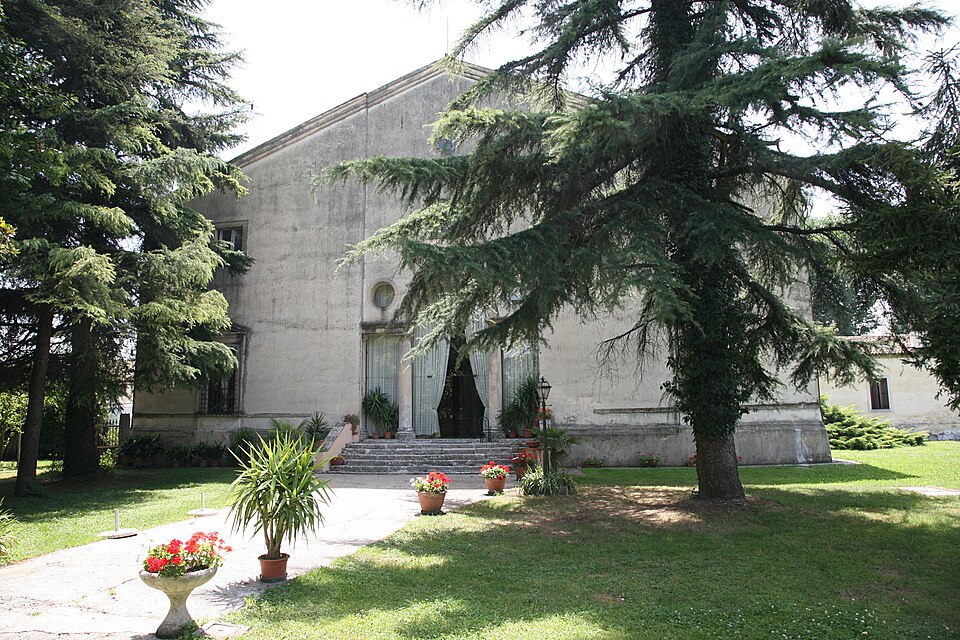
Hans A. Rosbach, CC BY-SA 3.0 via Wikimedia Commons
Know before you go
Private visits and events eventi@villavalmaranabressan.it +39 348 266 1188
In this story: Dinner in Palladio's Serliana ↓ Twelve Roman Emperors and Four Mysterious Ladies ↓ The Young Palladio's Laboratory ↓ The Architecture of Natural Light ↓ Two Families, One Shared Loggia ↓ Joseph and the Seven Years of Famine ↓ Palladio's Original Drawing in London ↓ Visit & Private Access ↓
DINNER IN PALLADIO'S SERLIANA
At Villa Valmarana Bressan, an evening can begin beneath one of the earliest architectural experiments of Andrea Palladio.
The great Doric serliana, a central arch flanked by two lower rectangular openings, gives the villa its distinctive northern façade. Beyond it lies the Loggia dei Cesari, whose walls are populated by twelve Roman emperors painted in the likeness of ancient statues. [1, 3]
The room can be reserved for private dining and personal occasions. During the day, natural light enters through the glazed arches. In the evening, candelabra bring a different atmosphere to the painted architecture, with the Roman figures remaining part of the gathering. [6]
A long dinner, an important birthday, a private celebration or a cultural evening can take place inside a UNESCO villa where Renaissance architecture and eighteenth century painting remain remarkably close to domestic life.
TWELVE ROMAN EMPERORS AND FOUR MYSTERIOUS LADIES
The Loggia dei Cesari has the character of an ancient sculpture gallery, although its imperial company is entirely painted.
Twelve Roman rulers occupy illusionistic niches in ochre monochrome, dressed in elaborate classical costumes and holding symbols of command. Their inspiration comes from The Twelve Caesars, the biographies of Rome's early emperors written by Suetonius. [4, 5]
Above the doorways, four elegantly dressed women introduce a different note to the room. Art historian Valentina Casarotto has suggested that they might portray Barbara, Vittoria, Beatrice and Giustina, daughters of Antonio Valmarana. The identification remains a hypothesis, giving the portraits an appealing element of mystery. [5]
The paintings belong to the eighteenth century, generations after Palladio designed the house. Their theatrical character adds another period of Venetian aristocratic taste to the severe Renaissance architecture beneath them.
THE YOUNG PALLADIO'S LABORATORY
Villa Valmarana belongs to the moment when Palladio was beginning to develop the architectural language that would eventually make him famous across Europe.
In 1541, he travelled to Rome with his intellectual patron Giangiorgio Trissino and encountered the vast architecture of antiquity, including the monumental spaces of Roman baths.
The following year, he designed Villa Valmarana for two cousins, Giuseppe and Antonio Valmarana, on land they had inherited together at Vigardolo, in the province of Vicenza. [1]
The Palladio Museum describes the project as one of his earliest independent experiments. Here, the proportions of traditional Vicentine houses met architectural ideas recently studied in Rome.
The villa still possesses the intimacy of a country residence. Yet its loggia, vaulted rooms and carefully proportioned interiors already announce an architect thinking far beyond the conventions of the Veneto countryside.
THE ARCHITECTURE OF NATURAL LIGHT
The serliana is the most visible expression of that experiment.
Its central arch establishes the principal opening, while two smaller lateral passages and circular openings enrich the façade. The recessed loggia creates a sequence between the garden, the open arch and the rooms beyond. [1, 3]
The Palladio Museum describes the serliana as a means of mediating between the interior and the outside world. Its significance is both architectural and experiential: daylight reaches the covered space through openings of different shapes, while the depth of the loggia creates areas of brightness and shade.
The relationship continues deeper into the house. From the square entrance hall, a narrow vestibule leads to a rectangular room opening towards the historic brolo, the orchard and kitchen garden behind the residence. [3]
There is an unusual pleasure in observing those differences during a visit: the generous light of the central arch, the more protected atmosphere beneath the loggia, and the passage into rooms with their own proportions and views.
The same serliana Palladio explored here would become one of the defining architectural motifs associated with his work, most famously in Vicenza's Basilica Palladiana. [1]
TWO FAMILIES, ONE SHARED LOGGIA
There is an intriguing domestic explanation for the villa's symmetry.
The Palladio Museum suggests that the plan may reflect the needs of the two Valmarana cousins, whose families shared the property. The bedrooms and private rooms were arranged in two almost mirrored groups, with circulation organised around a common entrance loggia and a rear hall. [1]
The arrangement offers an appealing glimpse into Renaissance country life: two households preserving their independence within a single architectural composition.
Palladio organised the lateral rooms according to carefully calculated proportions, with widths and lengths related by a ratio of 2:3:5.
Here, mathematical order served a very human purpose, allowing family life, hospitality and shared spaces to coexist within a relatively compact villa.
JOSEPH AND THE SEVEN YEARS OF FAMINE
A second painted story gives the house an unexpected connection with food, grain and the agricultural landscape of Vicenza.
In the south facing Sala del Fregio, an eighteenth century fresco cycle attributed to Costantino Pasqualotto recounts episodes from the biblical life of Joseph in Egypt. [3, 5]
Joseph famously interpreted Pharaoh's dream of seven years of abundance followed by seven years of famine. His advice was to store grain during the prosperous years, protecting the country against the coming scarcity.
It was a fitting subject for a Venetian country estate whose prosperity depended on agriculture. In the eighteenth century, additional granary space was created above the residence, while Joseph's story gave the working life of the estate a grand biblical counterpart. [5]
The former granaries were restored in 2018 and subsequently adapted for cultural use, including displays devoted to the civilisation of grain. Their present exhibition access should be confirmed before visiting.
PALLADIO'S ORIGINAL DRAWING IN LONDON
The villa has another address, on paper, in London.
The Royal Institute of British Architects preserves an original drawing by Palladio for Villa Valmarana, catalogued as XVII/2 recto in the Burlington Devonshire Collection. It includes a plan and an elevation, providing a direct comparison between the architect's intentions and the surviving building. [2]
The Palladio Museum identifies several differences. The original raised podium could not be executed as planned because of the local waterways. The proposed interrupted pediment was omitted, a mezzanine was introduced, and the loggia received a flat ceiling in place of a vault. [1]
These differences make the villa particularly rewarding for architecture enthusiasts. The drawing preserves the ambitions of a young architect, while the building reveals the conditions under which those ideas became reality.
VISIT & PRIVATE ACCESS
Villa Valmarana Bressan is part of the UNESCO World Heritage property City of Vicenza and the Palladian Villas of the Veneto.
The villa and its garden can be visited by arrangement. Private lunches, dinners, celebrations and cultural gatherings can also be organised within selected spaces, including the historic serliana. [3, 6]
For travellers looking for private experiences in Italy, historic interiors in Europe or the early architectural experiments of Andrea Palladio, the villa offers a rare opportunity to experience the relationship between Renaissance space, natural light and the social life of a historic country residence.
Can you reserve the Serliana for a private dinner?
Yes. Villa Valmarana Bressan offers private dining and events by reservation. Confirm the available rooms, catering arrangements and level of exclusivity directly with the property.
Can you stay overnight?
No public overnight accommodation programme has been confirmed for Villa Valmarana Bressan. Its principal visitor experiences are guided visits, art and architecture, and private occasions.
Sources
- Centro Internazionale di Studi di Architettura Andrea Palladio · Early Palladian experimentation, Roman baths, proportions and the serliana · Villa Valmarana Bressan, Monticello Conte Otto
- Royal Institute of British Architects, RIBA Collections · Andrea Palladio, Burlington Devonshire Collection, XVII/2 recto · Design for the Villa Valmarana, Vigardolo: plan and elevation
- Ministero della Cultura · Catalogo generale dei Beni Culturali, record 0500184340, serliana, openings and architectural composition · Villa Valmarana, Magni, Cita, Bressan
- Sito Patrimonio Mondiale UNESCO Vicenza · Roman emperors, frescoes, Joseph and the architectural history of the villa · Villa Valmarana, Monticello Conte Otto
- Valentina Casarotto · Art historical examination of the Loggia dei Cesari, four female portraits and the Joseph frescoes · Villa Valmarana Bressan, sulle tracce del giovane Palladio
- Villa Valmarana Bressan · Current private dining, candlelit events, visits and reservation conditions · La Serliana