Home › Places › Villas & Palaces › Villa da Schio
ITALIAN GARDENS · BAROQUE SCULPTURE · UNIQUE STAYS
A Baroque Garden of 35 Gods, Four Private Houses and a River Moved for Beauty
A Garden of Gods and Private Houses
An eighteenth century sculpture garden, a monumental fishpond fed by a diverted stream and four private residences within a historic Italian estate. At Villa da Schio in Castelgomberto, Vicenza, the world of Venetian country houses extends from mythological statues and centuries old avenues to private dinners, classical music and nights spent within the gardens.
You have saved two places. Leave your email and you will find them on any device, plus the next drop.
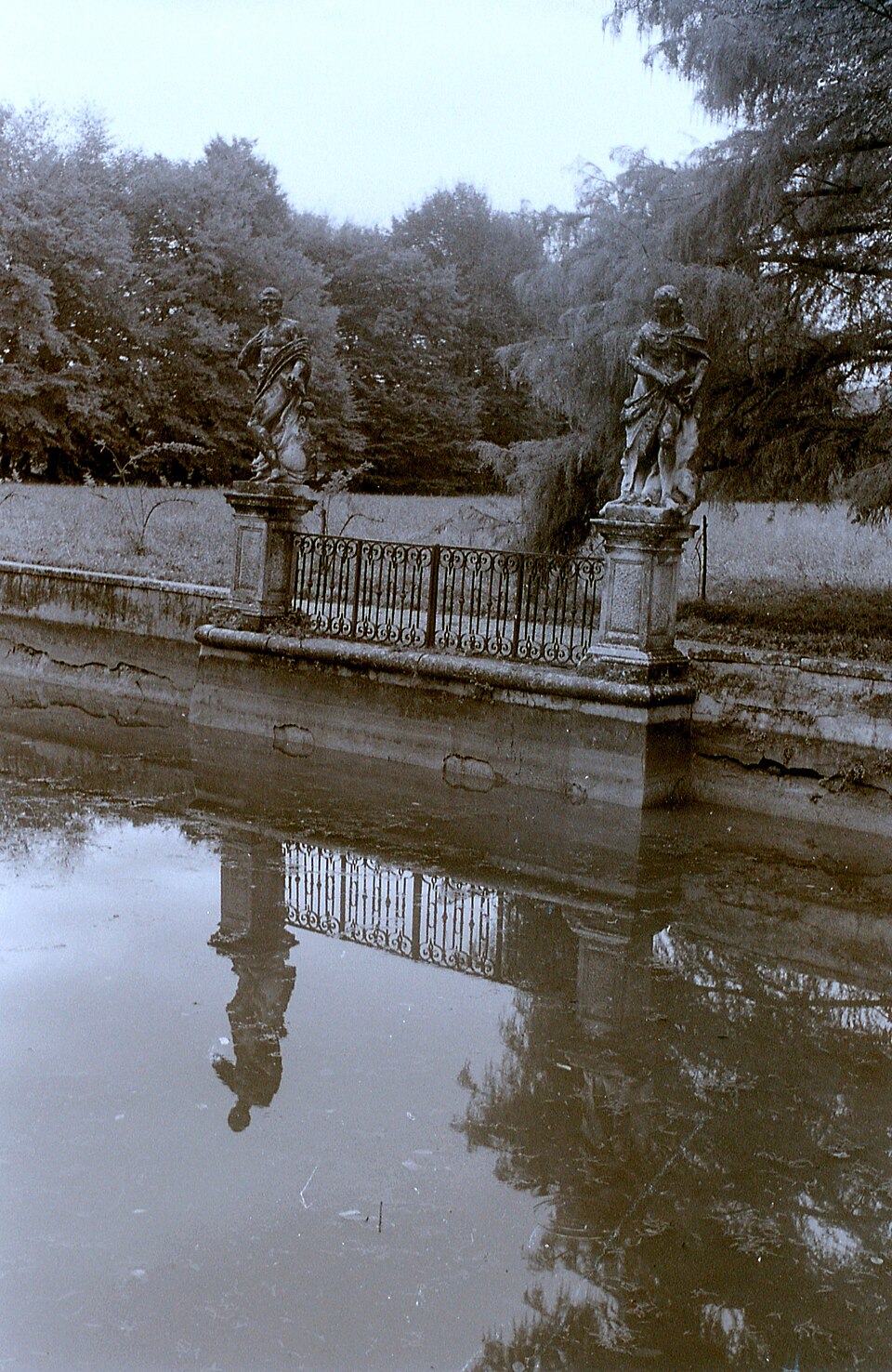
Lars (Lon) Olsson, CC BY-SA 4.0 via Wikimedia Commons
Know before you go
VISITS & PRIVATE STAYS Villa da Schio Via Villa 117, 36070 Castelgomberto, Vicenza, Italy General information and stays info@villadaschio.com +39 335 6455820 Current visitor dates, private accommodation and event conditions are provided directly by the estate.
In this story: The River Moved for Beauty ↓ Thirty Five Figures in the Garden ↓ Four Private Houses Among the Trees ↓ The Courtyard, the Silk Room and the Billiards ↓ Make the Estate Your Own ↓ Two Ways of Looking at Water ↓ Music Among the Statues ↓ The Chapel with a Medieval Past ↓ Plan Your Visit ↓
THE RIVER MOVED FOR BEAUTY
At Villa da Schio, the garden was important enough to change the course of a river.
In the seventeenth century, the Piovene family diverted the Poscola stream to make room for the landscape they wanted to create. The decision is documented by the Associazione Dimore Storiche Italiane and the Veneto Region, both of which describe the monumental fishpond and its relationship with the diverted watercourse. [1, 2]
The resulting garden developed around a vast stone peschiera, a historic basin that served as both a reservoir for agricultural irrigation and an architectural composition in water. Sculptures stood beside its edges, while long avenues and terraces drew the eye towards the countryside beyond.
Even the house had to negotiate with nature. Construction originally began closer to the road, but flooding from the nearby Agno forced the project to move to higher ground. The present complex was developed from 1656, following a design attributed to Antonio Pizzocaro for the Piovene family. [1, 3]
The architect's name is worth remembering. Pizzocaro worked within the Palladian tradition, yet Villa da Schio belongs to the seventeenth century, with a much more theatrical treatment of courtyards, gardens, sculpture and water.
THIRTY FIVE FIGURES IN THE GARDEN
The great pleasure of the park is the company it keeps.
Thirty five statues attributed to the workshop of Orazio Marinali, the celebrated sculptor from Bassano del Grappa, populate the landscape with biblical, mythological and allegorical figures. The sculptural ensemble is documented by ADSI, the Veneto Region and the architects responsible for the estate's conservation. [1, 2, 3]
The figures are distributed around the formal garden, the peschiera and the belvederes, or raised viewing terraces.
Three great avenues of lime and hornbeam trees organise the landscape into long perspectives. At their ends, the view opens across the surrounding fields. Closer to the façade, clipped box hedges and lemon trees establish the more intimate geometry of the Italian garden.
The pleasure is in moving between these different scales: a sculpted figure emerging beside the water, the clipped geometry of the parterre, the shade of mature trees and the agricultural countryside beyond the garden's formal boundaries.
This is one of the less familiar historic sculpture gardens in the province of Vicenza, where eighteenth century Venetian garden culture can be experienced through its original relationship with water, agricultural land and a noble country residence.
FOUR PRIVATE HOUSES AMONG THE TREES
Villa da Schio has a second attraction beyond the gardens: four individual residences within the historic complex, each offering a different way to spend time on the estate. [4]
The Courtyard occupies the noble courtyard, the architectural centre of the villa's domestic life. A studio residence arranged over two levels, it has a generous living and study area, a private kitchen and an upstairs sleeping space for two. The courtyard's colonnades and fountain give this small residence a particularly intimate position within the monumental complex.
La Peschiera takes its name from the great historic water basin that defines the garden. The residence stands within the park and occupies approximately 120 square metres across two levels. Terracotta floors, exposed timber beams, a kitchen with a fireplace, separate living and dining rooms and a veranda give it the character of a private Italian country house. It accommodates four guests.
Ca' Fosca is arranged over three floors, with a sitting room and fireplace, kitchen, three bedrooms and two bathrooms. Terracotta downstairs and wooden bedroom floors preserve the material character of the old estate buildings. The residence accommodates six guests.
Il Cedro, named for the cedar, rises through three levels. A sitting room with fireplace occupies the ground floor, while wooden staircases lead to the principal bedroom and a second bedroom beneath the roof. Exposed beams and an attic room give the house its particular character. It accommodates four guests. [4]
These are independent private residences within the estate, rather than guestrooms in the principal seventeenth century villa. Their importance lies in that distinction. The visitor has a house of their own, while the monumental architecture and historic landscape remain part of the address.
For travellers comparing unique stays in Italy, the attraction is unusually complete: a private residence within a historic Venetian estate, with Baroque sculpture, water, gardens and cultural life close at hand. Access to individual parts of the monumental house and park follows the property's arrangements and should be confirmed when booking.
THE COURTYARD, THE SILK ROOM AND THE BILLIARDS
The interiors give Villa da Schio another character, away from the long avenues and monumental peschiera.
The quadrangular courtyard is enclosed by porticoes on three sides, while the fourth is formed by the principal residence. At its centre stands a fountain within a circular planted area, with the colonnades creating an almost cloister like architectural composition. [5]
The historic rooms have names that invite curiosity: the Silk Room, the Tapestry Room, the Fireplace Room, the Billiard Room, the dining room and the large upper hall.
The Silk Room measures approximately 56 square metres, while the principal and upper halls each extend to about 105 square metres. The scale belongs to a residence designed for receiving guests, gatherings and the social rituals of a landed family. [5]
The villa has retained historic furnishings, and selected rooms can be experienced during special guided visits or private events. Regular garden admission should not be understood as unrestricted access to these interiors.
MAKE THE ESTATE YOUR OWN
Beyond the individual residences, Villa da Schio can be reserved for private occasions.
The distinction is particularly appealing for a personal celebration: the setting can move from a seventeenth century colonnaded courtyard to the formal Italian garden, the monumental fishpond or one of the historic interior rooms. [5]
A birthday dinner, family gathering, private musical evening, anniversary, art presentation or cultural celebration can be imagined around spaces with entirely different characters.
The courtyard has its fountain and surrounding portico. The larger rooms offer historic interiors for more intimate gatherings. Outside, the long avenues and formal garden give the occasion a relationship with the landscape that few conventional event venues can reproduce.
Villa da Schio also hosts legally recognised civil marriage ceremonies, although the estate's appeal extends considerably beyond that single use. [5]
For travellers researching private historic estates in Italy, the useful possibility is combining residential accommodation with the use of selected monumental spaces. The four houses, historic interiors and gardens have separate arrangements; exclusive use of the entire complex, including all residences, must be agreed directly with the property.
TWO WAYS OF LOOKING AT WATER
The historic peschiera now has a contemporary companion.
The restoration of Villa da Schio's park, developed through Italy's PNRR programme for historic parks and gardens, introduced a new natural pond designed to enrich biodiversity within the estate. The project was developed by architect Giacomo di Thiene of Th&Ma Architettura, with landscape architect Pamela Nichele and specialist Vera Luciani. [3, 6]
The biopond occupies 91 square metres. Part of the basin is devoted to aquatic plants that filter the water naturally, including yellow iris, sedges, purple loosestrife, water lilies and rushes. [6]
The distinction between the two bodies of water is fascinating.
The original peschiera was designed for irrigation, perspective and the pleasure of an eighteenth century landscape. The new biopond belongs to a contemporary understanding of garden ecology, where water supports plant life, pollinators and small aquatic habitats.
The restoration also recovered historic avenues, belvederes, sections of the portico and the collection of potted lemon trees. [3]
Visitors can therefore read several centuries of landscape design in the same grounds: Baroque sculpture, agricultural water management, formal garden geometry and a new botanical intervention.
MUSIC AMONG THE STATUES
The garden has a cultural life that continues beyond ordinary visiting hours.
Villa da Schio belongs to the network of Le Dimore del Quartetto, which connects historic residences with classical music and young professional ensembles. The villa has also participated in the European cultural project MERITA, which recognises the historic house as a place for music and artistic exchange. [7, 8]
The park's avenues, broad lawns and architectural backdrop have been used for performances and concerts, allowing music to become part of the historic setting.
During 2026, the programme included performances featuring Mozart, Beethoven and Salieri, alongside the Design in Villa festival, bringing contemporary design into some of Veneto's historic houses. [9]
The calendar changes from one edition to the next, with performances and special openings announced separately.
THE CHAPEL WITH A MEDIEVAL PAST
Within the villa complex stands a chapel dedicated to Saint Mary Magdalene, whose history reaches much further back than the Baroque residence.
Local historical documentation traces its origins to 1296, when Bellancio da Castelgomberto, associated with the Knights Gaudenti, received permission to establish a chapel. The building later passed to the Piovene family and was reconstructed after falling into ruin. [5]
The surviving chapel belongs to the architectural composition of the villa, close to the courtyards and agricultural buildings. It is included in certain special guided visits.
It is another reminder that Villa da Schio was assembled across centuries, with domestic, religious, agricultural and ornamental spaces sharing the same estate.
FAQ
WHY VISIT VILLA DA SCHIO IN VICENZA?
Villa da Schio brings several experiences together in one historic address: an eighteenth century garden with thirty five biblical and mythological sculptures, a monumental water basin fed by a diverted stream, four private residences, Baroque interiors, classical music and a recently restored botanical landscape.
The historic park is open for visits on selected dates, while stays and private use are arranged separately.
For travellers interested in the best historic gardens in Italy, unusual places to stay in Europe or privately experienced Italian country houses, Villa da Schio offers the chance to encounter an estate through more than its façade.
CAN YOU STAY AT VILLA DA SCHIO?
Yes. Four individually furnished residences are available within the historic complex: The Courtyard for two guests, La Peschiera for four, Ca' Fosca for six and Il Cedro for four. Each has its own domestic facilities and is booked separately. [4]
CAN YOU VISIT THE GARDEN WITHOUT STAYING OVERNIGHT?
Yes. The historic park offers visits on selected dates during the season, including independent walks without a guide when scheduled. Special guided visits may also include the interiors and chapel. Advance reservation is required. [9]
CAN VILLA DA SCHIO BE RESERVED FOR A PRIVATE OCCASION?
Yes. The estate offers selected historic rooms, courtyards and gardens for private events, cultural gatherings, concerts and legally recognised civil marriage ceremonies. Complete exclusivity of the estate and the four residences must be confirmed directly. [5]
Sources
- Associazione Dimore Storiche Italiane · History of the Piovene estate, diversion of the Poscola and Marinali sculpture · Villa da Schio, Castelgomberto
- Regione del Veneto · Villa Veneta, IRVV A0500001440, gardens, fishpond, sculpture and historic watercourse · Villa da Schio
- Th&Ma Architettura · Giacomo di Thiene, conservation, original architectural composition and historic landscape · Villa Piovene da Schio in Castelgomberto
- Villa da Schio · Four private residences, interiors, room arrangements and capacities · Hospitality, Courtyard, La Peschiera, Ca' Fosca and Il Cedro
- Villa da Schio · Historic rooms, private events, gardens and medieval chapel · The Abode and Events
- Vera Luciani, Luciani Biolaghi · 11 March 2026, 91 square metre biopond, botanical planting and natural water filtration · Biopond in the Eighteenth Century Park of Villa da Schio
- Le Dimore del Quartetto · Historical estate, landscape and classical music programme · Villa da Schio, Castelgomberto
- MERITA European Cultural Project · Historic houses, preservation and chamber music in an international European network · Villa da Schio
- Villa da Schio · 2026 visiting calendar, concerts, garden activities and special openings · News and Visits