Home › Places › Villas & Palaces › Villa Thiene
PALLADIO · GIULIO ROMANO · RENAISSANCE FRESCOES
The Palladian villa with a façade 90 degrees from the original design
a façade redesigned centuries later, and a painted world of Greek mythology, Amazons and ancient Rome.
A Palladian villa whose main façade changed direction by 90 degrees, with Renaissance ceilings depicting the survivors of the Greek flood, Amazons and Roman legends. In Quinto Vicentino, the unfinished Villa Thiene brings together Giulio Romano, Andrea Palladio and Giovanni Demio, and its historic rooms still play a part in civic life, including civil marriage ceremonies. The municipality officially permits civil marriage ceremonies at Villa Thiene.
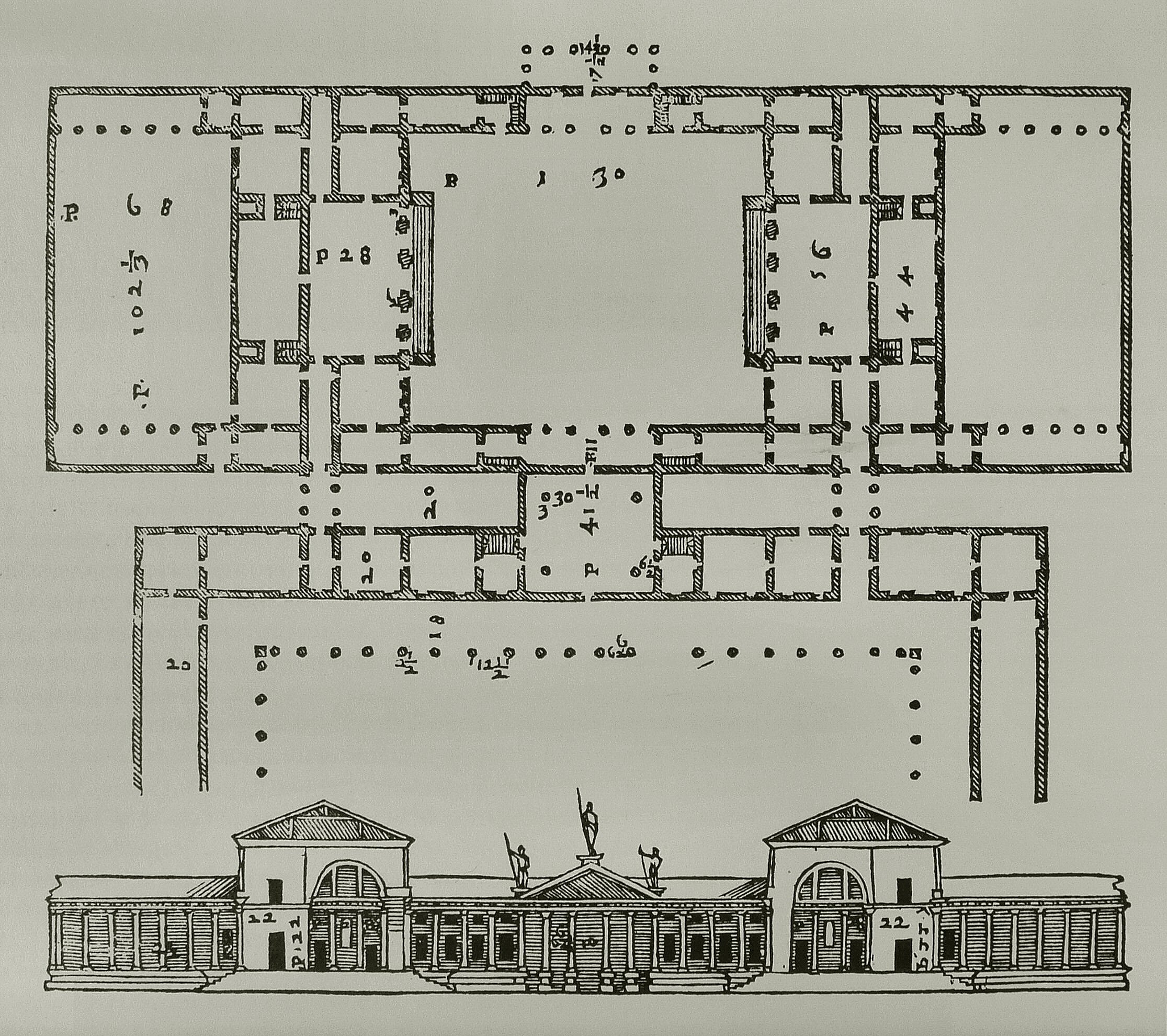
Andrea Palladio, I Quattro Libri dell’Architettura, 1570 · Wikimedia Commons · Public Domain
Know before you go
Villa Thiene is both a UNESCO monument and the town hall. The fresco rooms have free weekday access, while a fuller visit should be arranged with the Culture Office.
In this story: The Villa That Changed Direction ↓ Giulio Romano and Palladio ↓ The Greek Flood on the Ceiling ↓ Amazons and Roman Legends ↓ A Civil Ceremony Inside a Renaissance Villa ↓ Art and Opera in the Park ↓ Plan Your Visit ↓
THE VILLA THAT CHANGED DIRECTION
Villa Thiene has one of the strangest architectural histories among the UNESCO Palladian villas of Vicenza. Its original project was never completed, and the façade visitors see today faces a different direction from the one envisaged in the sixteenth century.
The Palladio Museum documents the decisive alteration. Before 1740, architect Francesco Muttoni removed the great loggia and created a new principal façade towards the south. What had originally been the sides of the building became its main elevations, effectively changing the architectural orientation by ninety degrees. [1]
The earlier project had been ambitious. A vast barrel vaulted loggia would have dominated the house, with agricultural courts extending to either side. Palladio published the design in I Quattro Libri dell’Architettura in 1570, although much of it remained unbuilt. [1]
In 1614, the English architect Inigo Jones recorded the unfinished state of the building in his annotated copy of Palladio’s treatise. The house had already become part of the architectural conversation between Italy and England long before Muttoni altered its appearance. [1]
For anyone interested in Italian Renaissance architecture, the pleasure is unusually visual: compare Palladio’s published engraving with the surviving villa and see how much of the original ambition remained on paper.
GIULIO ROMANO AND PALLADIO
There is another reason Villa Thiene deserves attention beyond the conventional Palladio itinerary.
The Palladio Museum and Treccani identify Giulio Romano, Raphael’s former pupil and the architect of Palazzo Te in Mantua, as the probable author of the original project. Andrea Palladio was involved in its execution and development. [1, 2]
The commission belonged to Marcantonio and Adriano Thiene, members of a powerful Vicentine family simultaneously developing an ambitious urban palace and a large country estate.
Treccani places these commissions within a period of intense political rivalry among Vicenza’s aristocratic families. Architecture served as an expression of family prestige and public ambition. The Thiene projects were conceived on a scale that matched those aspirations. [2]
Construction at Quinto stopped during the 1550s. The brothers’ deaths and the movement of family interests towards other estates contributed to the abandonment of the larger plan. The surviving villa therefore preserves an unusually tangible encounter between two major Renaissance architects and the ambitions of their patrons. [1]
THE GREEK FLOOD ON THE CEILING
The most unexpected story at Villa Thiene unfolds overhead.
A vaulted room preserves frescoes by Giovanni Demio, a painter born in Schio, in the province of Vicenza, whose work belongs to one of the most inventive strands of Italian Mannerism.
At the centre is Deucalion and Pyrrha, the couple who survived the great flood in Greek mythology. According to the story recounted by Ovid in his Metamorphoses, they repopulated the Earth by throwing stones behind them, which became new human beings. [3, 4, 5]
The subject has a distinguished international afterlife. Peter Paul Rubens painted the same myth in 1636–1637, in a work now held by Madrid’s Museo Nacional del Prado. [5]
At Villa Thiene, the story occupies the heart of a painted ceiling, with mythological scenes arranged around it. The subject belongs to a wider Renaissance fascination with antiquity, catastrophe and the origins of human life.
AMAZONS, CENTAURS AND ROMAN LEGENDS
The surrounding frescoes reward a closer look.
Giovanni Demio populated the ceiling with Hercules obtaining the belt of Hippolyta, queen of the Amazons; the abduction of the Sabine women; the battle between the Lapiths and Centaurs; and Amazons fighting in defence of Troy. [4]
These are scenes of conflict, desire, legendary heroism and violent encounters between different worlds. Figures twist across the painted surfaces, framed by architectural inventions, ornamental figures and classical motifs.
The art historian Marina Repetto Contaldo, writing for Treccani, connects Demio’s frescoes at Villa Thiene to the powerful, inventive painting of Giulio Romano at Palazzo Te. She also identifies his work at Quinto as an important expression of his individual Mannerist language. [3]
Demio’s career extended far beyond this villa. He worked as a mosaicist at St Mark’s Basilica in Venice and contributed to the decorated ceiling of the Biblioteca Marciana. Andrea Palladio himself praised him in I Quattro Libri, calling him a man of beautiful ingenuity. [3]
A CIVIL CEREMONY INSIDE A RENAISSANCE VILLA
Villa Thiene has an unusual contemporary life. The unfinished sixteenth century residence now serves as the municipal headquarters of Quinto Vicentino.
The municipality officially permits civil marriage ceremonies at Villa Thiene. The possibility is particularly appealing for a personal occasion with a strong architectural setting: a ceremony in a UNESCO Palladian villa whose historic rooms preserve centuries of artistic and civic life. [6]
The official service concerns the civil ceremony. Any additional use of the park or interior rooms, private reception or exclusive access must be discussed separately with the municipality.
For couples considering an unusual civil ceremony in Italy, the attraction lies in the place itself, its Renaissance architecture, Mannerist frescoes and the contrast between the building’s aristocratic origins and its public life today.
ART AND OPERA IN THE PARK
Villa Thiene also has a cultural life beyond its municipal function.
Its park has hosted theatrical performances and musical evenings, while the frescoed rooms have been used for exhibitions, art presentations and public cultural events.
The 2026 programme included an outdoor opera gala featuring music from Le nozze di Figaro, Don Giovanni, Rigoletto, La Traviata and Turandot. The villa also welcomed exhibitions and literary presentations, including events held inside the frescoed rooms. [7]
The programme changes seasonally. Check the municipality’s published calendar for future performances and exhibitions.
WHY VISIT VILLA THIENE IN VICENZA?
Villa Thiene offers an unusually rich combination for an Italian art and architecture itinerary: a Renaissance project associated with Giulio Romano and Palladio, a façade whose architectural orientation was changed, frescoes of Greek and Roman mythology, and an active cultural programme inside a UNESCO property.
It also provides a chance to encounter a less familiar Vicentine painter whose work connects the villa to St Mark’s Basilica, the Biblioteca Marciana, Palazzo Te and the wider history of European Mannerism. [1, 3, 8]
CAN YOU VISIT THE FRESCOES?
Villa Thiene is partly accessible because it remains a working municipal building. Visits to the historic rooms can be arranged through the Comune di Quinto Vicentino.
The visitor experience has also been developed with digital interpretation and three dimensional models, allowing details of the architecture and frescoed ceilings to be explored more closely. [9]
Confirm the available rooms, visiting arrangements and accessibility before travelling.
VISIT & CONTACTS
Villa Thiene
Piazza IV Novembre, Quinto Vicentino, Vicenza, Italy
Visits and cultural information
cultura.istruzione@comune.quintovicentino.vi.it
+39 0444 584235
Civil marriage ceremonies
demografici@comune.quintovicentino.vi.it
+39 0444 584246
Sources
- Centro Internazionale di Studi di Architettura Andrea Palladio · Giulio Romano, Palladio, Inigo Jones and the ninety degree alteration · Villa Thiene, Quinto Vicentino
- Treccani, Dizionario Biografico degli Italiani · Andrea Palladio, the Thiene commissions and Vicentine aristocratic rivalries · Andrea Palladio
- Marina Repetto Contaldo, Treccani · Dizionario Biografico degli Italiani, Volume 38, 1990 · Demio, Giovanni
- Barbara Rocco · Art historical interpretation of Giovanni Demio’s mythological frescoes · Giovanni Demio a Villa Thiene
- Museo Nacional del Prado · Peter Paul Rubens, 1636–1637, Deucalion and Pyrrha · Deucalion and Pyrrha
- Comune di Quinto Vicentino · Civil marriage ceremonies at the municipal headquarters · Matrimoni
- Comune di Quinto Vicentino · Cultural programme and outdoor opera, August 2026 · Gran Galà Lirico
- UNESCO World Heritage Centre · International significance of Palladio’s architecture · City of Vicenza and the Palladian Villas of the Veneto
- Villa Thiene, Comune di Quinto Vicentino · Current access, digital interpretation and three dimensional models · Risorse e visite