Home › Places › Gardens & parks › Cava Arcari, Vicenza
HIDDEN ARCHITECTURE IN ITALY · VICENZA
An Underground Theatre Inside a Flooded Vicenza Stone Quarry designed by David Chipperfield
A 1,880 square metre performance space in Vicenza by the 2023 Pritzker laureate
For travellers searching for the best hidden architecture in Italy or unusual cultural spaces in Europe, Cava Arcari is one of Vicenza’s strongest answers. In Zovencedo, beneath the Berici Hills, sixty years of Pietra di Vicenza extraction left megalithic limestone pillars, stepped ceilings and underground chambers filled with water. David Chipperfield Architects responded with a 1,880 square metre performance space made from the same white Vicenza stone, adding platforms, ramps and tiers to a cavern already shaped by quarrymen, geology and water.
You have saved two places. Leave your email and you will find them on any device, plus the next drop.
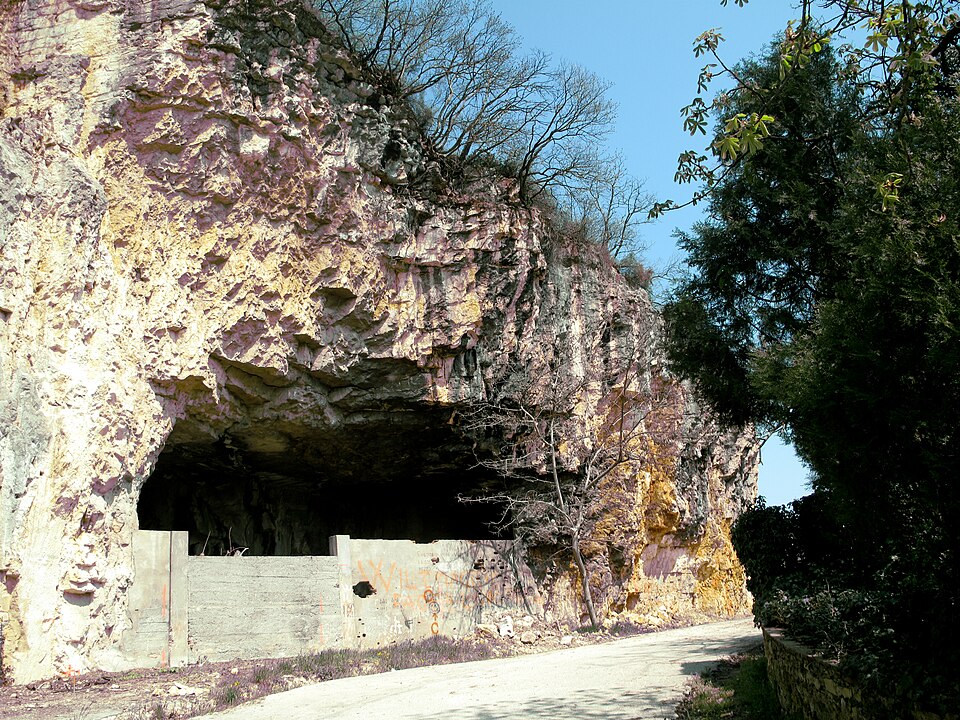
Cave di Pietra di Vicenza in the Berici Hills.
Know before you go
TO BOOK A VISIT: The entrance is normally closed and access is controlled because it is an underground former quarry. Visits can be arranged through Laboratorio Morseletto, and the cave also opens for selected guided visits, architectural programmes, concerts and cultural events. Laboratorio Morseletto Tel. +39 0444 563155 Email morseletto@morseletto.com DIRECTIONS: From Vicenza, drive southwest into the Berici Hills towards Zovencedo, approximately 19 to 20 km, around 20 to 25 minutes by car. Zovencedo is a small hill village surrounded by woods and historic underground limestone quarries.
About
WHY GO
For one of the most extraordinary architecture experiences in Vicenza: a Pritzker Prize architect working inside the void left by quarrymen, with a 30 million year old limestone seabed, underground water and a performance history linking Michael Nyman, Marco Paolini and Mario Rigoni Stern. And for architecture people, there is another reason to recognise the family behind it. Laboratorio Morseletto has worked with Carlo Scarpa, Frank Gehry, Mario Botta, Ettore Sottsass and Chipperfield, with projects ranging from Scarpa’s Brion Cemetery to Gehry’s DG Bank in Berlin and stonework for major international fashion houses.
THE STORY
Only 20 km southwest of Vicenza, the road climbs into the wooded Berici Hills to About 20 km southwest of Vicenza city, in the province of Vicenza, the road climbs into the wooded Berici Hills to Zovencedo, a tiny village above one of the area’s historic underground stone districts. Somewhere beneath those trees is a quarry so large that, once inside, the hill seems to have disappeared.
Cava Arcari was excavated for around sixty years for white Pietra di Vicenza. Quarrymen removed the limestone horizontally, leaving huge irregular pillars behind to support the hill. Groundwater later occupied the abandoned chambers, creating dark underground pools between the columns.
The stone itself began much earlier. Pietra di Vicenza formed around 30 million years ago from a warm tropical sea, with coral reef material, shells, crustaceans and algae compressed into the limestone of today’s Berici Hills. Here you are effectively walking inside that ancient seabed.
Then David Chipperfield, winner of the 2023 Pritzker Architecture Prize, designed a permanent performance space inside the quarry. He added remarkably little: platforms, ramps and broad stone tiers made from the same white Vicenza limestone, surrounded by the original quarry pillars and water filled chambers. Domus went underground with the project team in 2024 and described the quarry as an underground landscape of megalithic pillars, stepped ceilings, water and stone.
The theatre began with a performance. Before Chipperfield’s project existed, Marco Paolini performed Il Sergente, based on Mario Rigoni Stern’s Il sergente nella neve, inside Cava Arcari, with Rigoni Stern himself present. That night helped convince the Morseletto family that the abandoned quarry could have a cultural life.
When Chipperfield’s Cavea was inaugurated in 2018, Michael Nyman played piano inside it, performing music from The Piano, Gattaca and other scores while musicians occupied different platforms around the cavern. The surrounding pools were illuminated from below.
WHAT IT FEELS LIKE INSIDE
You enter beneath a wooded hill and lose ordinary architectural scale almost immediately: massive limestone columns, quarry marks across the ceiling, black water between the platforms, dripping water amplified by the cavern and long views disappearing between pillars.
The quarry remains cool even in summer, around 12 to 13°C, so bring a layer. The last approach is on foot and suitable shoes matter.