Home › Places › Nature & trails › Lago di Fimon
PREHISTORIC FOOD · VICENZA
Picnic beside a Neolithic menu of pike, freshwater mussels and water chestnuts
A lakeside picnic where archaeology has reconstructed what people were eating thousands of years ago
You can walk around the entire lake in little more than an hour, while beneath your feet lies an archive stretching back 170,000 years, through glacial climates, vanished forests, prehistoric settlements and radically different versions of the Veneto landscape. And you do not need to read a geological section to feel it. The lake is still shallow, wet, reedy and enclosed by hills, exactly the sort of place where pollen, wood, seeds and human traces can survive in mud for thousands of generations.
You have saved two places. Leave your email and you will find them on any device, plus the next drop.
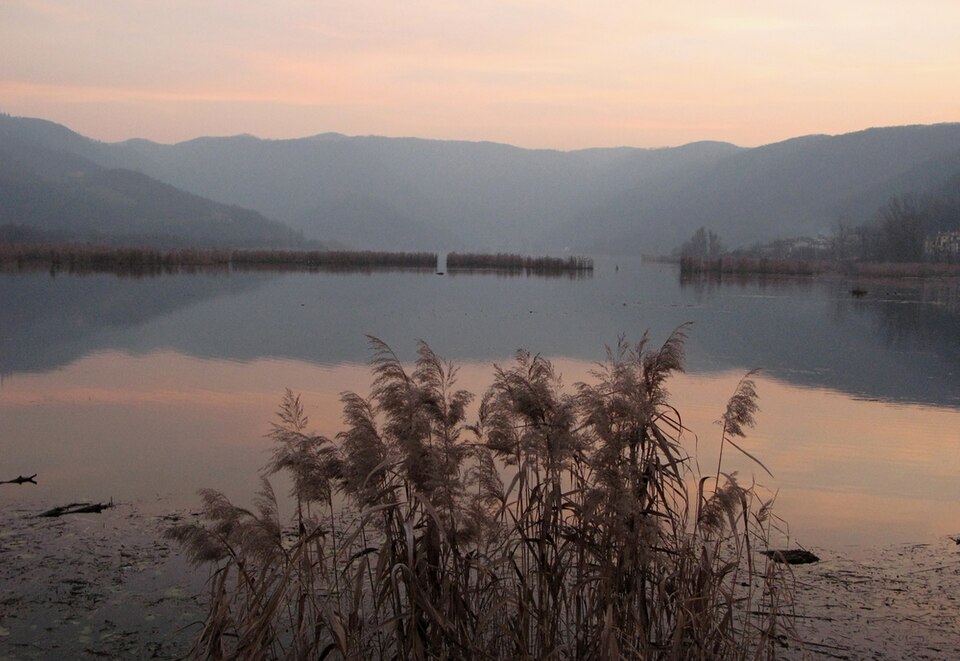
Rolfo at Italian Wikipedia, Public domain, via Wikimedia Commons
Know before you go
The lake circuit is free and accessible year round. Picnic conditions, fishing rules and access to sensitive wetland areas can vary, so check current local information before travelling.
About
Bring a picnic to Lago di Fimon and you are eating beside one of Vicenza’s richest prehistoric food landscapes. Archaeological research in the wetlands has identified pike, freshwater mussels, water chestnuts and other foods used by communities living around the lake thousands of years ago. Today an easy, almost flat circuit follows the water through reed beds and birdlife, with picnic tables along the quieter shore.
WALK, BIKE, PICNIC
Lake circuit, about 5 km, easy and flat Wooden jetties and birdwatching points Picnic tables along the quieter southern shore Fishing permitted under current regulations The lake can also be reached by bicycle from Vicenza, using the cycle network towards the Berici Hills. This is a protected lake ecosystem. Reed beds and sensitive archaeological and natural areas have restricted access, and motorboats are prohibited except for authorised uses.
170,000 YEARS UNDER THE PICNIC TABLE
Only about 10 km south of Vicenza, the road drops between the low wooded hills of the Berici and reaches a small, shallow lake framed by reeds, willows, fields and soft limestone slopes. It looks wonderfully uncomplicated. Underneath is another matter. In 2007 researchers drilled 44.5 metres into the former lake floor. Pollen, sediments, geochemistry and magnetic traces revealed what researchers describe as the longest Late Quaternary lake succession yet documented in Northern Italy, preserving roughly 170,000 years of environmental history. Those layers record entire landscapes disappearing and returning. Temperate forests, cold pine woodland, larch forest steppe, almost treeless landscapes and wetter interglacial conditions can all be reconstructed from fossil pollen. The Fimon record has even been compared with Greenland ice cores to date major climatic changes. Then humans appear. When water levels fell during the Holocene, people settled around the lake. Archaeologists have found Neolithic villages and Bronze Age waterside settlements, with timber structures, hearths, pottery and wooden piles preserved in the wet ground. Nineteenth century excavations even recovered prehistoric dugout canoes and ingenious wooden animal traps. The original canoes were later destroyed when Vicenza’s Civic Museum was bombed in 1944.
WHAT YOU ACTUALLY EXPERIENCE
The easy lake circuit is about 5 km and almost completely flat. Start beside the main lake parking area and follow the water past wooden jetties, reed beds and shaded stretches beneath willows, oaks, elders and poplars. The southern end becomes quieter and greener, with picnic tables and fewer cars. Look across the water for swans, mallards, herons, coots and moorhens. In 2026 the Province also added new accessible birdwatching stations and even built a dedicated toad underpass to protect the seasonal amphibian migration towards the lake.
A word from the Cimbrian layer of the plateau, connected to Tyrolean and Old High German forms. It names the moss on the trunks.
The Vicenza Lexicon →