Home › Places › Nature & trails › Asiago Astrophysical Observatory · Pennar Station
Astronomy experiences in Vicenza
Go inside a 50 tonne telescope dome and join an astronomy workshop
Night sessions, solar observing, star spectroscopy and astronomy walks in the Vicenza mountains.
Moon nights, solar observing, star spectra and astronomy walks, all at Pennar, the historic public observatory above Asiago in the Vicenza mountains. The programme follows the sky: one date may focus on solar prominences, another on the Moon, comets or the colours hidden inside starlight. Evening observations, spectroscopy laboratories, lectures and guided visits take place around the 1.22 metre Galileo telescope and its monumental rotating dome, while selected summer dates pair mountain trekking with astronomy after dark.
You have saved two places. Leave your email and you will find them on any device, plus the next drop.
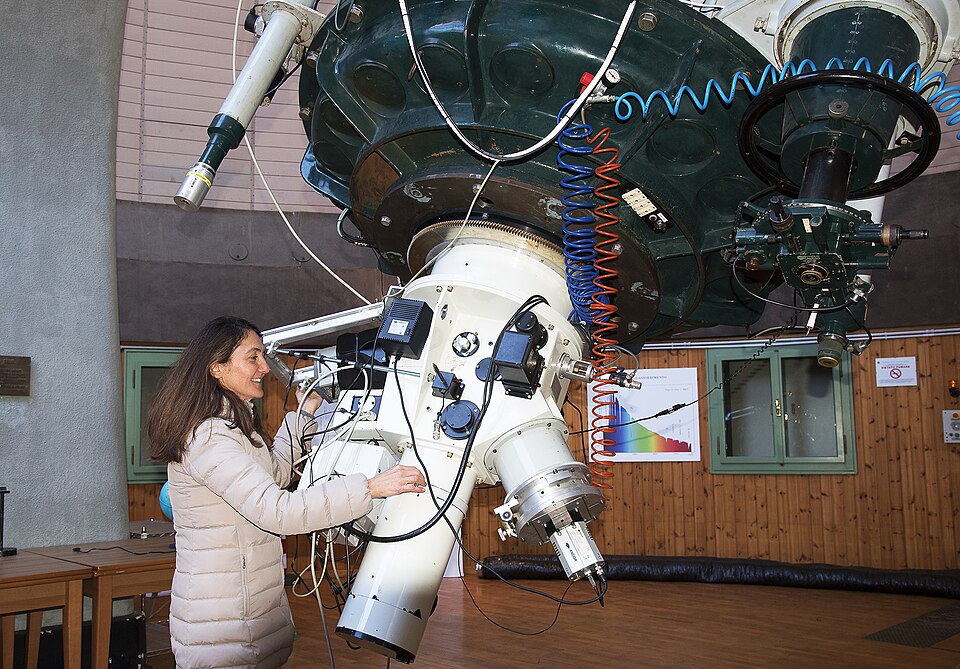
SN1968B, CC BY-SA 4.0 via Wikimedia Commons
Know before you go
Pennar does not have one permanent tourist experience repeated every day. The calendar determines the visit. Every public event requires reservation. Current information and bookings are handled through Asiago’s tourist information service. SIT Asiago +39 0424 462221 info@asiago.to
About
For stargazing in Italy, astronomy trekking and unusual night experiences in Europe, Vicenza has an extraordinary advantage: the Asiago Plateau. Pennar is the historic public observatory above Asiago, with the 1.22 metre Galileo telescope, a monumental rotating dome and a calendar of Moon nights, solar observing, spectroscopy, lectures and guided walks under the mountain sky.
→ Watch the Sun in daylight
The observatory is not only a night destination.
Osserviamo la nostra stella!, “Let’s observe our star”, combines a lesson on the Sun with direct observation when conditions are clear. Solar telescopes reveal sunspots and prominences, features impossible to examine safely with the naked eye. The 2026 calendar scheduled repeated afternoon sessions through July, August and September. For anyone who associates astronomy exclusively with midnight and telescopes pointed at black skies, this is one of Pennar’s most interesting alternatives.
→ Read what a star is made of from its light
I colori delle stelle, “The colours of the stars”, introduces spectroscopy, one of the fundamental tools of astrophysics.
The observatory’s teaching programme uses different light sources and diffraction glasses to show how light separates into a spectrum and how astronomers use those colours to study stars. It is astronomy at its most tangible: not simply identifying a constellation, but learning how scientists extract physical information from light arriving across enormous distances. The activity has also appeared in Pennar’s public summer calendar, including evening editions.
→ Natural history walk and astronomy after sunset
Trekking & Astronomia pairs the Asiago landscape with the observatory.
The 2026 programme scheduled late afternoon walks led by local guides, with Pennar as the destination and astronomy occupying the evening. Sessions ran from 17:30 to 22:30, long enough for the landscape to move from daylight into night during the experience. A separate programme, Emozioni tra le stelle, also combined a natural history walk, an evening observatory visit and an aperitivo. For travellers who want more than a seated lecture, these are the dates worth watching when the new calendar appears.
→ Lectures, laboratories and guided telescope visits
INAF describes the Asiago public programme broadly: laboratories, conferences, lessons and guided visits to the telescopes, all by reservation. Many activities take place in Pennar’s multimedia dome, equipped for lectures, practical work, observations of bright celestial objects and remote connections with the Galileo, Copernico and Schmidt telescopes. The room also has its own solar telescope. This breadth is what makes Pennar useful as a destination. A first visit can be an evening beneath the stars; another can be about solar physics, spectroscopy or a lecture on current astronomy.
Vicenza had its own word for looking closer, and it is the proper beginning for anything worth discovering.
The Vicenza Lexicon →