Home › Places › Villas & Palaces › Villa da Porto Barbaran
LITERARY ROMANCE · VILLA WEDDINGS IN VICENZA
Get married at the family villa of Romeo and Juliet’s Italian author
A villa wedding in the Vicenza countryside, on the family estate of Luigi da Porto, the Italian writer behind Romeo and Juliet.
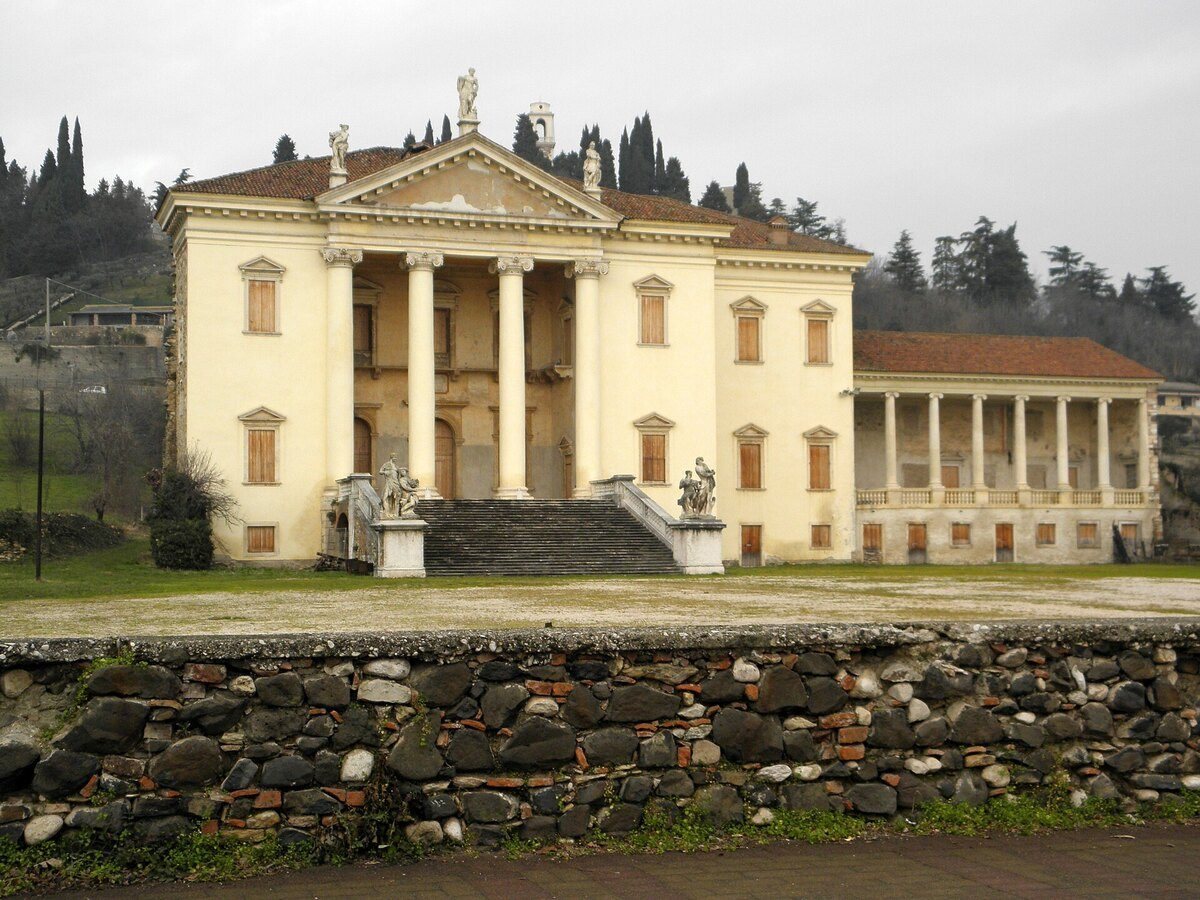
Romeo and Juliet has a family estate in Italy, and you can reserve it for a personal occasion. At Villa da Porto Barbaran in Vicenza, four monumental Ionic columns rise above a sculpted staircase, while the wooded Fratta hill preserves the landscape associated with Luigi da Porto, the Italian author whose lovers would reach Shakespeare. The present villa was built generations later, and today its historic rooms host civil ceremonies, contemporary art, literary evenings and occasional visits after dark.
You have saved two places. Leave your email and you will find them on any device, plus the next drop.
Threecharlie · CC BY-SA 4.0 · Wikimedia Commons
Know before you go
Private use, calendar and authorisations Comune di Montorso Vicentino, Ufficio Segreteria Email: segreteria@comune.montorsovicentino.vi.it Telephone: +39 0444 685402, extension 5 Guided visits and cultural events Pro Loco Montorso Vicentino Email: prolocomontorsovi@gmail.com Telephone: +39 368 718 6307 Opening dates for guided visits, exhibitions and special evening programmes vary. Confirm access before travelling.
In this story: A Private Occasion in Romeo and Juliet's Family Villa ↓ The Grand Staircase and the Double Height Hall ↓ Contemporary Art After Hours ↓ The House Where the Love Story Began ↓ The Balcony Before Shakespeare ↓ The Ghost of Luigi da Porto ↓ Literary Evenings and Life at the Villa ↓ Reserve the Villa ↓
A PRIVATE OCCASION IN ROMEO AND JULIET'S FAMILY VILLA
Few historic estates in Italy have a literary association quite like Villa da Porto Barbaran.
The family once included Luigi da Porto, the Vicentine soldier and writer whose account of Romeo and Juliet helped shape one of the most celebrated love stories in European literature. Today, the monumental villa associated with his family can be reserved for personal occasions, including legally recognised civil marriage ceremonies. [1]
The estate has served as an official civil ceremony venue since 2008. The municipality also publishes a calendar of available dates and a formal procedure for requesting use of the historic spaces. [2]
The setting is particularly distinctive. A broad staircase approaches an immense Ionic portico, beyond which lies a central hall rising through two storeys. The wooded Fratta hill stands behind the villa, with the surviving bell tower of a vanished church above the trees.
For an important birthday, an intimate celebration, a private cultural gathering or a civil ceremony, the attraction lies in the unusual union of architecture and literary history.
The villa is municipally managed, and use of the available spaces requires authorisation. Each occasion can be considered according to its scale, proposed activities and the conditions of the monument.
THE GRAND STAIRCASE AND THE DOUBLE HEIGHT HALL
The approach to Villa da Porto has the grandeur of a ceremonial entrance.
Two groups of sculpted figures stand at the beginning of the monumental staircase. Above them, four Ionic columns rise through the height of the portico, supporting a triangular pediment crowned by three statues.
FAI identifies the roof sculptures as Apollo, Minerva and Perseus, attributed to Giacomo Cassetti. The groups beside the staircase represent allegories of the Seasons and have been tentatively associated with the Bonazza sculptural tradition. [3]
Beyond the portico lies a salone of exceptional proportions.
The official architectural survey records a central hall approximately fourteen metres across, rising through two storeys. Three great arched openings bring daylight into the interior, while a gallery once connected the two residential wings at the level of the piano nobile. [4]
A spiral staircase survives beside the portico, its ceiling retaining painted decoration associated stylistically with the French artist Louis Dorigny. The great hall, the portico and the surviving stair give the building a scale rarely encountered in an ordinary country residence.
Historically, the villa was even larger. Its western wing disappeared during the nineteenth century, leaving the surviving eastern barchessa, the covered agricultural wing, to extend beside the main house.
The Villa da Porto that survives today is therefore an imposing fragment of an even grander residence.
CONTEMPORARY ART AFTER HOURS
The historic rooms have acquired an unexpected contemporary life.
From 25 September to 11 October 2026, Villa da Porto hosted BLOB, the thirteenth edition of the contemporary art exhibition organised by the cultural association Miti & Mete. Its installations brought established and emerging artists into the monumental interiors, with a performance by Etra Danza among the exhibited works on 10 October. [5]
Among the participating artists were Manuela Bedeschi, Giuliana Cobalchini, Paolo Gualtiero, Luciana Soriato and Luciana Zabarella.
The exhibition extended into the evening, with Friday openings until 22:00 and Saturday openings until 21:00. Visitors could experience contemporary art within spaces conceived for the aristocratic life of a much earlier century.
It is a particularly appealing contrast: monumental columns and historic stonework hosting sculpture, installations, photography and experimental performance.
BLOB concluded on 11 October 2026. Future exhibitions and evening openings are announced through the municipality and the participating cultural associations.
THE HOUSE WHERE THE LOVE STORY BEGAN
The literary history of Villa da Porto reaches further back than the grand architecture visible today.
Luigi da Porto lived in Montorso during the early sixteenth century, following a severe injury sustained while fighting for the Republic of Venice. The wound ended his military career, and he devoted the following years to poetry, correspondence and prose.
The Royal Shakespeare Company identifies da Porto among the Italian authors who developed the Romeo and Juliet narrative before Shakespeare. His story supplied crucial elements, including the lovers' names, their rival families and the tragedy of their secret marriage. [6]
The writer spent part of his life in the family's earlier residence at Montorso, where local historical accounts place the composition of his novella. The monumental villa standing today was built later, with major construction and alterations between 1662 and 1724. [7]
The distinction is an important part of the story. Visitors can experience the family estate and its surviving historic architecture, while the original residence in which Luigi lived survives only in fragments incorporated into the later complex.
Behind the villa rises the Fratta hill, associated with the writer's walks and his contemplation of the surrounding countryside.
His relationship with Montorso remains part of the town's literary identity, joining a real landscape to a story that subsequently travelled through French and English literature before becoming Shakespeare's tragedy.
THE BALCONY BEFORE SHAKESPEARE
The literary connection contains another delicious detail.
The balcony universally associated with Romeo and Juliet has a complicated history. Shakespeare's play describes the famous encounter through a window, while the word balcony is absent from the original scene.
Research published in Cahiers Élisabéthains, an international journal of English Renaissance studies, identifies an actual balcony in Luigi da Porto's earlier Italian novella. [8]
Researcher Roberta Zanoni examines the architectural settings of the lovers' encounter as the story passed through European literary traditions, tracing the relationship between balconies, windows, gardens and orchards.
The finding adds an unexpected architectural dimension to the story of da Porto. One of the most recognisable images of romantic literature already had a place in an earlier Italian version.
It is a literary connection, rather than evidence that any particular balcony on the Montorso estate inspired the scene.
For travellers researching the Italian origins of Romeo and Juliet, the family residence gives that history a physical destination in the Vicenza countryside.
THE GHOST OF LUIGI DA PORTO
Montorso also preserves a more mysterious account of its celebrated writer.
Local folklore places Luigi da Porto's restless spirit in the old estate buildings, particularly in the former service house along Via Villa. The story belongs to the town's oral tradition, a romantic afterlife for a man whose own life combined military injury, unfulfilled affection and literary invention. [7]
The villa has given that taste for mystery a contemporary expression.
On 13 September 2026, the historic complex hosted Suggestioni, a festival dedicated to paranormal stories and unusual experiences. The programme included literary presentations, guided visits and an evening visit to the villa's underground rooms at 21:30. [9]
The event treated the building as a setting for folklore, curiosity and theatrical storytelling.
There is something fitting about a place associated with the writer of a tragic romance acquiring its own ghost story centuries later.
The festival was a scheduled cultural event. Access to the underground rooms and future evening experiences depends on the individual programme.
LITERARY EVENINGS AND LIFE AT THE VILLA
The villa continues to make literature part of its cultural programme.
In September 2026, the festival Montorso Incanta hosted a presentation of Candido Lucato's Amore e morte, a book revisiting Luigi da Porto and his relationship with Lucina Savorgnan, the historical woman associated with the writer's own romantic disappointments. [10]
The event took place within the same estate whose earlier residence had belonged to his family.
The grounds also have a more convivial life. During the October 2026 Sagra del Santo Rosario, the park welcomed traditional food, music, photography and art exhibitions. The culinary programme included bigoli con l'arna, a local Veneto pasta preparation served with duck, alongside other festival dishes. [11]
These events belong to the public cultural calendar, with food and hospitality arranged for the occasion.
For a visitor, the appeal is the diversity of uses within one historic estate: a literary evening, a contemporary art exhibition, a guided visit, a summer gathering or a personal celebration can each bring a different character to the villa.
THE ARCHITECTURAL AFTERLIFE OF THE ESTATE
The present residence is the product of several centuries of rebuilding.
The villa incorporates elements of an older family property and was greatly enlarged between the seventeenth and eighteenth centuries.
Its architectural authorship has attracted different interpretations. Historical sources have connected the design to a French figure named Cherrette, described as architect and geographer to the king of France, while other attributions have proposed Carlo Borella or Francesco Muttoni. The Veneto's architectural catalogue treats these identifications cautiously. [4]
Conservation work undertaken for the municipality studied the building as a complex surviving record of successive periods, preserving its monumental scale, old masonry, spiral staircases and the remnants of the earlier agricultural buildings. [12]
The present complex includes the principal residence, an eastern portico, a barchessa incorporating part of a former pigeon tower, and an extensive walled area historically occupied by gardens, orchards and working yards.
That long history gives Villa da Porto its particular architectural character: Renaissance family origins beneath an eighteenth century monumental façade, with traces of the working estate still visible beside the formal residence.
CAN YOU RESERVE VILLA DA PORTO FOR A PRIVATE OCCASION?
Yes. The Comune di Montorso Vicentino publishes a calendar of availability and a formal application procedure for use of Villa da Porto.
Requests must be submitted to the municipal secretariat, which confirms whether the proposed date, spaces and activities can be authorised. Fees are established under the municipality's current tariff schedule. [2]
Civil marriage ceremonies are officially permitted, while other personal or cultural uses are evaluated according to the proposed arrangements. [1]
Complete exclusive use of the entire estate, including all historic rooms and grounds, should be confirmed specifically with the municipality.
CAN YOU STAY OVERNIGHT AT VILLA DA PORTO?
No public accommodation programme has been identified within Villa da Porto Barbaran.
Its principal opportunities concern civil ceremonies, authorised private use, exhibitions, cultural events and guided visits. Accommodation for visitors attending events must be arranged separately.
Sources
- Comune di Montorso Vicentino · Official civil marriage ceremonies at Villa da Porto since 2008 and new municipal venues in 2026 · Avviso pubblico per l'istituzione di separati uffici di stato civile
- Comune di Montorso Vicentino · 2026 availability calendar, application procedure, municipal fees and private use conditions · Calendario disponibilità Villa Da Porto
- FAI, Fondo per l'Ambiente Italiano · Monumental staircase, Apollo, Minerva, Perseus, sculpture and historic architecture · FAI un giro in Villa a Villa Da Porto Barbaran
- Istituto Regionale Ville Venete · Historical architecture, monumental hall, surviving porticoes and disputed authorship · Villa Porto, Porto Barbaran
- Comune di Montorso Vicentino · Contemporary art installations and dance performance, September to October 2026 · Mostra Blob
- Royal Shakespeare Company · Luigi da Porto, Italian literary sources and the development of Romeo and Juliet · Romeo and Juliet: Dates and Sources
- Comune di Montorso Vicentino · Luigi da Porto's earlier residence, the Fratta hill and local ghost tradition · Il Fantasma di Luigi da Porto
- Roberta Zanoni · Cahiers Élisabéthains, Sage Journals, 2024, Volume 114, Issue 1 · The pre-Shakespearean balcony and outdoor spaces from the European sources to Romeo and Juliet
- Comune di Montorso Vicentino · Guided visits and night access to the underground rooms, 13 September 2026 · Suggestioni: Festival del Paranormale
- Comune di Montorso Vicentino · Candido Lucato and the literary history of Luigi da Porto, 16 September 2026 · Montorso Incanta: Amore e morte
- Comune di Montorso Vicentino · Traditional food, exhibitions and festivities within the villa park, October 2026 · Sagra del Santo Rosario
- Gabbiani & Associati Architetti · Architectural conservation, original materials and study of the historic complex · Villa da Porto Barbaran a Montorso Vicentino