Home › Places › Villas & Palaces › Villa Saraceno
UNIQUE STAYS IN ITALY · PRIVATE VILLA BUYOUT · PALLADIO
Sixteen guests, three open fires, one entire UNESCO Palladian villa to yourselves
live with Renaissance frescoes and spend the evening inside the whole historic house
Three open fires, long communal rooms, gardens, no television and barely any mobile signal. Selected by Vogue, Architectural Digest and Quiet Spaces, Villa Saraceno is an entire UNESCO Palladio house for sixteen, with frescoed rooms and the austere beauty of an early masterpiece.
You have saved two places. Leave your email and you will find them on any device, plus the next drop.
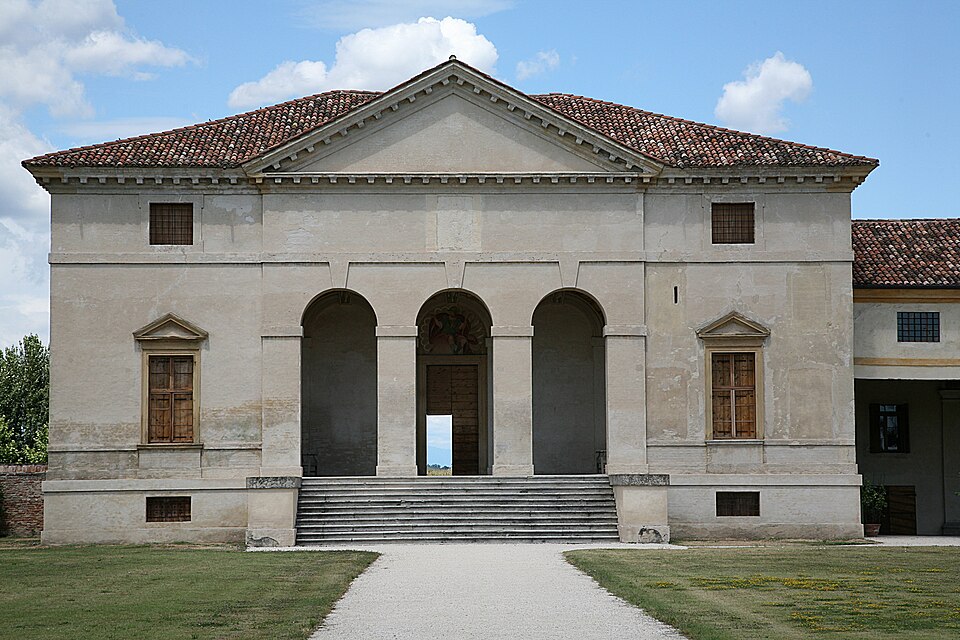
Hans A. Rosbach, CC BY-SA 2.5 via Wikimedia Commons
In this story: Chosen by Vogue and Architectural Digest ↓ Frescoes After Hours ↓ An Interior for Contemplation ↓ Palladio’s Country House ↓ The Restoration ↓ The Free Wednesday Visit ↓ Your Private Stay↓
CHOSEN BY VOGUE, ARCHITECTURAL DIGEST AND QUIET SPACES
Villa Saraceno has acquired a defining second life in contemporary design culture.
Vogue singled it out as perhaps the most architecturally impressive of a celebrated group of historic houses available for private stays, identifying it as the only building by Andrea Palladio that guests can rent and sleep in [1]. Architectural Digest Italia placed it among six Italian historic residences worth travelling for, describing a house conceived both as a cultivated country retreat and as the vibrant center of a working estate [2].
Up to sixteen guests can reserve the villa as a private house. Here, the experience belongs entirely to domestic life: long tables, quiet reading, the loggia in changing light, evenings beneath frescoed ceilings, and the rare pleasure of waking inside a masterpiece by the architect whose language traveled from Vicenza across Europe and America.
In Quiet Spaces, published by Thames & Hudson, British architect William Smalley placed it alongside Casa Barragán in Mexico City and Kettle’s Yard in Cambridge, celebrating interiors that reward reading, music, conversation, and private contemplation [3]. The Financial Times returned to Smalley’s personal memory of staying at Villa Saraceno, while Wallpaper reproduced the house as one of the book’s central architectural references.
That context changes how the villa is experienced. Its appeal lies neither in hotel spectacle nor in decorative excess. Palladio works through pure proportion, high rooms, restrained surfaces, and the relationship between the house and the agricultural plain, qualities that a private stay gives you the time to truly perceive.
AN INTERIOR FOR CONTEMPLATION
Villa Saraceno appears in Quiet Spaces because its restraint has contemporary force.
The exterior has what Vogue called a “sumptuously minimal” character. Inside, scale replaces ornament as the principal luxury. Rooms are generous without becoming theatrical, materials retain their age, and the architecture gives ordinary acts, reading, eating, talking, crossing the hall, a more deliberate pace. [1, 3, 4]
This is the high end proposition of Villa Saraceno. The value comes from inhabiting important architecture without the choreography of a grand hotel, and from sharing the entire house with the people you brought with you.
PALLADIO’S COUNTRY HOUSE
Palladio designed Villa Saraceno for Biagio Saraceno during the late 1540s, incorporating a noble residence into an agricultural estate already established by the family.
The Palladio Museum describes the house as one of the most accomplished works of the architect’s 1540s. Brick and plaster form an exceptionally pure volume, while worked stone is reserved for the points where structure and meaning require it. The piano nobile rises above cellars; the granary occupies the upper level; the loggia gives the working estate the ceremonial face of a Roman temple. [7]
Villa Saraceno matters precisely because domestic life, agricultural production and classical architecture remain legible within the same building. A stay allows that arrangement to be understood through use, over breakfast, across the central hall, from the loggia and through the changing conditions of the day.
FRESCOES AFTER HOURS
The grand hall carries a late sixteenth century painted narrative into the private life of the house.
Vogue draws attention to the frescoed frieze depicting the foundation myth of ancient Rome. RIBA Collections attributes the principal hall decoration to Anselmo Canera and identifies its subject with Orazia, Pietro Aretino’s tragedy of 1546. The room joins Palladio’s architecture to a literary image of antiquity, viewed during the day as heritage and lived with in the evening as part of the house. [1, 6]
PALLADIO’S COUNTRY HOUSE
Andrea Palladio designed Villa Saraceno for Biagio Saraceno during the late 1540s, incorporating a noble residence into an agricultural estate already established by the family.
The Palladio Museum describes the villa as one of the most accomplished works of the architect’s 1540s. Its apparently simple volume depends on exact relationships between height, width, openings and internal rooms. Brick and plaster form most of the building, while worked stone is reserved for selected architectural details. [7]
The piano nobile rises above the cellars. Small upper windows once served the granary where the produce of the estate was stored. At the centre, the loggia gives the working farm the language of a Roman temple.
Inside, the T shaped hall organises pairs of rooms whose dimensions relate to one another. Architecture, agriculture and domestic life were conceived as parts of the same house.
The villa also differs from the idealised version Palladio later published in I Quattro Libri dell’Architettura. Existing agricultural buildings were retained, and only part of the larger composition represented in the treatise was constructed. The surviving estate therefore records both Palladio’s architectural ambition and the practical decisions of a working property. [7]
THE RESTORATION
By the late twentieth century, Villa Saraceno required an extensive conservation programme.
The work recovered the original distribution of the house, repaired historic masonry and timber, conserved lime finishes and brought the painted decoration back into view. The Society for the Protection of Ancient Buildings studied Villa Saraceno as an important example of conservation based on traditional materials and careful understanding of the existing fabric. [8]
The restoration avoided remaking the villa as an immaculate reconstruction. Age remains present in the surfaces, floors, walls and painted rooms, allowing the building to retain the character of a house with a long material history.
In 1994, the conservation project received a Diploma in the European heritage awards programme. The recognition acknowledged both the architectural work and the decision to give the villa a residential use capable of supporting its continued care. [9]
A stay therefore belongs to the conservation history of Villa Saraceno. The house survives through occupation, with private domestic use becoming part of the way its architecture is maintained.
VILLA SARACENO AND UNESCO VICENZA
Villa Saraceno forms part of the UNESCO World Heritage property City of Vicenza and the Palladian Villas of the Veneto.
UNESCO recognises Palladio’s work for its influence across England, Europe and North America. Villa Saraceno presents that global architectural history at an intimate scale, through a loggia, a sequence of rooms, a painted hall and an agricultural landscape in the province of Vicenza. [10]
For travellers looking for the best architecture stays in Italy or less familiar historic houses in Europe, the villa offers an uncommon combination: a UNESCO monument by Palladio that continues to function as an entire private residence.
THE FREE WEDNESDAY VISIT
An overnight stay is only one way to experience Villa Saraceno.
From 1 April to 31 October, the principal rooms open every Wednesday from 14:00 to 16:00. Admission is free and no advance appointment is required.
The contrast is unusual. Visitors can spend two hours inside an early Palladian villa without an admission charge, while guests reserving the house experience the same architecture through several days and nights.
THE PRIVATE STAY
Villa Saraceno is reserved as an entire house for groups of up to sixteen guests.
Three open fires, generous communal rooms and the enclosed garden give the cooler months a strong country house atmosphere. The interiors favour shared life, with space for long dinners, reading and evenings in the principal rooms.
Booking enquiries
+44 1628 825925
Information in Italian
+39 041 5222481
Sources
- Vogue · 16 August 2018 · The Landmark Trust Is the Airbnb for Historic European Homes
- Architectural Digest Italia · 15 April 2022 · Dimore storiche: 6 indirizzi in Italia per un soggiorno indimenticabile
- William Smalley, Edmund de Waal and Hélène Binet · Thames & Hudson, 2023 · Quiet Spaces
- Financial Times · 27 October 2023 · An Architect’s Celebration of Quiet Spaces
- Wallpaper* · 18 October 2023 · Quiet Spaces: William Smalley’s New Book Explores Architecture for Contemplation
- RIBA Collections · Anselmo Canera, the entrance hall frescoes and the Orazia cycle · Villa Saraceno, Finale di Agugliaro, Vicenza
- Centro Internazionale di Studi di Architettura Andrea Palladio · Commission, chronology, materials and architectural organisation · Villa Saraceno, Agugliaro
- Society for the Protection of Ancient Buildings · Construction, historic materials and conservation study · SPAB Scholars: Conservation at Villa Saraceno
- European Heritage Awards Archive · 1994 Diploma for architectural conservation · Villa Saraceno, Finale d’Agugliaro
- UNESCO World Heritage Centre · Villa Saraceno within the serial World Heritage property · City of Vicenza and the Palladian Villas of the Veneto