Home › Places › Gardens & parks › Giardini Salvi
THE HUNDRED
The Renaissance garden that opened to Vicenza in 1592, then closed for two centuries
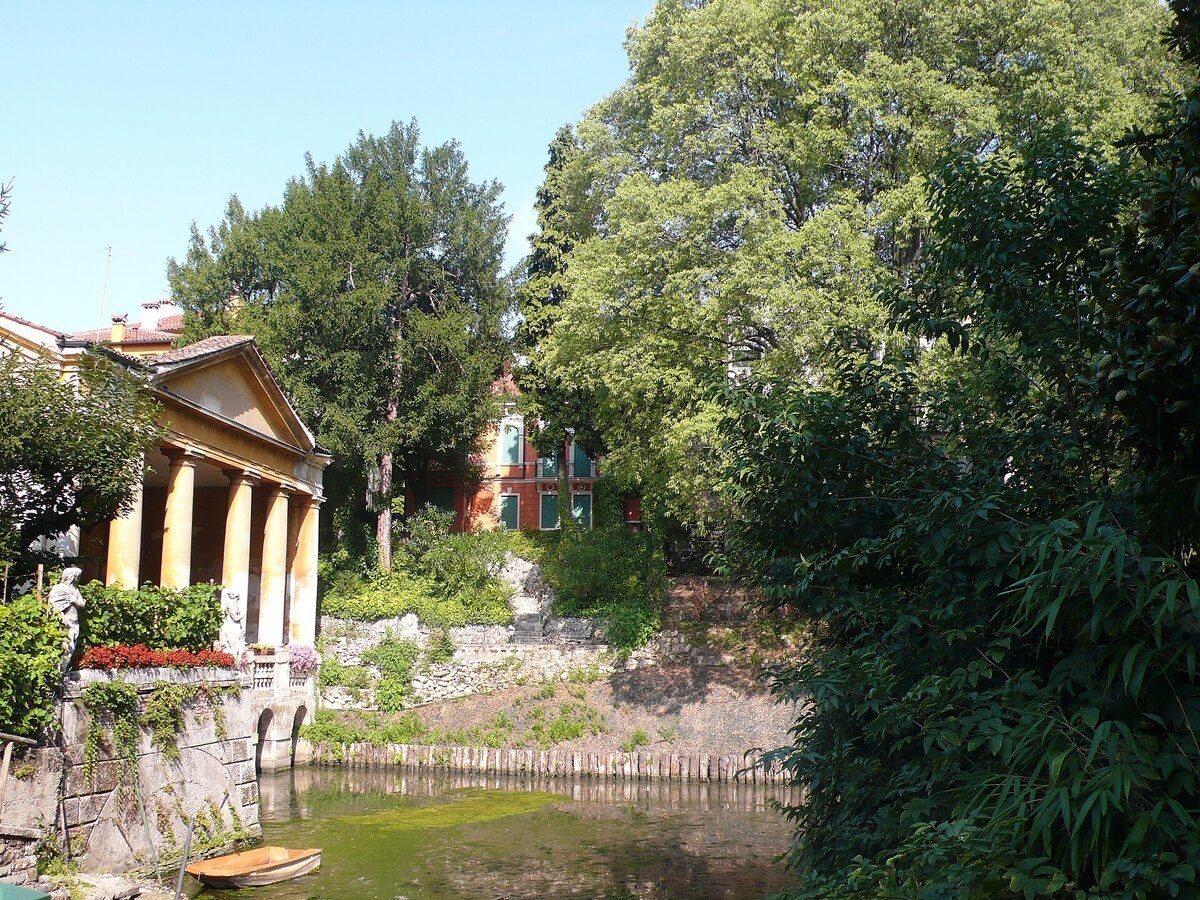
A few minutes from Vicenza station, just before Corso Palladio begins, water, old trees and Renaissance architecture suddenly appear behind the city walls. The Roggia Seriola, “Seriola watercourse”, bends through the garden beneath willows and stone bridges. Rising directly from the water is Loggia Valmarana, “Valmarana Loggia”, a six column pavilion shaped like a small classical temple, its arches and reflection forming one of the most romantic views in central Vicenza. The loggia belongs to Vicenza’s UNESCO World Heritage property. The garden has spent more than four centuries changing character around that water. The original Valmarana garden combined ornamental planting, fruit trees, flower beds, fountains and water. The Salvi family later broadened its botanical character and reshaped it according to nineteenth century Romantic taste. A collection rose garden was added during the restoration completed in 2009, while the Seriola remains the defining natural element running through the park. Dogs are welcome on a lead, photography is permitted and the garden is fully accessible. Renaissance parterres became a Romantic garden of winding paths and unexpected views, while statues, old trees and another waterside pavilion by Baldassarre Longhena accumulated around it. In 2025, more than 20,000 people voted for Giardino Salvi in FAI’s I Luoghi del Cuore, placing it 17th nationally and helping secure new conservation work.
You have saved two places. Leave your email and you will find them on any device, plus the next drop.
RatMan1234 · CC BY-SA 4.0 · Wikimedia Commons
Know before you go
Opening hours, access and prices can change, and some of these places open only by arrangement. Please check with the place before you travel.
About
WHY GO A few minutes from Vicenza station, just before Corso Palladio begins, water, old trees and Renaissance architecture suddenly appear behind the city walls. The Roggia Seriola, “Seriola watercourse”, bends through the garden beneath willows and stone bridges. Rising directly from the water is Loggia Valmarana, “Valmarana Loggia”, a six column pavilion shaped like a small classical temple, its arches and reflection forming one of the most romantic views in central Vicenza. The loggia belongs to Vicenza’s UNESCO World Heritage property. The garden has spent more than four centuries changing character around that water. The original Valmarana garden combined ornamental planting, fruit trees, flower beds, fountains and water. The Salvi family later broadened its botanical character and reshaped it according to nineteenth century Romantic taste. A collection rose garden was added during the restoration completed in 2009, while the Seriola remains the defining natural element running through the park. Dogs are welcome on a lead, photography is permitted and the garden is fully accessible. Renaissance parterres became a Romantic garden of winding paths and unexpected views, while statues, old trees and another waterside pavilion by Baldassarre Longhena accumulated around it. In 2025, more than 20,000 people voted for Giardino Salvi in FAI’s I Luoghi del Cuore, placing it 17th nationally and helping secure new conservation work.
THE STORY
The Valmarana family began creating the garden outside Vicenza’s walls in 1556 as a luogo di delizie, “place of delights”, a Renaissance landscape of greenery, water, statues and fountains beside their residence near Porta Castello. Then Leonardo Valmarana did something unusually generous for the period. In 1592, he opened the family garden to the city. An inscription associated with the garden invited citizens, friends and guests to enter and enjoy the beauty of the place. A wooden bridge crossed the Seriola, while the little classical loggia rose above the water nearby. The experiment in public pleasure did not last. The gates closed again, and the garden remained private for roughly two centuries. When the Salvi family acquired it in the nineteenth century, Renaissance order gave way to the taste for the English landscape garden, with richer planting, curving paths and deliberately composed views through foliage and across water. The city eventually acquired the property and reopened it permanently to the public in the early twentieth century. So the garden you walk through today contains several centuries of changing ideas about what a city garden should feel like, formal Renaissance pleasure, Romantic greenery, civic park, all arranged around the same stream.
A RENAISSANCE TEMPLE FLOATING ON WATER IN THE MIDDLE OF VICENZA
Loggia Valmarana, “Valmarana Loggia”, is the image to look for. Six Doric columns rise above arches planted directly in the bed of the Seriola, with a triangular pediment above them. From the path, the pavilion appears to float between architecture and reflection. For years it was casually labelled a Palladio. The real story is better. No document proves Palladio designed it, and scholars have debated the attribution for generations. Current research suggests an early Palladian influence and has proposed Paolo Antonio Valmarana as a possible designer, perhaps drawing inspiration from Vincenzo Scamozzi. The uncertainty has become part of the attraction, a UNESCO monument with a famous architectural question mark attached.
TWO ARCHITECTS, ONE STREAM
Across the garden, the water produces another architectural surprise. The seventeenth century Loggia Longhena, “Longhena Loggia”, is associated with Baldassarre Longhena, the great Venetian architect behind Santa Maria della Salute. It was created as a place for academic gatherings and rises above another branch of the Seriola with three large arches. One garden therefore contains a Palladian mystery at one end and a pavilion associated with one of Baroque Venice’s major architects at the other. The Longhena Loggia has also become part of the garden’s current revival. In 2026, Giardino Salvi won funding from FAI and Intesa Sanpaolo to restore the connection between the park, the loggia and Piazzale Giusti. Only two sites in Veneto received funding in that round.
HOW TO VISIT
Giardini Salvi, “Salvi Gardens” Corso Santi Felice e Fortunato 2 36100 Vicenza Entry is free every day. May to September 7:30 to 21:00 October to April 7:30 to 20:00 There are entrances from Corso Santi Felice e Fortunato, Piazzale De Gasperi and Contrà Mure Porta Nova. The garden is fully accessible and dogs are allowed on a lead. Loggia Valmarana itself cannot currently be entered, so the experience is the garden, the water and the architecture seen from the paths.
The recorded example says it best: the wheat under the snow s’ingavàssa. It meant putting down roots and becoming lush.
The Vicenza Lexicon →