Home › Places › Gardens & parks › Giardino Jacquard
VICENZA · SECRET GARDENS
A secret garden in Vicenza, with grottoes, a pagoda and a romantic glasshouse
Giardino Jacquard, Vicenza’s secret garden of grottoes and theatrical illusions
Giardino Jacquard in Schio, in the province of Vicenza, features in Touring’s L’Italia dei giardini and joined Grandi Giardini Italiani in 2021, as reported by Gardenia. Visit for an orchid collector’s greenhouse, grottoes, exotic trees and theatrical ruins, beside a complex that once offered mill workers a library, an evening school and a theatre for 800.
You have saved two places. Leave your email and you will find them on any device, plus the next drop.
Guido Rampon · CC BY-SA 3.0 · Wikimedia Commons
Know before you go
Opening hours, access and prices can change, and some of these places open only by arrangement. Please check with the place before you travel.
About
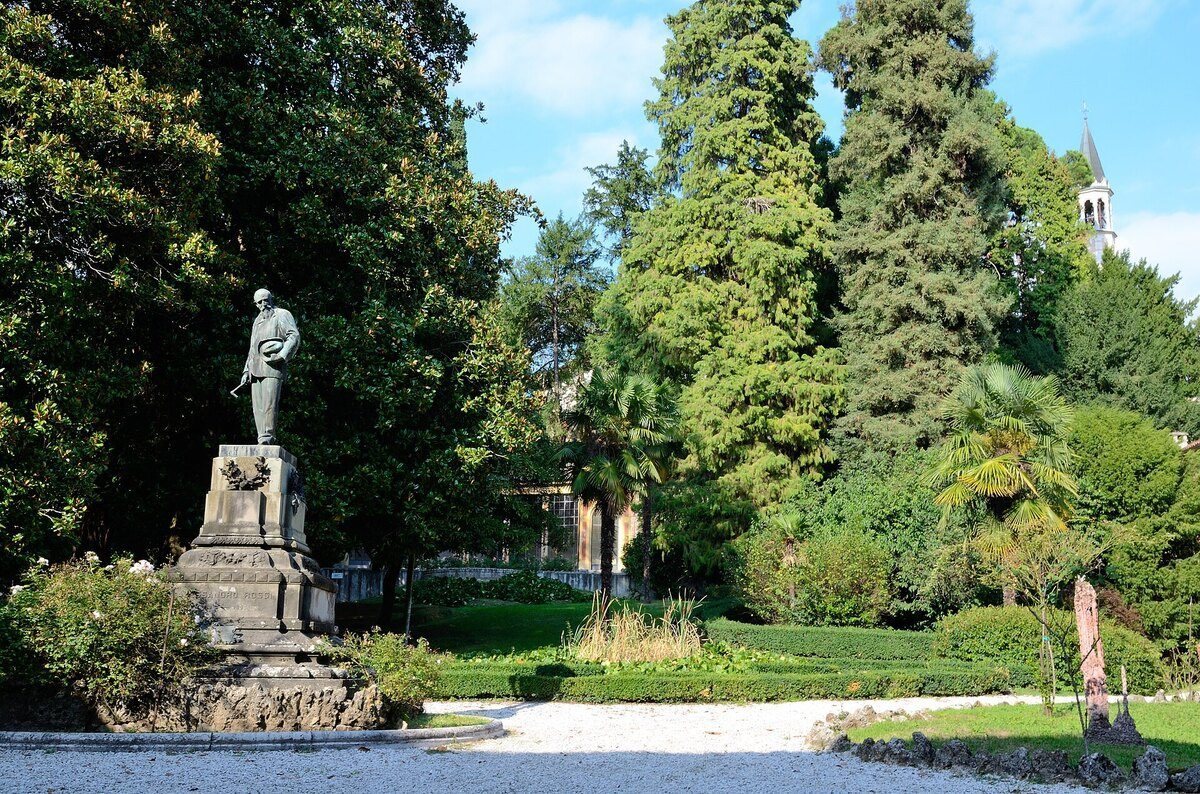
In Schio, in the province of Vicenza, Giardino Jacquard brings romantic garden design into an unexpected setting, opposite the Rossi wool mill. Commissioned by textile entrepreneur Alessandro Rossi and designed by architect Antonio Caregaro Negrin, it combines a curved greenhouse, grottoes, imagined ruins and winding hillside paths. For lovers of unusual Italian gardens, its appeal is both visual and historical: the landscape belongs to an ambitious experiment in the cultural life of a factory town.
Why is it called Giardino Jacquard?
The garden takes its name from the adjoining theatre, dedicated to Joseph Marie Jacquard, the French inventor who perfected a loom mechanism for weaving intricate patterns using punched cards. The dedication placed textile invention at the centre of a place created for a textile community. The name connects the garden directly to the work, skills and industry that shaped Schio. Jacquard’s influence extended beyond weaving. Charles Babbage borrowed the idea of punched cards for his proposed Analytical Engine, giving the name an unexpected connection to the history of computing.
The greenhouse, built for an orchid collector
The curved greenhouse is one of Jacquard’s defining sights. Its sheltered position protected delicate plants from northerly winds, while ventilation and a stove made of glazed ceramic helped regulate growing conditions. Rossi cultivated orchids here and gave the flowers to valued clients. The building also shapes the visitor’s experience. Its elegant façade introduces the garden’s theatrical landscape, with grottoes and climbing paths beyond it. Understanding its original purpose adds another dimension to the architecture: this was a carefully equipped growing space for a collector’s demanding plants. The planting benefited from the expertise of Marco Restiglian of Padua’s Botanical Garden, connecting Rossi’s horticultural ambitions with an established centre of botanical knowledge.
Books, music and an 800 seat theatre for mill workers
As the garden developed during the 1860s and 1870s, the adjoining complex gave workers access to education, reading, music and public gatherings. An evening school offered opportunities to study beyond working hours. A circulating library provided books to borrow, while a rehearsal room supported the workers’ band. In 1869, the upper floor was converted into a horseshoe shaped theatre accommodating around 800 people. Its programme included operettas, melodramas inspired by workers’ lives, musical performances and assemblies. The ground floor also contained a café and the theatre’s ticket office. These functions explain the scale of Rossi’s project. The garden belonged to a broader cultural complex where recreation, learning and collective life shared the same setting. Today, the theatre façade, decorated with twelve terracotta portrait medallions, remains a visible expression of those ambitions.
A crocodile, a pagoda tower and the secrets of wool
Beside the grotto, a sculpted crocodile introduces an apparently exotic detail. The official garden guide connects it to ancient Egypt and its textile culture, another reference to weaving within the landscape. The octagonal tower with its pagoda roof has an even more surprising history. Before becoming an ornamental aviary, it housed workers’ urinals. The urine supplied ammonia used in processing wool. Its picturesque appearance conceals a practical connection to the neighbouring mill.
A theatrical garden with a connection to Teatro Olimpico
Rossi and Caregaro Negrin met at Vicenza’s Teatro Olimpico in 1846, during a performance of Oedipus Rex. The architect had worked on the theatre’s scenery. That background adds particular interest to Jacquard’s artificial rockwork, architectural illusions and carefully composed views. Included in Touring’s L’Italia dei giardini, Giardino Jacquard deserves attention on an itinerary devoted to historic Italian gardens. Follow the paths beyond the greenhouse: the combination of botanical ambition, theatrical imagination and workers’ cultural history is what makes this corner of Vicenza so distinctive.
The recorded example says it best: the wheat under the snow s’ingavàssa. It meant putting down roots and becoming lush.
The Vicenza Lexicon →