Home › Places › Gardens & parks › La Rotonda
PALLADIO · HISTORIC GARDENS · FOREST BATHING
Forest bathing in 12,554 square metres of Romantic woodland made for retreat
Behind Palladio’s most famous villa, a restored nineteenth century grove brings old trees, panoramic paths, a nymphaeum and 65,000 spring bulbs into the visit.
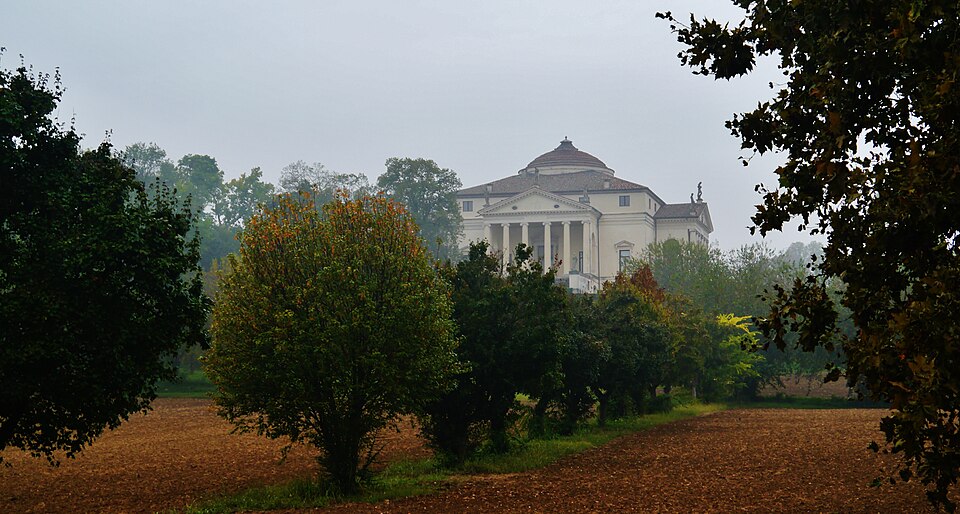
La Rotonda is one of the universal icons of Palladian architecture. Behind it, a 12,554 square metre Romantic Grove offers another reason to visit Vicenza: old trees, restored views, shaded paths and a landscape made for walking slowly. Today, it also lends itself beautifully to the contemporary practice of forest bathing. [1, 2, 3]
You have saved two places. Leave your email and you will find them on any device, plus the next drop.
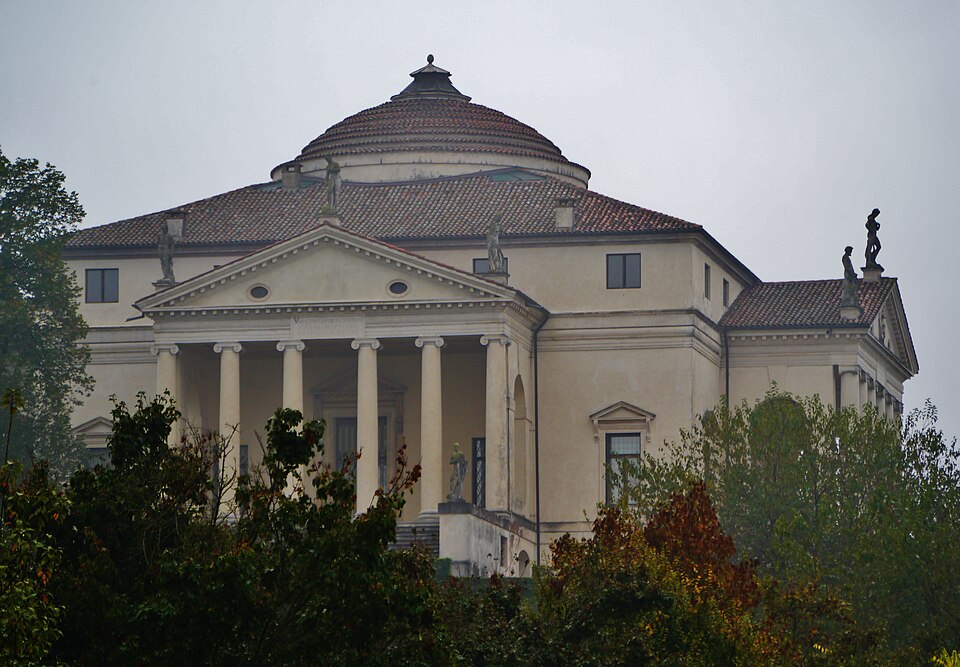
Vicenza_Villa_Rotonda_La_Capra_06 Zairon, CC BY-SA 4.0 via Wikimedia Commons
PLAN YOUR VISIT
La Rotonda can be visited with both the Piano Nobile and the nineteenth century Romantic Grove included in the standard ticket. Regular visits do not require advance booking, while private and exclusive visits can be arranged separately. Opening days change by season, so check the official calendar before travelling. Contact info@villalarotonda.it WhatsApp: +39 351 792 2118
About
You probably know La Rotonda, Andrea Palladio’s most famous villa and one of the great icons of Renaissance architecture.
What almost nobody comes looking for is the 12,554 square metre Romantic Grove behind it. Created in the nineteenth century for walking, retreat and escape, the woodland was used by the villa’s inhabitants to withdraw from everyday life and, according to the villa’s historical programme, seek restoration and healing in nature. Ancient trees, shaded paths, aromatic plants, seasonal flowers and restored views across the Vicenza countryside make the grove remarkably close to what we now call forest bathing.
And it is all behind one of the most photographed Palladian villas in the world.
In this story: Palladio Built for the View ↓ The Romantic Grove ↓ 12,554 Square Metres of Woodland ↓ The Nymphaeum and Citrus Garden ↓ Make It a Forest Bathing Walk ↓
PALLADIO BUILT FOR THE VIEW
Long before the Romantic Grove existed, landscape was already fundamental to La Rotonda.
In I Quattro Libri dell’Architettura, Palladio describes the hill as one of the most delightful sites imaginable, with views ranging from nearby hills to horizons in the distance. That is why he placed a loggia on every face of the house: architecture was designed to look outward in four directions. [1]
The Palladio Museum gives the building an even more unusual status. La Rotonda was conceived less as an agricultural villa than as a suburban residence, a “villa temple” built around an ideal of geometric order and harmony. [2]
The forest arrived centuries later, adding a looser, more intimate landscape behind one of the most controlled buildings of the Renaissance.
Rai Radio 3 has also published Palladio’s own description of the site, including the famous passage about the villa enjoying beautiful views in every direction.
THE ROMANTIC GROVE
The woodland west of La Rotonda dates from the late nineteenth century. It was conceived in a completely different spirit from Palladio’s geometry: winding paths, clearings, shade, old trees and changing prospects replaced the axial order of the villa. [3]
The restored grove now covers 12,554 square metres. Grandi Giardini Italiani records its role as a place for strolling and escape, while the recent restoration brought its historical paths and panoramic relationships with the surrounding countryside back into view. [3]
That contrast is the real pleasure of the visit. First Palladio gives you the landscape as architecture. A few minutes later, the grove gives you the landscape as immersion.
Grandi Giardini Italiani confirms both the exact 12,554 square metre figure and the recent landscape restoration.
12,554 SQUARE METRES OF WOODLAND
The restoration was substantial. Italy’s Ministry of Culture awarded €1,986,678.12 through its PNRR programme for historic parks and gardens, placing La Rotonda among the highest ranking funded projects in the national programme. [4]
The nineteenth century grove contains mature exotic species alongside field maple, lime, elm, ash and robinia. Some plane trees approach six metres in circumference, while a large Himalayan cedar remains one of the most imposing specimens. The restoration reopened clearings, treated historic trees, removed invasive growth and recovered long views between villa and countryside. [3, 5]
The landscape was also planted with tens of thousands of spring bulbs. Grandi Giardini Italiani records 65,000 narcissus and tulip bulbs, giving the woodland a very different character during the flowering season. [3] The Ministry funding and project amount are directly documented in the official PNRR ranking.
THE NYMPHAEUM AND THE CITRUS GARDEN
One of the best parts of the restoration lies beside the old cellars.
The former citrus garden was recovered with citrus trees and Prunus subhirtella, creating a partly shaded walk around the historic nymphaeum. The intervention also brought back architectural evidence of the old cedraia, the protected area historically used for citrus plants. [3, 5] This is where the grove becomes particularly good destination material. The visit moves from one of the most famous façades in architectural history to citrus, water, shade and old woodland in only a few minutes.
MAKE IT A FOREST BATHING WALK
The Romantic Grove already has everything a slow woodland walk needs.
Its restoration has brought back the large clearings that belonged to the nineteenth century design, reopened long views towards La Rotonda and the agricultural landscape, and protected an understory rich in spontaneous species. The planting mixes field maple, lime, elm, ash and robinia with exotic trees fashionable in nineteenth century parks, including Celtis occidentalis, Gleditsia triacanthos and Diospyros virginiana. Some plane trees approach six metres in circumference, while a large Himalayan cedar still anchors the grove.
Closer to the paths, the landscape becomes more tactile and seasonal. Restored clearings have been planted with shrubs and spring bulbs, including narcissus, iris and crocus, while the former citrus garden brings pots of citrus and Prunus subhirtella back around the historic nymphaeum. Along the southern edge, century old mulberries preserve a trace of the agricultural landscape that once framed the villa.
The Giornale dell’Architettura describes the restoration as a recovery of biodiversity, historic clearings and visual corridors, reconnecting the woodland with Palladio’s architecture and the surrounding countryside. That relationship is what makes the grove especially good for a slower visit: the villa appears, disappears behind foliage, and returns through the restored views.
There is a gentle Japanese way of reading this landscape. In 1982, Japan’s Forestry Agency introduced the expression shinrin yoku, forest bathing, as a way of experiencing a forest through the senses. Its description dwells on the breeze moving through trees, shifting light and shadow, and the scent of the woods. At La Rotonda, those cues are already part of the walk: cedar shade, old plane bark, citrus beside the nymphaeum, spring flowers and Palladio appearing again between the trees. [8]
So there is no need to stage a formal forest bathing session. Walk slowly enough to notice the shift from citrus and nymphaeum to mature trees, spontaneous herbs, bulbs, shade and open views.
For travellers looking for forest bathing in Italy, historic gardens in Europe or unusual nature experiences in Vicenza, this is the version of La Rotonda that you must add to your journey.
Sources
- Andrea Palladio · I Quattro Libri dell’Architettura, Book II, 1570 · Villa Almerico Capra, La Rotonda
- Centro Internazionale di Studi di Architettura Andrea Palladio · Architecture, chronology and interpretation of La Rotonda · Villa Almerico Capra detta “la Rotonda”, Vicenza
- Grandi Giardini Italiani · Romantic Grove, 12,554 square metres, 65,000 bulbs and restored historic views · Villa La Rotonda
- Ministero della Cultura · PNRR historic parks and gardens programme, €1,986,678.12 funding · Villa Capra detta la Rotonda
- Filippo Giustiniani, Annachiara Vendramin and restoration team · Botanical survey, historic views, nymphaeum and landscape restoration · Restauro del Boschetto Romantico di Villa Almerico Capra detta la Rotonda
- Michele Antonelli et al. · International Journal of Environmental Health Research, 2022 · Effects of forest bathing (shinrin yoku) on individual well being: an umbrella review
- Aurélio Matos Andrade et al. · Frontiers in Psychology, 2026 · Short term cardiovascular and mental health responses to Shinrin Yoku: a systematic review and meta analysis
- UNESCO World Heritage Centre · Palladio’s international architectural influence and Villa Almerico Capra within the World Heritage property · City of Vicenza and the Palladian Villas of the Veneto
- Il Giornale dell’Architettura · 30 October 2024 · Veneto: il patrimonio di ville e giardini valorizzato dal PNRR
- Filippo Giustiniani & Partners, Giuseppe Rallo and Annachiara Vendramin · Botanical survey, historic clearings, visual corridors and restoration of the Romantic Grove · Restauro del Boschetto Romantico di Villa Almerico Capra detta la Rotonda
- Japan Forestry Agency · Shinrin yoku, five senses and the Japanese origin of forest bathing in 1982 · 森林浴 いつでも森と、心をほどく
- Yoshifumi Miyazaki et al. · Environmental Health and Preventive Medicine · The physiological effects of Shinrin yoku: evidence from field experiments in 24 forests across Japan