Home › The Hundred › A GILDED MOON OVER PIAZZA DEI SIGNORI
ASTRONOMY · VICENZA
Find the gilded moon that follows the lunar cycle
A lunar clock documented here since 1597
Look beneath the clock face of Torre Bissara and you will find a gilded moon changing with the lunar cycle. The mechanism revives an extraordinary idea documented in Vicenza in 1597, when an iron moon moved by counterweights showed the waxing and waning of the real one above Piazza dei Signori.
You have saved two places. Leave your email and you will find them on any device, plus the next drop.
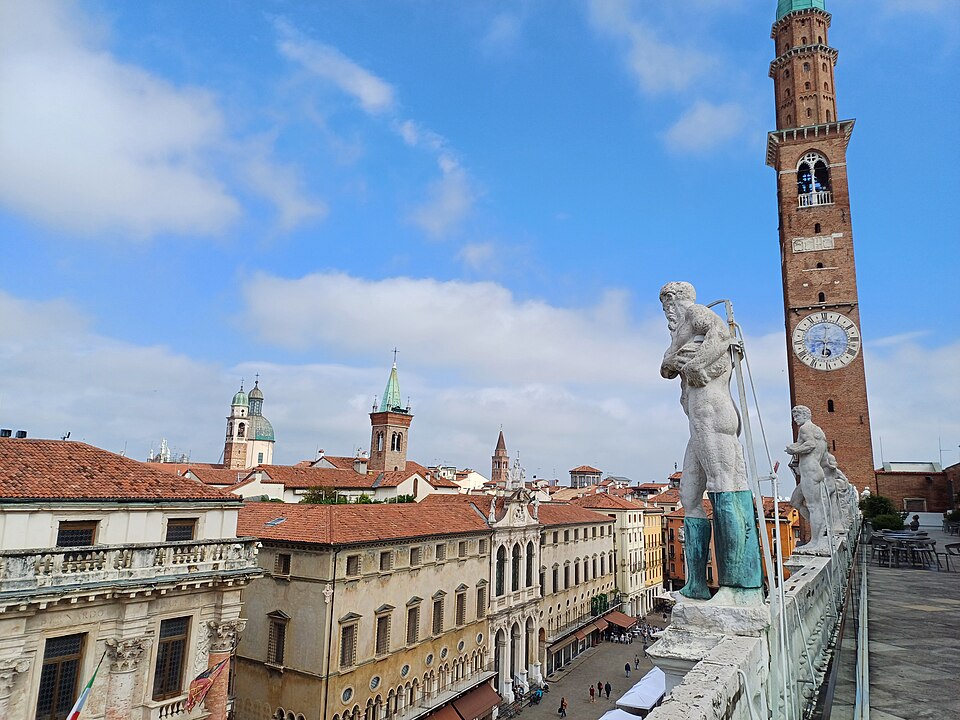
Andrek02, CC0, via Wikimedia Commons
Know before you go
The tower does not currently operate as a regular public climb. The lunar display is visible from Piazza dei Signori. Access conditions can change, so check current information before planning a visit.
THE LUNAR DIAL ↓ / THE MOON IN 1597 ↓ / THE 2002 RESTORATION ↓ / THE VIEW FROM THE SQUARE ↓
THE LUNAR DIAL
On Torre Bissara in Vicenza’s Piazza dei Signori, a gilded moon shares the clock face with the hours. Look at the six o’clock position: a sphere measuring 72 centimetres across appears against a blue background scattered with stars. Its gold surface and two opposing cobalt blue discs reproduce the lunar phases, with blue indicating the new moon. The cycle lasts approximately 29.5 days. As the moon orbits Earth, the visible portion of its sunlit half grows from a crescent towards full moon and gradually diminishes again. That is the sequence represented on the dial, where the changing moon adds a longer measure of time to the passing hours.
THE MOON IN 1597
The earliest surviving account identified in the specialist literature dates to 1597. The Vicentine historian Silvestro Castellini described an iron moon driven by counterweights, reproducing the waxing and waning of the real moon. His description records a working astronomical feature already familiar to the city at the end of the Renaissance. The tower’s clock had a longer history. Faccio Pisano installed a public clock here in 1378, beside the seat of civic government. Castellini also recorded a later adjustment to its striking mechanism: reducing the sequence from twenty four strokes to twelve made counting the hours more convenient for merchants. Read alongside his description of the moon, this small practical detail gives a sense of the clock’s place in the daily business of the square.
THE 2002 RESTORATION
The gilded sphere visible today was reinstated in 2002 following research by Stefano Soprana. Its Renaissance ancestry belongs to the documented idea and function; the present object is a modern reconstruction. The work accompanied a substantial restoration of Torre Bissara, completed in May that year. The municipal project addressed the tower’s structural condition, stone decoration and clock mechanism. Restoring the lunar display recovered an astronomical detail within a monument that had undergone centuries of alterations and repairs.
THE VIEW FROM THE SQUARE
View the dial from Piazza dei Signori, beside the Basilica Palladiana. Daylight helps distinguish the blue and gold; binoculars or a camera with optical zoom make the smaller details easier to examine. You can also check the phase against a lunar calendar. The movement belongs to the pace of the month, so allow days between observations to appreciate the difference.
Save Torre Bissara to your Vicenza wishlist and explore the other places in Hidden Gems to plan your route through the city.
Sources
- Musei Civici di Palazzo Chiericati, Cherubina Marte e Stefano Soprana · Gli orologi notturni dei Papi. Le diverse letture del tempo nella Bibbia e loro applicazione nell’orologeria
- Anna Milan e Stefano Soprana, Museo Diocesano di Vicenza · Orologi rinascimentali. Tra potere e prestigio. Quando per misurare il tempo bastava una lancetta
- Comune di Vicenza, Forum Center · Torre Bissara: restauro e consolidamento statico
- Regione del Veneto, Luisella Ferrarese · Recensione a La Torre Bissara di Vicenza tra antica memoria e nuova percezione, Notiziario Bibliografico n. 49
- NASA Science · Moon Phases
When Vicenza celebrated, it made campanon: the bells rung in celebration across the towers of the centre.
The Vicenza Lexicon →