Home › Places › Nature & trails › Copernico 1.82 m Telescope · Cima Ekar
ASTROTURISM · THE WILD TRAIL
How a British mirror became Italy’s largest optical telescope
Find Italy’s largest optical telescope in Vicenza mountains
A 1.82 metre mirror crossed the sea from England, climbed a rough mountain road and photographed Orion in 1973. More than fifty years later, Italy’s largest optical telescope is studying stellar explosions and testing adaptive optics that improved stellar image resolution by up to 20 times in 2026.
You have saved two places. Leave your email and you will find them on any device, plus the next drop.
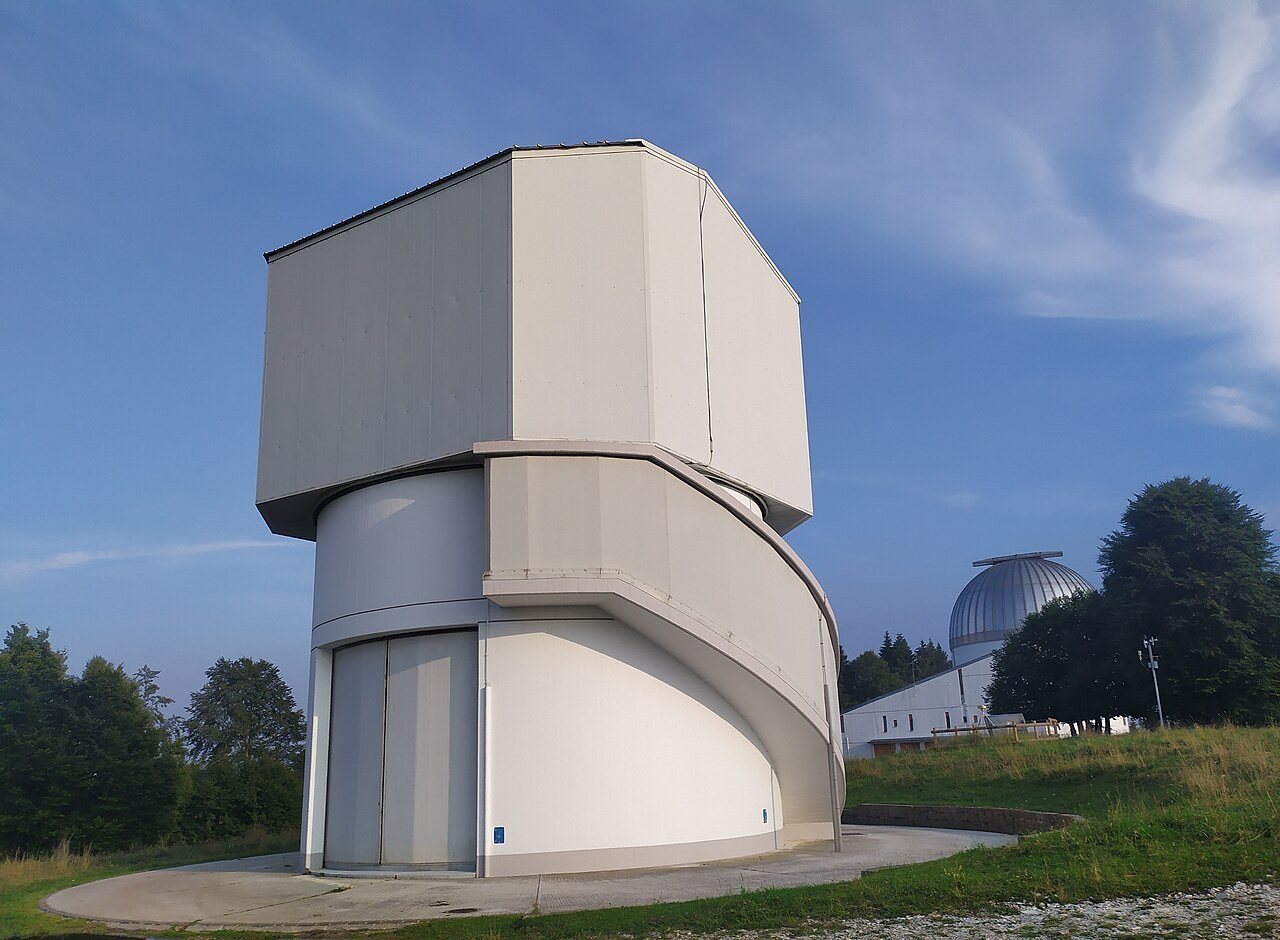
Nordavind · CC BY-SA 4.0 · Wikimedia Commons
Know before you go
Altitude: 1,376 metres. INFORMATION AND RESERVATIONS Tourist Information Office: +39 0424 462221; info@asiago.to SCIENTIFIC INFORMATION INAF, Osservatorio Astronomico di Padova: www.oapd.inaf.it Cima Ekar is an active INAF research station, not a walk-in attraction. Public visits and astronomy events follow scheduled programmes and require advance booking. Altitude: 1,376 metres. GUIDED VISITS AND BOOKINGS INAF and the University of Padua organise public astronomy activities in collaboration with the local tourist information service. For the next available telescope visit, dates, access conditions and reservations, contact: Tourist Information Office: +39 0424 462221; info@asiago.to OFFICIAL SCIENTIFIC INFORMATION INAF, Osservatorio Astronomico di Padova; www.oapd.inaf.it
· THE HUNT FOR DARKER SKIES ↓ · THE BRITISH MIRROR ↓ · THE LAST ASCENT ↓ · ORION, 1973 ↓ · THE SUPERNOVA MYSTERY ↓ · CASSIOPEIA, 2026 ↓ · PLAN YOUR VISIT ↓
In July 1972, an enormous British mirror reached a rough mountain road in northern Italy. It had taken approximately two years to manufacture in Newcastle, survived a difficult optical test and visited a royal observatory at an English castle. Its destination was a steel dome, still under construction, high in the mountains of Vicenza. [1] That mirror became the heart of the Copernico 1.82 m, Italy's largest optical telescope on Italian soil. At 1,376 metres above sea level on Cima Ekar, the instrument has spent more than fifty years investigating the universe, from the birth of stars in Orion to explosions in galaxies millions of light years away. [2]
The British optics, the Italian engineering and the improbable mountain delivery belong to one of the more unusual stories in European astronomical heritage. Today, the Copernico remains an active INAF research telescope, with occasional guided public visits. [2][9]
THE HUNT FOR DARKER SKIES
Why astronomers went looking for another mountain.
In the late 1960s, astronomer Leonida Rosino had a problem. The historic 122 centimetre Galileo telescope was increasingly limited by the lights of a growing mountain resort, while scientific research demanded observations of fainter and more distant objects. Astronomers needed a larger telescope and a darker location, with very little money available for either.
In the summer of 1969, Rosino gathered his colleagues to decide where the new observatory should be built. They chose Cima Ekar, about five kilometres from Asiago, far enough from the town's lights to improve observing conditions, yet accessible to the existing astronomical workshops. [1] The project received no special construction allocation. The observatory's technicians designed much of the machinery themselves, working with the Sarti engineering company in Bologna. The expedition was already underway before the British mirror had arrived.
THE BRITISH MIRROR
Newcastle, a 46 millimetre imperfection and an English castle.
The 1.82 metre primary mirror was manufactured by Grubb Parsons of Newcastle, England, one of the historic names in British astronomical engineering. The company had also worked on the 98 inch Isaac Newton Telescope at the Royal Greenwich Observatory's Herstmonceux site. [3] Producing the Italian mirror took approximately two years. During final testing, using the Foucault optical test and interferometry, engineers discovered a narrow defect extending around a ring approximately 46 millimetres wide near the mirror's edge.
They made an unusual decision: leave it alone. The affected area contributed no more than ten per cent of the collected light, and further polishing risked damaging the optical quality. The finished mirror already exceeded the required specifications. [1] From Newcastle, it travelled to the Royal Observatory at Herstmonceux Castle in Sussex, where its surface received the thin aluminium coating needed to reflect starlight.
After that came the sea voyage to Italy. A mirror manufactured in Britain, tested in an English optical workshop and prepared inside the grounds of a Renaissance castle was about to become the largest astronomical mirror operating on Italian soil.
THE LAST ASCENT
July 1972. One narrow mountain road and a 16 metre steel dome.
The final journey was the most demanding. According to INAF's construction history, transporting the telescope's mechanical components and especially its enormous mirror along the narrow, uneven dirt road to Cima Ekar required exceptional care. The observatory was still being completed. Its stainless steel dome measured 16 metres across, while the telescope rested on a four metre support pillar containing sand and gravel to absorb vibrations. The mechanical assembly was divided into four large sections. Each had to be lifted above the dome and lowered into the building through its two great shutters. [1] The mounting had been designed by the observatory's Italian technicians, including Galazzi, Pertile and Rigoni, with mechanical construction undertaken in Bologna.
By December 1972, the building was ready for technical operations. The mirror from Newcastle was finally in place, more than 1,300 metres above sea level.
ORION, 8 MARCH 1973
The first photograph captured a birthplace of stars.
On 8 March 1973, the telescope produced its first astronomical photograph. Its subject was M42, the Orion Nebula. [1] According to NASA, Orion is approximately 1,500 light years from Earth and among the closest large regions of active star formation. Its glowing clouds of gas and dust can even be glimpsed without a telescope under sufficiently dark skies. [5]
The official inauguration followed on 16 June 1973, during the celebrations for the 500th anniversary of Nicolaus Copernicus's birth. The astronomer had studied medicine at the University of Padua between 1501 and 1503. [4] The telescope's first photographic plates opened a research career that would extend from stellar nurseries to some of the most violent phenomena in the universe.
THE SUPERNOVA MYSTERY
A stellar explosion, 65 million light years away, with evidence that misled astronomers.
The Copernico's original mirror remains active in modern astronomical investigations. In 2024, researchers examined SN 2024bch, a supernova in the galaxy NGC 3206, approximately 65 million light years from Earth. Observations made with the Copernico contributed to an international campaign that also used other Italian telescopes and NASA's Swift satellite. The investigation followed the explosion for 140 days. Early observations suggested that matter expelled by the dying star was colliding violently with surrounding gas. The evidence proved more complicated.
In a study published in Astronomy & Astrophysics in 2025, researchers proposed that the distinctive light signatures could be explained principally by fluorescence, a process involving radiation exciting atoms around the explosion, rather than the violent collision initially suspected. [6] The British mirror that photographed a stellar nursery in 1973 was still helping astronomers investigate the deaths of distant stars half a century later.
CASSIOPEIA, 2026
450 actuators. One thousand corrections per second. A new life for the Copernico.
On 31 August 2026, the telescope entered another chapter with the first observations of Ekarus, an adaptive optics experiment developed by INAF in collaboration with French research institutions ONERA and the Laboratoire d'Astrophysique de Marseille. The original 1.82 metre mirror still collects the incoming starlight. Ekarus uses a separate deformable mirror to correct the distortions produced as that light passes through Earth's turbulent atmosphere.
Approximately 450 tiny actuators reshape the mirror up to 1,000 times per second. During its first observations, including the star Beta Cassiopeiae, the technology improved image resolution by a factor of 10 to 20. [7] The European Southern Observatory is developing related adaptive optics technology for its Extremely Large Telescope in Chile, whose primary mirror will measure 39 metres. [8]
The Copernico now provides a place to experiment with advanced instruments destined to influence future astronomical research. An extraordinary second career for a British mirror that first reached the Vicenza mountains on a dirt road in 1972.
CAN YOU VISIT ITALY'S LARGEST OPTICAL TELESCOPE?
Yes. Guided visits to the observatories are organised through programmes involving INAF and the University of Padua. All public activities require advance booking. [9]
The Copernico is a professional research instrument. Public stargazing events, astronomy lessons and observatory visits may take place at different facilities, so check the exact location and programme before reserving.
Sources
- INAF Osservatorio Astronomico di Padova · Il telescopio Copernico
- INAF Osservatorio Astronomico di Padova · Copernico 1.82m
- Royal Greenwich Observatory · The Isaac Newton Telescope
- INAF Osservatorio Astronomico di Padova · Inaugurazione e prime osservazioni
- NASA Science · Messier 42 (The Orion Nebula)
- Astronomy & Astrophysics · Signatures of anti-social mass loss in the ordinary Type II SN 2024bch
- Media INAF · Le stelle di Cassiopea nella prima luce di Ekarus
- European Southern Observatory · A deformable floating mirror for the world's largest telescope
- INAF Osservatorio Astronomico di Padova · Divulgazione ad Asiago