The first voyage around the world had a Vicenza storyteller
DISCOVER THE FIRST VOYAGE →What does Vicenza have to do with the first global voyage?
Everyone knows Magellan. Antonio Pigafetta from Vicenza wrote the principal surviving narrative of the expedition, the eyewitness account that lets us follow the first circumnavigation in detail.
The first voyage around the world in 60 seconds
About 240 left. Only 18 came back.
The Magellan expedition became one of history’s great survival stories at sea: mutiny, shipwreck, starvation and scurvy. Magellan died in the Philippines. Pigafetta returned to Spain aboard the Victoria in 1522, one of about 18 men from the original expedition to make it back.
Magellan led the voyage. Pigafetta recorded it.
National Geographic calls Pigafetta’s journal history’s principal written source for detailed information on the entire voyage. The New Yorker calls it the standard eyewitness account. That is why we can still follow the first circumnavigation in extraordinary detail.
A travel journal of people, languages, food and wildlife
Pigafetta recorded geography, wildlife, food, trade, customs and words from the languages he encountered. Scholars describe the work as an ethnographic and geographical account, while the Library of Congress highlights its early descriptions of the people and languages of the Philippines.
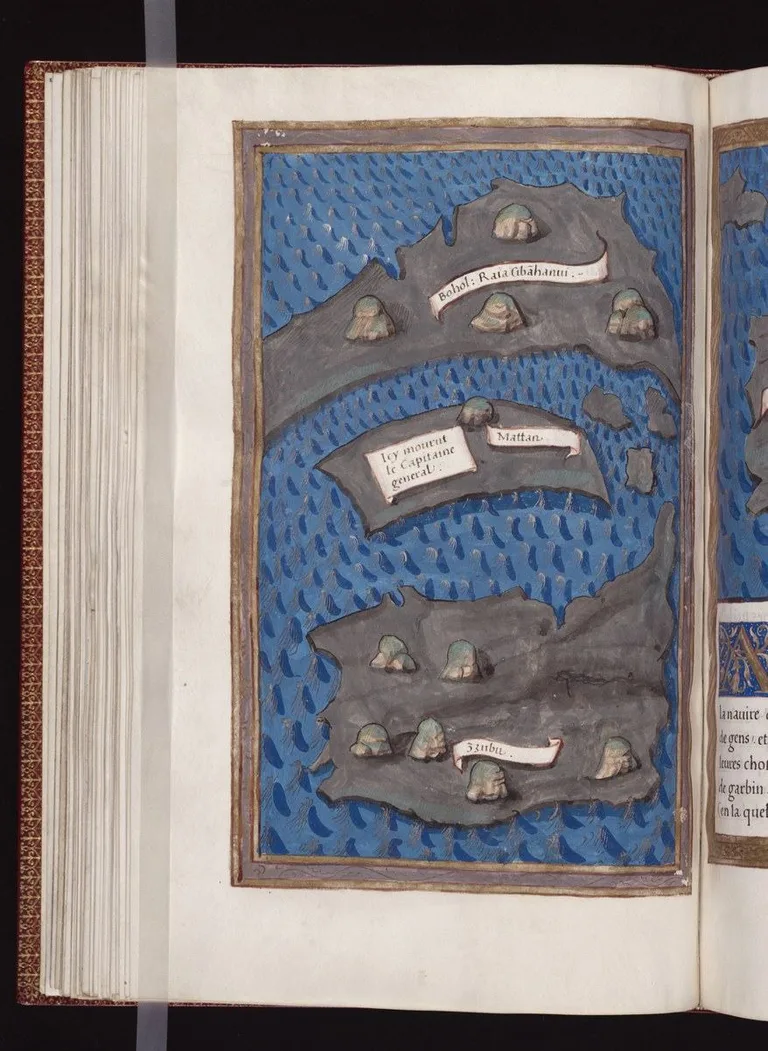
He drew 23 maps of the voyage.
Four manuscript versions of Pigafetta’s account survive. Each preserves a complete set of 23 hand drawn colour maps, including his map of the Strait of Magellan.
The first travel creator?
At the opening of his account, Pigafetta addresses curious readers who wanted to know the remarkable things he had seen and suffered, and the routes that had taken him there. Five centuries later, the language feels remarkably close to the reason people still document a journey for an audience.
“Il n’est rose sans espine.
“No rose without a thorn.” The motto is still carved in Vicenza’s historic centre, on the Gothic façade of Antonio Pigafetta’s family house.
A WILD TRAIL THROUGH VICENZA
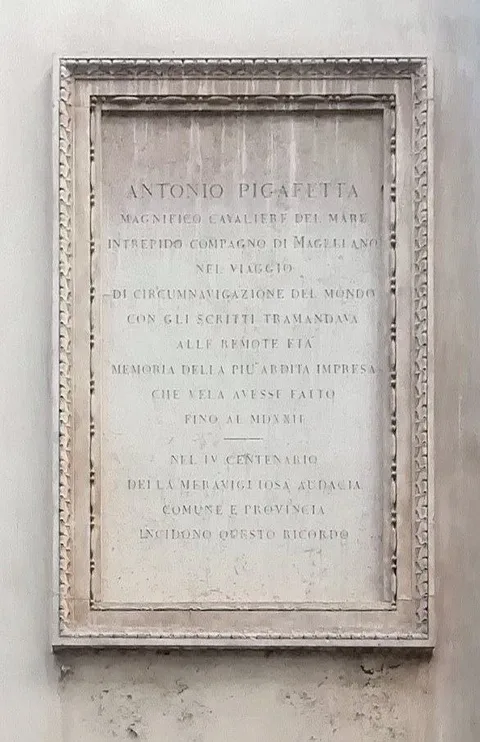 CASA PIGAFETTA · VICENZA
Read the motto carved on Pigafetta’s family house
See where the motto is carved → PIGAFETTA FAMILY · BERICI HILLSFollow the Pigafetta family into the Berici Hills
Walk the family’s hills → NEARLY 40 KM UNDERGROUNDGo underground in Veneto’s largest cave
Into Veneto’s largest cave → 4,444 STONE STEPSClimb 4,444 stone steps on Italy’s longest staircase through the mountains
Take Italy’s longest staircase → 1942 AND 1973Find the mountain that broke the astronomy record twice
Stargaze above Vicenza →FOLLOW THE PIGAFETTA PAPERS
Leave your email and we’ll tell you when a new Pigafetta Paper is published.
From Vicenza to the first global voyage
Play tennis inside a 19th-century monastery garden just 3 minutes from the city centre
Your next reason to visit Vicenza.
Get new stories, unusual things to do and places to eat and stay in Vicenza, Italy, by email. Save your favourites on the website and plan your visit.